
 CATEGORIES
- ORGANIC COMPOUNDS(1129)
- Thiols(1)
- Metal-organic compounds(1)
- Sulfonic acids(6)
- Alcohols(74)
- Aldehydes(47)
- Alkyl nitrites(6)
- Amines(55)
- Aminoacids(59)
- Amides(33)
- Anhydrides(11)
- Acyl Halides(5)
- Carboxylic Acids(170)
- Dyes and Indicators(99)
- Esters(52)
- Ethers(17)
- Organic Halogens (Organohalides)(30)
- Flavonoids(5)
- Heterocycles(24)
- Hydrocarbons(34)
- Imides(2)
- Ketones(29)
- Mixed solvents(16)
- Nitro Compounds(5)
- Nitriles(9)
- Organic salts(74)
- Phenols(30)
- Polymers ( HMW compounds )(68)
- Sugars (Saccharides)(24)
- Silicoorgano and Phosphoorganocompounds(1)
- Peptides(2)
- Terpenes(16)
- Others(126)
- INORGANIC COMPOUNDS(1055)
- LAB EQUIPMENT(5176)
- *(1)
- Organic Synthesis(417)
- Industry(775)
Language
US version allows shipping to all available destinations


 MANUFACTURER
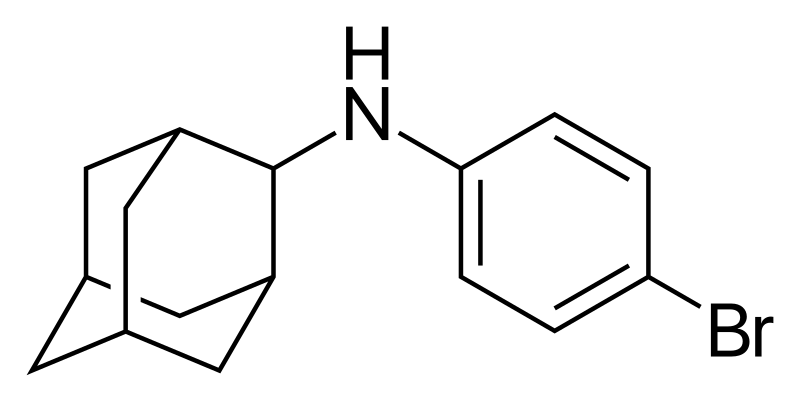
Bromantane
Regular price:
Regular price:
product unavailable
add to wish list
3.68967

Description
Bromantane
Other Names: Bromantan, N-(4-Bromophenyl)adamantan-2-amine, Adamantylbromphenylamine
Chemical Formula: C16H20BrN
Molar Mass: 306.24 g/mol
CAS Number: 87913-26-6
SMILES: C1C2CC3CC1CC(C2)C3NC4=CC=C(C=C4)Br
Appearance: Crystalline organic solid
Bromantane is a synthetic adamantane derivative containing a rigid tricyclic adamantane framework connected through a secondary amino group to a para-brominated phenyl ring. Its systematic name is N-(4-bromophenyl)adamantan-2-amine. The combination of a highly lipophilic adamantane moiety and an aromatic amine group gives the molecule physicochemical properties characteristic of many biologically active adamantane derivatives. PubChem reports the molecular formula C16H20BrN, a molecular mass of 306.24 g/mol and the canonical structural representation corresponding to CAS 87913-26-6.
Chemical and structural properties
The adamantane portion of bromantane consists of a rigid, three-dimensional hydrocarbon cage. Adamantane substituents are frequently used in medicinal chemistry because their pronounced lipophilicity and conformational rigidity can substantially affect membrane affinity, molecular recognition and pharmacokinetic behavior. Bromantane additionally contains a secondary aniline-type nitrogen atom and a bromine substituent located para to the amino group on the aromatic ring.
Bromantane belongs to the broader class of aminoadamantane derivatives. Scientific literature describes its preparation through reactions involving adamantan-2-one and 4-bromoaniline, and modern synthetic studies have continued to use bromantane as a reference structure when developing conformationally modified adamantane derivatives. A 2023 structural and medicinal-chemistry study reported bromantane preparation by reductive amination under Leuckart-Wallach-type conditions and used it as a comparison compound for related cage-containing molecules.
The rigid adamantane group strongly limits conformational mobility compared with flexible hydrocarbon substituents. This structural feature has motivated the synthesis of more conformationally flexible bromantane analogues to investigate relationships between molecular geometry and biological activity. Studies of N-[(adamantan-1-yl)methyl]-4-bromoaniline analogues demonstrate that relatively small changes in the connection between the aromatic amine and the adamantane framework can substantially alter pharmacological profiles.
Applications
Bromantane is used principally as a research compound in neuropharmacology and medicinal chemistry. It serves as a reference structure for studies of adamantane-based central nervous system agents, structure-activity relationships and the effects of rigid lipophilic cage systems on pharmacological activity.
In medicinal chemistry, bromantane has been employed as a prototype for the design of new adamantane-containing amines. Research has examined conformationally flexible analogues, modified aromatic substituents and alternative linkers in order to determine how structural changes influence biological activity and physicochemical behavior.
The compound is additionally relevant to analytical and toxicological research involving centrally active adamantane derivatives. Its distinctive combination of an adamantane cage, secondary aromatic amine and bromine atom provides useful structural features for chromatographic and mass-spectrometric identification.
Handling and safety
Bromantane is a pharmacologically active research compound and should be handled using appropriate laboratory controls. Direct skin contact, inhalation of dust and accidental ingestion should be avoided. Experimental toxicological studies demonstrate dose-dependent effects on neurological and motor behavior in animals, with stimulation at lower experimental exposures and suppression of behavioral activity at substantially higher exposures. These findings indicate that bromantane should not be treated as an inert laboratory chemical.
Because comprehensive occupational exposure limits and long-term toxicological data are limited compared with common industrial chemicals, bromantane should be handled in a controlled laboratory environment using suitable gloves, eye protection and procedures that minimize airborne particulate formation.
Scientific references
PubChem. Bromantan. CID 4660557. Molecular formula C16H20BrN; CAS Registry Number 87913-26-6.
Oliynyk, S.; Oh, S. The Pharmacology of Actoprotectors: Practical Application for Improvement of Mental and Physical Performance. Biomolecules & Therapeutics, 2012, 20, 446–456. PMID: 24009833.
Morozov, I. S.; Klimova, N. V.; Karpova, T. D.; Shestopalov, S. S. The characteristics of the neuropsychotropic activity of bromantane in laboratory animals. Experimental and Clinical Pharmacology, 1999, 62, 3–6.
Krapivin, S. V.; Sergeeva, S. A.; Morozov, I. S. A quantitative pharmaco-electroencephalographic analysis of the action of bromantane. Bulletin of Experimental Biology and Medicine, 1993, 116, 515–518.
Structure-Based Design, Synthesis, and Biological Evaluation of the Cage-Amide Derived Orthopox Virus Replication Inhibitors. Viruses, 2023, 15, 29.
Orlinson, B. S. et al. Potential Synthetic Adaptogens. II. Synthesis and Pharmacological Activity of New Conformationally Labile Bromantane Analogs, N-[(Adamantan-1-yl)Methyl]-4-Bromoanilines. Pharmaceutical Chemistry Journal, 2017, 50, 781–787. DOI: 10.1007/s11094-017-1531-5.
Safety

Signal Word: Warning
H315 (100%): Causes skin irritation [Warning Skin corrosion/irritation]
H319 (100%): Causes serious eye irritation [Warning Serious eye damage/eye irritation]
H335 (100%): May cause respiratory irritation [Warning Specific target organ toxicity, single exposure; Respiratory tract irritation]
P261, P264, P264+P265, P271, P280, P302+P352, P304+P340, P305+P351+P338, P319, P321, P332+P317, P337+P317, P362+P364, P403+P233, P405, and P501
First Aid Measures
-
Eye Contact: Rinse thoroughly with water. Seek medical advice if irritation continues
-
Skin Contact: Wash with soap and water. Remove contaminated clothing
-
Inhalation: Move to fresh air. Seek medical attention if symptoms occur
-
Ingestion: Rinse mouth. Do not induce vomiting. Seek medical advice
Handling and Storage
-
Storage Conditions: Store in a tightly closed container in a cool, dry, and well-ventilated place. Protect from heat, moisture, and direct light
-
Handling Precautions: Avoid formation of dust. Use personal protective equipment and operate in ventilated conditions
Shipping costs
The price does not include any possible payment costs
Related products
Chlodantane ( ADK-910 )
Net price: 287,62 Kč
Chlomantane (N-(4-chlorophenyl)adamantan-2-amine)
Net price: 598,70 Kč