


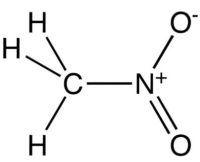
The nitro group is best described by resonance forms featuring N⁺(=O)–O⁻, making the nitrogen formally cationic and the oxygens anionic. This produces a highly polarized substituent with a powerful −I and −M effect (especially on aromatic rings), lowering electron density and altering acidity and reaction rates. In aromatic nitro compounds, the group is strongly deactivating toward electrophilic aromatic substitution and directs incoming electrophiles to the meta position, because ortho/para σ-complexes place positive charge adjacent to the electron-withdrawing nitro group.
Synthesis.
-
Aromatic nitration is typically done via electrophilic aromatic substitution using mixed acid (HNO₃/H₂SO₄), generating the nitronium ion (NO₂⁺) as the active electrophile.
-
Aliphatic nitro compounds can be prepared by radical nitration of alkanes, substitution of alkyl halides with nitrite salts (often giving mixtures of nitro vs. alkyl nitrite products depending on conditions), or by oxidation of amines/oximes in specialized routes.
Acidity and α-chemistry.
Aliphatic nitro compounds bearing α-hydrogens are relatively acidic (pKₐ ~10 for nitroalkanes) because deprotonation yields a resonance-stabilized nitronate anion. This enables key C–C bond-forming reactions such as the Henry (nitroaldol) reaction with carbonyls to give β-nitro alcohols, and subsequent transformations (e.g., dehydration to nitroalkenes).
Redox and functional group interconversions.
Nitro groups are versatile synthetic handles:
-
Reduction (catalytic hydrogenation, metal/acid, or hydride methods) converts nitro groups to amines, often via nitroso and hydroxylamine intermediates. This is one of the most important routes to anilines and alkylamines.
-
Nef reaction oxidatively converts nitronate salts to carbonyl compounds (aldehydes/ketones), effectively using the nitro group as a masked carbonyl.
-
Elimination/Addition chemistry of nitroalkenes makes them strong Michael acceptors due to conjugation with the electron-withdrawing NO₂ group.
Spectroscopic signatures.
Nitro compounds show two strong IR bands for N–O stretching: the asymmetric stretch near ~1520–1560 cm⁻¹ and the symmetric stretch near ~1340–1380 cm⁻¹. In NMR, the nitro group causes deshielding of nearby protons/carbons due to its strong inductive effect.
Applications and safety notes.
Nitro groups appear in dyes, pharmaceuticals, and agrochemicals, and are also central to energetic materials (e.g., nitroaromatics and polynitro compounds) because they contain both oxidizing and reducing elements within the same molecule. Increased nitro density generally correlates with higher energy content and sensitivity, so heavily nitrated compounds require careful handling.