
 CATEGORIES
- ORGANIC COMPOUNDS(1129)
- Thiols(1)
- Metal-organic compounds(1)
- Sulfonic acids(6)
- Alcohols(74)
- Aldehydes(47)
- Alkyl nitrites(6)
- Amines(55)
- Aminoacids(59)
- Amides(33)
- Anhydrides(11)
- Acyl Halides(5)
- Carboxylic Acids(170)
- Dyes and Indicators(99)
- Esters(52)
- Ethers(17)
- Organic Halogens (Organohalides)(30)
- Flavonoids(5)
- Heterocycles(24)
- Hydrocarbons(34)
- Imides(2)
- Ketones(29)
- Mixed solvents(16)
- Nitro Compounds(5)
- Nitriles(9)
- Organic salts(74)
- Phenols(30)
- Polymers ( HMW compounds )(68)
- Sugars (Saccharides)(24)
- Silicoorgano and Phosphoorganocompounds(1)
- Peptides(2)
- Terpenes(16)
- Others(126)
- INORGANIC COMPOUNDS(1055)
- LAB EQUIPMENT(5176)
- *(1)
- Organic Synthesis(417)
- Industry(775)
Language
US version allows shipping to all available destinations


 MANUFACTURER
Adamantanes are rigid, highly symmetrical polycyclic saturated hydrocarbons based on the adamantane cage (C₁₀H₁₆), which resembles a fragment of the diamond lattice. Their framework is exceptionally stable and lipophilic, making adamantane derivatives useful in materials and medicinal chemistry.
Bromantane

✈︎ Shipping Limitations: We do not ship this product to: US | Unless government approved ⓘ
Availability: na wyczerpaniu
Dispatched within: 5 days

Chlomantane (N-(4-chlorophenyl)adamantan-2-amine)
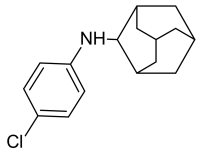
✈︎ Shipping Limitations: We do not ship this product to: US | Unless government approved ⓘ
Suspicious purchases that appear unrelated to legitimate scientific or research purposes may be canceled.
Availability: Large quantity
Dispatched within: 5 days
Adamantane is the smallest “diamondoid,” a tricyclo[3.3.1.1³,⁷]decane cage in which all carbons are sp³-hybridized and constrained into a near-tetrahedral network. This topology creates a strain-free but conformationally locked scaffold with high melting point, low polarizability per carbon, and notable thermal/chemical robustness. Because the skeleton mimics the diamond lattice, higher homologues (diamantane, triamantane, etc.) are collectively termed diamondoids.
Substitution patterns and reactivity.
Adamantane has two distinct positions: bridgehead (1°) and secondary (2°) carbons. Functionalization often occurs preferentially at bridgehead sites due to the stability of the corresponding carbocation-like intermediates and the accessibility of these positions. Typical transformations include radical halogenation, nitration, oxidation, and Friedel–Crafts-type or Lewis-acid-mediated substitutions to give 1- or 2-substituted adamantanes. The rigid cage also enforces well-defined stereochemical outcomes, and substituted adamantanes can transmit steric bulk without adding conformational flexibility.
Physical/structural consequences.
The bulky, nonpolar cage increases lipophilicity, molecular volume, and metabolic stability when appended to functional molecules. It can raise glass-transition temperatures and improve crystallinity in polymers, while in small molecules it often enhances membrane permeability and protects labile functional groups by steric shielding. In supramolecular contexts, adamantane binds strongly to hosts such as cyclodextrins, enabling modular self-assembly.
Applications.
Adamantane motifs appear in pharmaceuticals (e.g., antiviral and CNS-active agents) where they act as hydrophobic anchors and shape-directing groups. In materials science, diamondoids and functionalized adamantanes serve as rigid building blocks for high-performance polymers, molecular electronics, and surface modification, leveraging their diamond-like stability and defined 3D geometry.