
 CATEGORIES
- ORGANIC COMPOUNDS(1129)
- Thiols(1)
- Metal-organic compounds(1)
- Sulfonic acids(6)
- Alcohols(74)
- Aldehydes(47)
- Alkyl nitrites(6)
- Amines(55)
- Aminoacids(59)
- Amides(33)
- Anhydrides(11)
- Acyl Halides(5)
- Carboxylic Acids(170)
- Dyes and Indicators(99)
- Esters(52)
- Ethers(17)
- Organic Halogens (Organohalides)(30)
- Flavonoids(5)
- Heterocycles(24)
- Hydrocarbons(34)
- Imides(2)
- Ketones(29)
- Mixed solvents(16)
- Nitro Compounds(5)
- Nitriles(9)
- Organic salts(74)
- Phenols(30)
- Polymers ( HMW compounds )(68)
- Sugars (Saccharides)(24)
- Silicoorgano and Phosphoorganocompounds(1)
- Peptides(2)
- Terpenes(16)
- Others(126)
- INORGANIC COMPOUNDS(1055)
- LAB EQUIPMENT(5176)
- *(1)
- Organic Synthesis(417)
- Industry(775)
Language
US version allows shipping to all available destinations


 MANUFACTURER
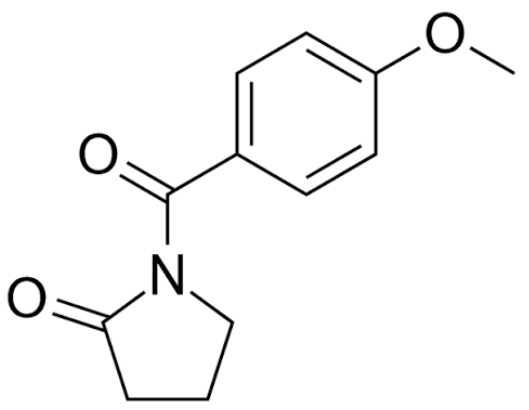
Aniracetam, 1-(4-Methoxybenzoyl)-2-pyrrolidinone
Regular price:
Regular price:
product unavailable
add to wish list
0

-2-pyrrolidinone "Pin It")
Description
Aniracetam
Other Names: N-Anisoyl-2-pyrrolidinone, 1-(4-Methoxybenzoyl)-2-pyrrolidinone, Ro 13-5057
Chemical Formula: C12H13NO3
Molar Mass: 219.24 g/mol
CAS Number: 72432-10-1
Appearance: Powder
Odor: Not specified in the reviewed scientific publications.
Aniracetam is a synthetic compound structurally characterized as 1-(4-methoxybenzoyl)-2-pyrrolidinone. Its structure contains an aromatic methoxy-substituted ring and a pyrrolidinone ring connected through a carbonyl-containing linkage. Structural studies using X-ray crystallography have examined aniracetam in molecular complexes and showed that its three oxygen atoms participate in interactions involving hydrogen-bonding networks, while the aromatic portion contributes nonpolar contacts. Aniracetam has also been investigated extensively from a physicochemical perspective. Experimental studies have examined its dissolution, crystallization and solid-state behavior in different solvent systems. Solubility measurements performed between 273.15 and 318.15 K demonstrated a clear dependence on both temperature and solvent composition. Published analytical studies have additionally established chromatographic procedures for its separation and quantitative determination, making the compound useful as a reference substance in analytical and biochemical research.
Chemical and physical properties
Published data report a melting point of approximately 121–122 °C for aniracetam crystallized from ethanol.
Solubility experiments in methanol, ethanol, n-propanol, isopropanol, acetone, toluene and ethyl acetate showed that aniracetam solubility increases with temperature. Among the pure solvents examined, the highest solubility was observed in acetone, followed by ethyl acetate and toluene, while the lowest was found in n-propanol. PXRD and infrared spectroscopy were also used to compare the crystallized material with the original solid.
Separate aqueous studies reported low intrinsic water solubility and investigated the influence of molecular complexation on its dissolution behavior.
Applications
Aniracetam is used as a reference compound in chromatographic analysis. Published methods include reversed-phase HPLC procedures and LC–MS/MS techniques developed for its selective quantitative determination.
It is also employed as a model compound in physicochemical research, particularly in studies of solubility, solvent–solute interactions, crystallization and solid-state characterization.
In biochemical and structural research, aniracetam has been used as a molecular probe in studies of AMPA receptor structure and ligand–protein interactions, including X-ray crystallographic and electrophysiological investigations.
SAFETY
(REGULATION (EC) No 1272/2008) Not a hazardous substance or mixture.