
 CATEGORIES
- ORGANIC COMPOUNDS(1134)
- Thiols(1)
- Metal-organic compounds(1)
- Sulfonic acids(6)
- Alcohols(74)
- Aldehydes(47)
- Alkyl nitrites(6)
- Amines(56)
- Aminoacids(59)
- Amides(33)
- Anhydrides(11)
- Acyl Halides(5)
- Carboxylic Acids(170)
- Dyes and Indicators(99)
- Esters(52)
- Ethers(17)
- Organic Halogens (Organohalides)(30)
- Flavonoids(5)
- Heterocycles(25)
- Hydrocarbons(38)
- Imides(2)
- Ketones(29)
- Mixed solvents(16)
- Nitro Compounds(5)
- Nitriles(9)
- Organic salts(74)
- Phenols(30)
- Polymers ( HMW compounds )(68)
- Sugars (Saccharides)(24)
- Silicoorgano and Phosphoorganocompounds(1)
- Peptides(2)
- Terpenes(16)
- Others(125)
- INORGANIC COMPOUNDS(1055)
- LAB EQUIPMENT(5176)
- *(1)
- Organic Synthesis(421)
- Industry(775)
Language
US version allows shipping to all available destinations


 MANUFACTURER
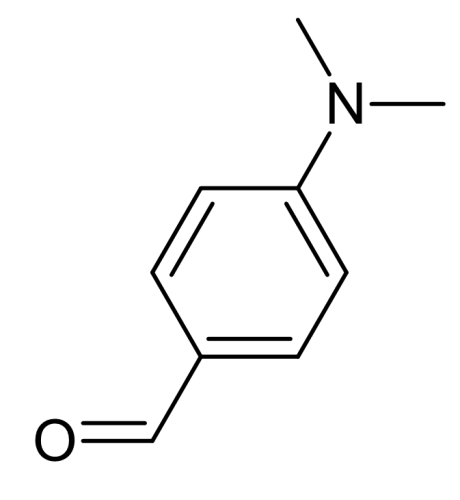
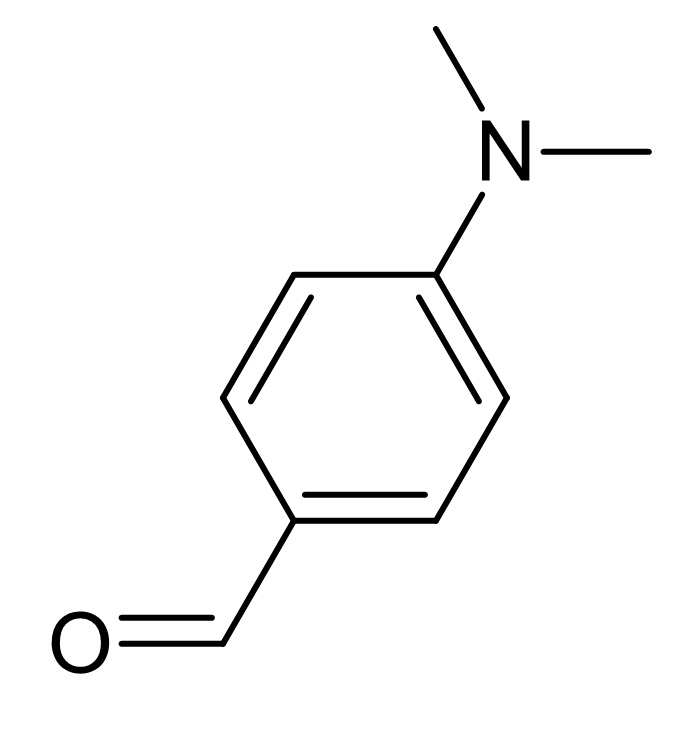
p-dimethylaminobenzaldehyde : p-DMAB : 4-(Dimethylamino)benzaldehyde - For Ehrlich Reagent

Regular price:
Regular price:
product unavailable
add to wish list
0

benzaldehyde - For Ehrlich Reagent "Pin It")
Description
p-Dimethylaminobenzaldehyde
Other Names: 4-(Dimethylamino)benzaldehyde, 4-Dimethylaminobenzaldehyde, Ehrlich's reagent component, DMAB, PDAB
Chemical Formula: C9H11NO
Molar Mass: 149.19 g/mol
CAS Number: 100-10-7
Appearance: White to pale yellow crystalline solid
Odor: Characteristic
SMILES: CN(C)C1=CC=C(C=C1)C=O
p-Dimethylaminobenzaldehyde is an aromatic aldehyde containing a dimethylamino group and an aldehyde group in para positions on a benzene ring. The molecule combines a strongly electron-donating N,N-dimethylamino substituent with an electron-accepting formyl group, creating a conjugated donor–acceptor system. Electronic communication between these groups produces pronounced intramolecular charge-transfer characteristics and strongly influences the compound's optical, spectroscopic and chemical properties.
The conjugated structure of p-dimethylaminobenzaldehyde makes it an important model compound in studies of molecular electronic structure, solvatochromism and excited-state processes. Changes in solvent polarity can influence the relative stabilization of its electronic states, producing measurable changes in absorption and emission behavior. The aldehyde functionality also provides a reactive site for condensation and derivatization reactions, while the dimethylamino group strongly modifies the electron density of the aromatic system.
Chemical and physical properties
p-Dimethylaminobenzaldehyde is a crystalline solid under ambient conditions. Reported experimental data place its melting point at approximately 73–75 °C. Its relatively low molecular mass combined with its planar, conjugated aromatic structure contributes to its characteristic crystalline and spectroscopic properties.
The compound is only sparingly soluble in water but dissolves more readily in many organic solvents. Its solubility and spectroscopic behavior depend on solvent polarity and on acid–base conditions because protonation of the dimethylamino group substantially changes the electronic structure of the molecule.
The para arrangement of the electron-donating dimethylamino group and electron-withdrawing aldehyde group enables strong resonance interaction across the aromatic ring. As a result, the molecule exhibits substantial polarization and charge-transfer character. This donor–acceptor architecture is frequently used as a model for understanding substituent effects in conjugated aromatic compounds.
The aldehyde group readily participates in reactions characteristic of aromatic aldehydes, including nucleophilic addition and condensation. Reactions with suitable nitrogen-containing compounds can generate highly conjugated derivatives with intense visible absorption, forming the chemical basis of several analytical color reactions.
Applications
p-Dimethylaminobenzaldehyde is widely used as a chromogenic analytical reagent. Under acidic conditions it reacts with selected nitrogen-containing and heterocyclic compounds to produce strongly colored condensation products. The intensity of the resulting absorption can be measured spectrophotometrically, allowing qualitative detection and quantitative determination of suitable analytes.
The compound is a principal component of Ehrlich-type reagents, which are used in analytical chemistry for color-forming reactions with indole and related heterocyclic structures. The reaction involves electrophilic interaction of protonated p-dimethylaminobenzaldehyde with an electron-rich substrate, followed by formation of a conjugated chromophore.
p-Dimethylaminobenzaldehyde is also employed in biochemical and microbiological analytical methods. Its reactions with indole derivatives have been extensively investigated and provide the basis for spectrophotometric and colorimetric assays used in laboratory research.
In organic synthesis, p-dimethylaminobenzaldehyde serves as a useful aromatic aldehyde building block. Its formyl group can undergo condensation with compounds containing activated methylene groups, hydrazines, amines and other nucleophiles, enabling preparation of Schiff bases, hydrazones and extended conjugated structures.
The compound is additionally investigated in optical and materials chemistry because its donor–acceptor structure provides a convenient platform for studying intramolecular charge transfer. Derivatives containing the p-dimethylaminophenyl unit are used in research on chromophores, fluorescent probes, nonlinear optical materials and molecular systems whose electronic properties respond to changes in their chemical environment.
Scientific references
National Center for Biotechnology Information. PubChem Compound Summary for CID 7479, 4-Dimethylaminobenzaldehyde. PubChem, U.S. National Library of Medicine.
National Institute of Standards and Technology. NIST Chemistry WebBook, SRD 69. 4-(Dimethylamino)benzaldehyde, CAS Registry Number 100-10-7.
Ehrlich, P. “Über die Dimethylamidobenzaldehydreaktion.” Medizinische Woche, 1901. Classical work describing the characteristic color reactions associated with p-dimethylaminobenzaldehyde.
Voet, D.; Voet, J. G. Biochemistry. Wiley. Reference work covering indole-containing biomolecules and principles underlying spectrophotometric and colorimetric biochemical analysis.
Reichardt, C.; Welton, T. Solvents and Solvent Effects in Organic Chemistry, 4th ed.; Wiley-VCH: Weinheim, 2011. Reference work covering solvent effects, molecular polarity and charge-transfer phenomena in organic compounds.
Safety

Signal Word: Warning
Hazard Statements:
H302: Harmful if swallowed
H315: Causes skin irritation
H319: Causes serious eye irritation
H335: May cause respiratory irritation
Precautionary Statements:
P261: Avoid breathing dust or vapors
P264: Wash hands thoroughly after handling
P270: Do not eat, drink, or smoke when using this product
P280: Wear protective gloves, protective clothing, and eye protection
P301+P312: IF SWALLOWED: Call a POISON CENTER or doctor if you feel unwell
P305+P351+P338: IF IN EYES: Rinse cautiously with water for several minutes. Remove contact lenses if present and easy to do. Continue rinsing
First Aid Measures
Eye Contact: Rinse cautiously with water for several minutes. Seek medical attention if irritation persists.
Skin Contact: Wash with soap and water. Remove contaminated clothing. Seek medical attention if irritation occurs.
Inhalation: Move to fresh air. Seek medical attention if symptoms persist.
Ingestion: Rinse mouth with water. Do not induce vomiting. Seek medical help if unwell.
Handling and Storage
Storage Conditions: Store in a tightly closed container in a cool, dry, and well-ventilated area. Keep away from light and strong oxidizers.
Handling Precautions: Avoid inhalation of dust and contact with skin and eyes. Use appropriate personal protective equipment.