
 CATEGORIES
- ORGANIC COMPOUNDS(1129)
- Thiols(1)
- Metal-organic compounds(1)
- Sulfonic acids(6)
- Alcohols(74)
- Aldehydes(47)
- Alkyl nitrites(6)
- Amines(55)
- Aminoacids(59)
- Amides(33)
- Anhydrides(11)
- Acyl Halides(5)
- Carboxylic Acids(170)
- Dyes and Indicators(99)
- Esters(52)
- Ethers(17)
- Organic Halogens (Organohalides)(30)
- Flavonoids(5)
- Heterocycles(24)
- Hydrocarbons(34)
- Imides(2)
- Ketones(29)
- Mixed solvents(16)
- Nitro Compounds(5)
- Nitriles(9)
- Organic salts(74)
- Phenols(30)
- Polymers ( HMW compounds )(68)
- Sugars (Saccharides)(24)
- Silicoorgano and Phosphoorganocompounds(1)
- Peptides(2)
- Terpenes(16)
- Others(126)
- INORGANIC COMPOUNDS(1055)
- LAB EQUIPMENT(5176)
- *(1)
- Organic Synthesis(417)
- Industry(775)
Language
US version allows shipping to all available destinations


 MANUFACTURER
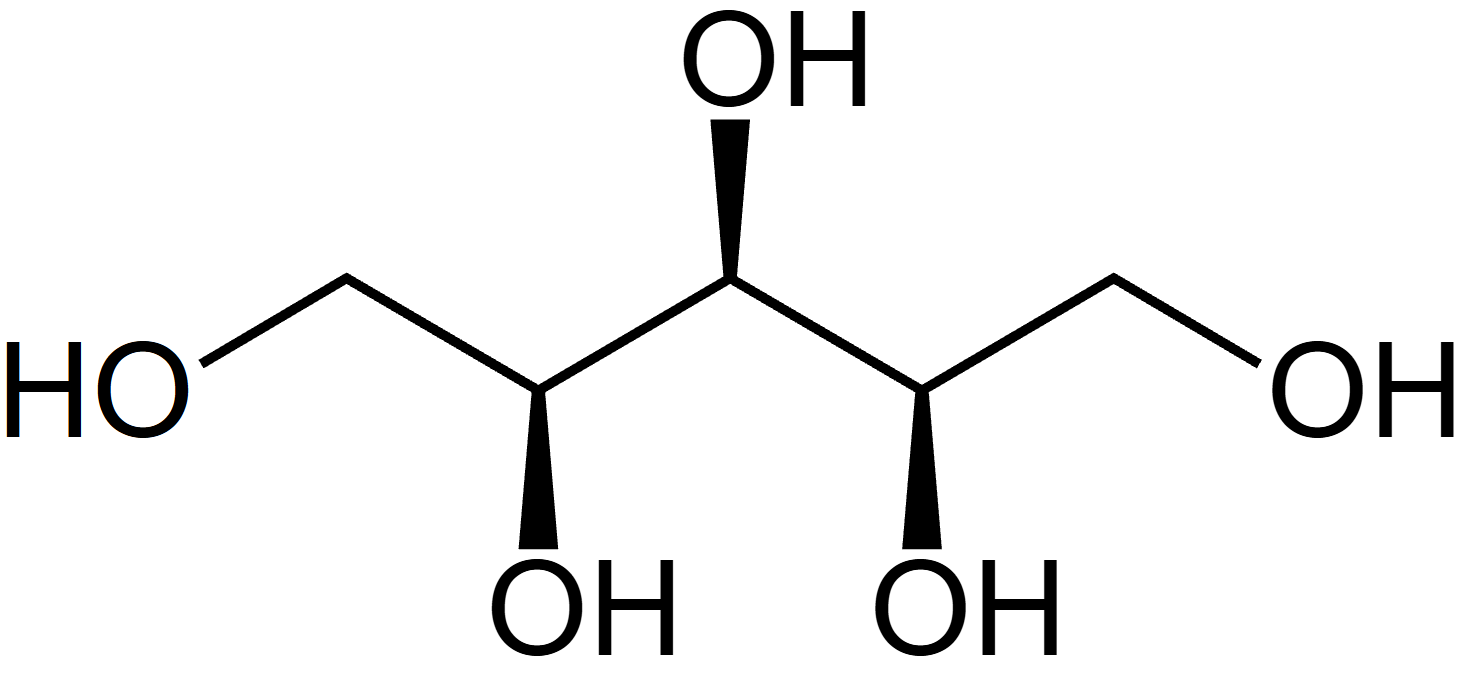
Xylitol
Regular price:
Regular price:
product unavailable
add to wish list
0

Description
Xylitol
Other Names: Xylite, meso-Xylitol, Xylo-pentitol, Pentane-1,2,3,4,5-pentol
Chemical Formula: C5H12O5
Molar Mass: 152.15 g/mol
CAS Number: 87-99-0
SMILES: C(C(C(C(CO)O)O)O)O
Appearance: White crystalline solid
Odor: Odorless
Xylitol is a five-carbon polyol containing five hydroxyl groups and no carbonyl functional group. Its high hydroxyl-group density gives the molecule pronounced hydrophilicity and the ability to participate extensively in intermolecular hydrogen bonding. Xylitol is therefore of interest not only as a molecular polyol but also as a renewable chemical building block and functional component in polymer and materials chemistry. Industrially, xylitol can be produced by catalytic hydrogenation of xylose obtained from lignocellulosic raw materials. Its multifunctional structure also allows further chemical transformation through reactions involving its hydroxyl groups, including esterification and polycondensation.
Chemical and physical properties
Xylitol is a crystalline solid under ambient conditions. Literature data for its stable crystalline form indicate a melting temperature of approximately 93–97 °C. A metastable crystalline modification with a considerably lower melting temperature has also been reported, demonstrating polymorphic behavior of the compound.
The five hydroxyl groups make xylitol strongly hydrophilic and readily soluble in water. Dielectric-spectroscopy investigations of aqueous xylitol solutions at 25 °C demonstrated extensive interaction between xylitol and surrounding water molecules. An effective hydration number of approximately 5.66 water molecules per xylitol molecule was determined experimentally, illustrating the pronounced hydration of the polyol in aqueous systems.
The terminal and internal hydroxyl groups participate in hydrogen-bond networks and display different molecular dynamics in solution. These intermolecular interactions influence properties such as crystallization, viscosity, molecular mobility and interactions with polymer matrices, making xylitol useful as a model compound for physicochemical studies of polyols and hydrogen-bonded systems.
Applications
Xylitol is used as a multifunctional monomer and building block in polymer and biomaterials research. Polycondensation of xylitol with dicarboxylic acids such as sebacic acid produces cross-linked polyesters including poly(xylitol sebacate). Such materials have been investigated as biodegradable elastomers whose mechanical properties and degradation behavior can be adjusted by polymer composition and processing conditions.
Xylitol has also been employed in the synthesis of other polyester networks, including poly(xylitol-dodecanedioic acid). Research on these materials has demonstrated the possibility of producing elastic and biodegradable polymer systems for applications investigated in tissue engineering, controlled molecular release and related biomedical-material technologies.
In polymer processing, xylitol can function as a polyol plasticizer. Its multiple hydroxyl groups form hydrogen bonds with hydroxyl-containing polymer matrices and can modify molecular mobility, glass-transition behavior, mechanical properties and crystallization. It is consequently studied as a functional additive in biodegradable and bio-based polymer systems.
Xylitol is additionally investigated as a renewable platform chemical for catalytic synthesis. Catalytic hydrogenolysis can convert xylitol into lower molecular-weight polyols, particularly ethylene glycol and propylene glycol. Studies using supported metal catalysts have demonstrated that reaction temperature, hydrogen pressure, catalyst composition and basicity strongly affect conversion and product selectivity. These transformations make xylitol an important model substrate in research on renewable routes to industrial glycols and other chemical intermediates.
Scientific references
- PubChem, National Center for Biotechnology Information. (2S,4R)-Pentane-1,2,3,4,5-pentol, PubChem CID 6912. Molecular formula, molecular mass and structural identifiers. https://pubchem.ncbi.nlm.nih.gov/compound/6912
- Delgado Arcaño Y., Valmaña García O.D., Mandelli D., Carvalho W.A., Magalhães Pontes L.A. Xylitol: A review on the progress and challenges of its production by chemical route. Catalysis Today, 2020, 344, 2–14. DOI: 10.1016/j.cattod.2018.07.060
- Płowaś-Korus I., Buchner R. Structure, molecular dynamics, and interactions in aqueous xylitol solutions. Physical Chemistry Chemical Physics, 2019, 21, 24061–24069. DOI: 10.1039/C9CP04547C
- Bruggeman J.P., Bettinger C.J., Langer R. Biodegradable xylitol-based elastomers: In vivo behavior and biocompatibility. Journal of Biomedical Materials Research Part A, 2010, 95A, 92–104. DOI: 10.1002/jbm.a.32733
- Firoozi N., Kang Y. A Highly Elastic and Autofluorescent Poly(xylitol-dodecanedioic Acid) for Tissue Engineering. ACS Biomaterials Science & Engineering, 2019, 5, 1257–1267. DOI: 10.1021/acsbiomaterials.9b00059
- Sun J., Liu H. Selective hydrogenolysis of biomass-derived xylitol to ethylene glycol and propylene glycol on supported Ru catalysts. Green Chemistry, 2011, 13, 135–142. DOI: 10.1039/C0GC00571A
Safety
According to available safety data sheets, xylitol is not classified as a hazardous substance under GHS/CLP criteria.
Signal word: none
Hazard statements:
No GHS classification
Precautionary statements:
No specific P-statements resulting from GHS classification
First aid
Eye contact: rinse eyes carefully with water for several minutes. If irritation persists, seek medical advice.
Skin contact: wash skin with soap and water. If irritation occurs, consult a doctor.
Inhalation: move the affected person to fresh air. If symptoms occur, seek medical advice.
Ingestion: rinse mouth with water. If feeling unwell, seek medical advice.
Storage and handling
Store the product in a tightly closed container in a dry, cool and well-ventilated place. Protect from moisture, contamination and incompatible materials. During handling, avoid the formation and inhalation of dust. The use of standard personal protective equipment is recommended, such as protective gloves, safety goggles and respiratory protection in case of dust formation risk.