
 CATEGORIES
- ORGANIC COMPOUNDS(1135)
- Thiols(1)
- Metal-organic compounds(1)
- Sulfonic acids(6)
- Alcohols(74)
- Aldehydes(47)
- Alkyl nitrites(6)
- Amines(56)
- Aminoacids(59)
- Amides(33)
- Anhydrides(11)
- Acyl Halides(5)
- Carboxylic Acids(170)
- Dyes and Indicators(99)
- Esters(52)
- Ethers(17)
- Organic Halogens (Organohalides)(30)
- Flavonoids(5)
- Heterocycles(25)
- Hydrocarbons(38)
- Imides(2)
- Ketones(29)
- Mixed solvents(16)
- Nitro Compounds(5)
- Nitriles(9)
- Organic salts(74)
- Phenols(30)
- Polymers ( HMW compounds )(68)
- Sugars (Saccharides)(24)
- Silicoorgano and Phosphoorganocompounds(1)
- Peptides(2)
- Terpenes(16)
- Others(126)
- INORGANIC COMPOUNDS(1055)
- LAB EQUIPMENT(5176)
- *(1)
- Organic Synthesis(421)
- Industry(775)
Language
US version allows shipping to all available destinations


 MANUFACTURER
Triethylamine Anhydrous ( TEA ) N,N-Diethylethanamine
Regular price:
Regular price:
product unavailable
add to wish list
0

 N,N-Diethylethanamine "Pin It")
Description
Triethylamine
Other Names: N,N-Diethylethanamine, Triethyl amine, TEA, Et3N
Chemical Formula: C6H15N
Molar Mass: 101.19 g/mol
CAS Number: 121-44-8
SMILES: CCN(CC)CC
Appearance: Clear, colorless liquid
Odor: Strong, characteristic amine-like odor
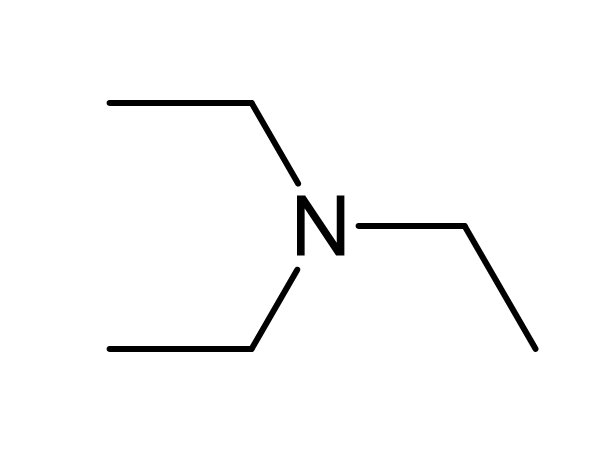
Triethylamine is a tertiary aliphatic amine consisting of a central nitrogen atom bonded to three ethyl groups. The nitrogen atom contains a nonbonding electron pair that determines much of the compound's chemical behavior, including its basicity and ability to act as an electron-pair donor. Triethylamine is widely used in synthetic organic chemistry as a non-nucleophilic or weakly nucleophilic organic base, particularly for neutralizing acids generated during chemical reactions. Its volatility, relatively low boiling point and broad compatibility with organic solvents make it convenient for laboratory synthesis and chemical processing.
Chemical and physical properties
Triethylamine is a clear, colorless and highly volatile liquid under ambient conditions. Experimental thermodynamic data report a melting point of approximately −115 °C and a normal boiling point of approximately 89 °C.
The density of triethylamine is approximately 0.726 g/cm3 at 20 °C, making it substantially less dense than water. Its refractive index is approximately 1.40 near room temperature.
Triethylamine is moderately soluble in water and is miscible with many common organic solvents. The nitrogen atom acts as a hydrogen-bond acceptor, whereas the molecule contains no N–H bond and therefore cannot act as a conventional hydrogen-bond donor. Its three ethyl groups contribute a substantial hydrophobic component to the molecular structure.
Triethylamine is a Brønsted base and readily accepts a proton to form the triethylammonium ion, (C2H5)3NH+. The pKa of the triethylammonium conjugate acid in water is approximately 10.7 at room temperature. Consequently, triethylamine efficiently neutralizes many organic and inorganic acids and forms corresponding triethylammonium salts.
The lone electron pair on nitrogen also gives triethylamine Lewis-basic properties. It can interact with Lewis acids, metal centers and electrophilic species. Steric shielding by the three ethyl substituents reduces its nucleophilicity relative to less hindered amines in many reaction systems, although triethylamine is not completely non-nucleophilic.
Applications
Triethylamine is extensively used as an organic base in synthetic chemistry. One of its principal functions is the neutralization of acids generated during reactions. For example, reactions of alcohols or amines with acyl chlorides and sulfonyl chlorides produce hydrogen chloride, which can be captured by triethylamine to form triethylammonium chloride.
In peptide and amide chemistry, triethylamine is employed as a base during coupling, acylation and related transformations. It can neutralize acidic species and maintain reaction conditions favorable for nucleophilic reactions of amines and other functional groups.
Triethylamine is also commonly used in esterification, etherification, sulfonylation and protection or deprotection procedures. In reactions involving acid chlorides, anhydrides and related activated derivatives, it frequently serves as an auxiliary base rather than becoming incorporated into the desired product.
In elimination chemistry, triethylamine can function as a proton acceptor and promote base-mediated transformations. Its steric properties and moderate basicity make it useful when a soluble tertiary amine base is required without introducing an N–H functionality into the reaction system.
Triethylamine is used in polymer and materials chemistry as a catalyst, acid scavenger or pH-adjusting reagent. It has been employed in polymer functionalization, preparation of coatings, sol–gel processes and reactions involving acid-sensitive monomers or intermediates.
In chromatography and analytical chemistry, small quantities of triethylamine are sometimes incorporated into mobile phases to modify interactions between basic analytes and stationary-phase surface sites. Such modification can influence chromatographic retention and reduce undesirable peak tailing for certain nitrogen-containing compounds.
Scientific references
National Institute of Standards and Technology (NIST). NIST Chemistry WebBook: Triethylamine, CAS 121-44-8. Experimental thermodynamic, phase-change, spectroscopic and physicochemical data for triethylamine.
National Center for Biotechnology Information (NCBI), PubChem. Triethylamine, CID 8471. Chemical identity and physicochemical data including molecular formula, molecular mass, structure, melting point, boiling point, density and solubility.
Hall, H. K. Correlation of the Base Strengths of Amines. Journal of the American Chemical Society, 1957, 79(20), 5441–5444. DOI: 10.1021/ja01577a030.
Perrin, D. D. Dissociation Constants of Organic Bases in Aqueous Solution. Butterworths, London, 1965. Experimental reference data for protonation equilibria and basicity of organic amines.
Espinosa, S.; Bosch, E.; Rosés, M. Retention of ionizable compounds on high-performance liquid chromatography. IX. Modelling retention in reversed-phase liquid chromatography as a function of pH and solvent composition with acetonitrile-water mobile phases. Journal of Chromatography A, 2002, 947, 47–58.
Safety Information


Signal Word: ⚠️ Danger
GHS Hazard Statements
H225 (> 99.9%): Highly Flammable liquid and vapor [Danger Flammable liquids]
H302 (97.5%): Harmful if swallowed [Warning Acute toxicity, oral]
H311 (47.5%): Toxic in contact with skin [Danger Acute toxicity, dermal]
H312 (52.5%): Harmful in contact with skin [Warning Acute toxicity, dermal]
H314 (> 99.9%): Causes severe skin burns and eye damage [Danger Skin corrosion/irritation]
H318 (45.2%): Causes serious eye damage [Danger Serious eye damage/eye irritation]
H331 (46.5%): Toxic if inhaled [Danger Acute toxicity, inhalation]
H332 (52.6%): Harmful if inhaled [Warning Acute toxicity, inhalation]
H335 (47.4%): May cause respiratory irritation [Warning Specific target organ toxicity, single exposure; Respiratory tract irritation]
P210, P233, P240, P241, P242, P243, P260, P261, P262, P264, P264+P265, P270, P271, P280, P301+P317, P301+P330+P331, P302+P352, P302+P361+P354, P303+P361+P353, P304+P340, P305+P354+P338, P316, P317, P319, P321, P330, P361+P364, P362+P364, P363, P370+P378, P403+P233, P403+P235, P405, and P501
Handling and Storage
-
Handling: Ensure proper ventilation. Avoid inhalation and contact with eyes or skin. Use spark-proof tools and explosion-proof equipment
-
Storage: Store in a tightly sealed container in a cool, dry, and well-ventilated place, away from sources of ignition and incompatible materials such as acids and oxidizers