
 CATEGORIES
- ORGANIC COMPOUNDS(1134)
- Thiols(1)
- Metal-organic compounds(1)
- Sulfonic acids(6)
- Alcohols(74)
- Aldehydes(47)
- Alkyl nitrites(6)
- Amines(56)
- Aminoacids(59)
- Amides(33)
- Anhydrides(11)
- Acyl Halides(5)
- Carboxylic Acids(170)
- Aromatic Acids(11)
- Dyes and Indicators(99)
- Esters(52)
- Ethers(17)
- Organic Halogens (Organohalides)(30)
- Flavonoids(5)
- Heterocycles(25)
- Hydrocarbons(38)
- Imides(2)
- Ketones(29)
- Mixed solvents(16)
- Nitro Compounds(5)
- Nitriles(9)
- Organic salts(74)
- Phenols(30)
- Polymers ( HMW compounds )(68)
- Sugars (Saccharides)(24)
- Silicoorgano and Phosphoorganocompounds(1)
- Peptides(2)
- Terpenes(16)
- Others(125)
- INORGANIC COMPOUNDS(1055)
- LAB EQUIPMENT(5176)
- *(1)
- Organic Synthesis(421)
- Industry(775)
Language
US version allows shipping to all available destinations


 MANUFACTURER
Trichloroacetic Acid ( TCA ) Pure Crystalline
Regular price:
Regular price:
product unavailable
add to wish list
0

 Pure Crystalline "Pin It")
Description
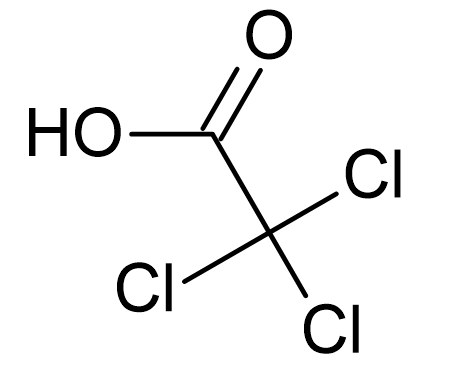
Trichloroacetic Acid
Other Names: 2,2,2-Trichloroacetic acid, Trichloroethanoic acid, Trichloracetic acid, TCA, TCAA
Chemical Formula: C2HCl3O2 (CCl3COOH)
Molar Mass: 163.38 g/mol
CAS Number: 76-03-9
SMILES: C(=O)(C(Cl)(Cl)Cl)O
Appearance: Colorless to white, hygroscopic crystalline solid
Odor: Sharp, pungent odor
Trichloroacetic acid (TCA) is a halogenated carboxylic acid derived structurally from acetic acid by replacement of all three hydrogen atoms of the methyl group with chlorine atoms. The strongly electron-withdrawing trichloromethyl group substantially increases the acidity of the adjacent carboxyl group compared with acetic acid. Consequently, trichloroacetic acid is a relatively strong organic acid and is extensively studied in acid-base chemistry, solution thermodynamics, organic synthesis and biochemical laboratory methods. Its combination of high polarity, strong acidity and ability to disrupt intermolecular interactions also makes it an important laboratory reagent.
Chemical and physical properties
Trichloroacetic acid is a colorless to white crystalline material under typical laboratory conditions. It is strongly hygroscopic and can absorb sufficient atmospheric moisture to form a concentrated liquid or syrup-like material. Experimental data report a melting point of approximately 57–58 °C and a normal boiling point close to 197 °C.
The compound has a relatively high density of approximately 1.63 g/cm3 near room temperature. It is highly soluble in water, and dissolution is strongly exothermic. Trichloroacetic acid is also soluble in a variety of polar organic solvents.
Trichloroacetic acid is considerably more acidic than acetic acid. Its aqueous pKa is approximately 0.7. This increased acidity originates primarily from the strong electron-withdrawing inductive effect of the three chlorine atoms, which stabilizes the trichloroacetate conjugate base after dissociation of the carboxylic proton.
In aqueous solution, trichloroacetic acid undergoes proton dissociation to produce hydronium and trichloroacetate ions. Its acid-base equilibria and thermodynamic behavior have been investigated experimentally as model systems for understanding substituent effects on the acidity of halogenated carboxylic acids.
Trichloroacetic acid is corrosive and concentrated solutions are strongly acidic. Its hygroscopic character and high water solubility are important considerations in quantitative laboratory applications because absorbed moisture can alter the effective concentration and composition of the material.
Applications
Trichloroacetic acid is widely used as a laboratory reagent in biochemistry and analytical chemistry for precipitation of proteins from aqueous solutions. Addition of TCA disrupts protein hydration and electrostatic interactions, promotes denaturation and decreases protein solubility, resulting in precipitation. This approach is commonly employed during protein isolation, concentration and sample preparation prior to analytical procedures.
In molecular biology and proteomic research, TCA precipitation is used for concentrating proteins from dilute solutions and removing interfering soluble components. The precipitated protein fraction can subsequently be separated by centrifugation and processed for electrophoretic, chromatographic or mass-spectrometric analysis.
Trichloroacetic acid is also employed in synthetic organic chemistry as a strongly electron-deficient carboxylic acid and as a precursor to trichloroacetate derivatives. The CCl3 group can participate in transformations involving decarboxylation and generation of reactive chlorinated intermediates, making trichloroacetic acid and its derivatives useful compounds in mechanistic and synthetic studies.
In peptide and oligonucleotide chemistry, trichloroacetic acid solutions can be used under acidic conditions for cleavage of selected acid-labile protecting groups. Its strong acidity combined with compatibility with suitable organic solvents makes it useful in controlled deprotection procedures during multistep synthesis.
Trichloroacetic acid is additionally investigated in environmental and atmospheric chemistry. It can occur as a transformation product of chlorinated organic compounds, and research has examined its formation, degradation and behavior in aqueous and atmospheric systems.
Recent photocatalytic research has also demonstrated the formation of trichloroacetic acid from chloroform and carbon dioxide in aqueous media over TiO2 under ultraviolet irradiation. Such studies provide insight into unusual carbon dioxide carboxylation pathways and the photochemical transformation of chlorinated organic compounds.
Scientific references
National Center for Biotechnology Information (NCBI), PubChem. Trichloroacetic Acid, CID 6421. Chemical identity and physicochemical information including molecular formula, molecular mass, structure, CAS number, appearance and water-solubility characteristics.
Koontz, L. TCA Precipitation. Methods in Enzymology, 2014, 541, 3–10. DOI: 10.1016/B978-0-12-420119-4.00001-X.
Rajalingam, D.; Loftis, C.; Xu, J. J.; Kumar, T. K. S. Trichloroacetic acid-induced protein precipitation involves the reversible association of a stable partially structured intermediate. Protein Science, 2009, 18(5), 980–993. DOI: 10.1002/pro.108.
Greish, A. A.; Shuvalova, E. V.; Finashina, E. D.; Krylov, I. B.; Tolkachev, N. N.; Tkachenko, O. P.; Kustov, L. M. First demonstration of photocatalytic synthesis of trichloroacetic acid from chloroform and CO2 over TiO2. Journal of Photochemistry and Photobiology A: Chemistry, 2027, 482, 117488. DOI: 10.1016/j.jphotochem.2026.117488.
National Institute of Standards and Technology (NIST). NIST Chemistry WebBook: Trichloroacetic Acid, CAS 76-03-9. Experimental thermodynamic, phase-change and physicochemical reference data for trichloroacetic acid.
SAFETY

Signal word: danger -
Pictograms GHS05, GHS07, GHS09
Hazard statements H314 Causes severe skin burns and eye damage. H335 May cause respiratory irritation. H410 Very toxic to aquatic life with long lasting effects.
Precautionary statements P260 Do not breathe dust/fume/gas/mist/vapours/spray. P280 Wear protective gloves/protective clothing/eye protection/face protection/hearing protection/ …. P303+P361+P353 IF ON SKIN (or hair): Take off immediately all contaminated clothing. Rinse skin with water or shower. P305+P351+P338 IF IN EYES: Rinse cautiously with water for several minutes. Remove contact lenses, if present and easy to do. Continue rinsing. P310 Immediately call a POISON CENTER/doctor. P403+P233 Store in a well-ventilated place. Keep container tightly closed.