
 CATEGORIES
- ORGANIC COMPOUNDS(1129)
- Thiols(1)
- Metal-organic compounds(1)
- Sulfonic acids(6)
- Alcohols(74)
- Aldehydes(47)
- Alkyl nitrites(6)
- Amines(55)
- Aminoacids(59)
- Amides(33)
- Anhydrides(11)
- Acyl Halides(5)
- Carboxylic Acids(170)
- Dyes and Indicators(99)
- Esters(52)
- Ethers(17)
- Organic Halogens (Organohalides)(30)
- Flavonoids(5)
- Heterocycles(24)
- Hydrocarbons(34)
- Imides(2)
- Ketones(29)
- Mixed solvents(16)
- Nitro Compounds(5)
- Nitriles(9)
- Organic salts(74)
- Phenols(30)
- Polymers ( HMW compounds )(68)
- Sugars (Saccharides)(24)
- Silicoorgano and Phosphoorganocompounds(1)
- Peptides(2)
- Terpenes(16)
- Others(126)
- INORGANIC COMPOUNDS(1055)
- LAB EQUIPMENT(5176)
- *(1)
- Organic Synthesis(417)
- Industry(775)
Language
US version allows shipping to all available destinations


 MANUFACTURER
Sodium Diethylenetriamine Pentamethylene Phosphonate ( Na DTPMP ) diethylenetriamine penta(methylene phosphonic acid) Sodium Salt - 32%
Regular price:
Regular price:
product unavailable
add to wish list
0
 diethylenetriamine penta(methylene phosphonic acid) Sodium Salt - 32% "Pin It")
Description
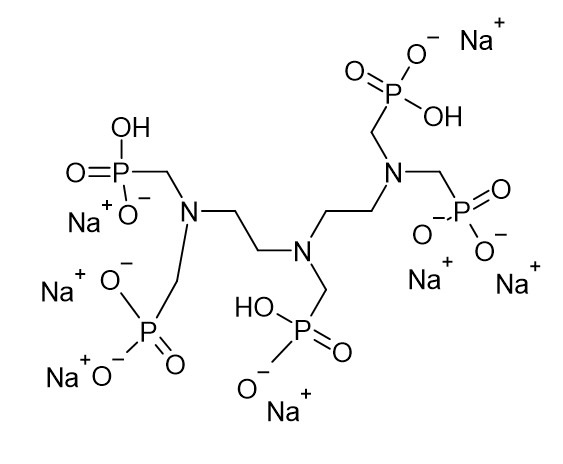
Sodium DTPMP
Other Names: DTPMP Sodium Salt, DTPMP-Na, Diethylenetriaminepenta(methylenephosphonic acid) Sodium Salt, Diethylenetriamine Pentamethylene Phosphonate Sodium Salt
Representative Salt Form: DTPMP·Na7 (Heptasodium DTPMP)
Chemical Formula: C9H21N3Na7O15P5 (heptasodium form)
Molar Mass: 727.07 g/mol (heptasodium form)
CAS Number: 68155-78-2 (DTPMP·Na7); 22042-96-2 is also used for DTPMP sodium salts with unspecified neutralization degree
SMILES: C(CN(CP(=O)(O)[O-])CP(=O)([O-])[O-])N(CCN(CP(=O)(O)[O-])CP(=O)([O-])[O-])CP(=O)(O)[O-].[Na+].[Na+].[Na+].[Na+].[Na+].[Na+].[Na+]
Appearance: Typically supplied as a colorless to pale yellow aqueous solution; isolated sodium salts may occur as white to off-white solids
Sodium DTPMP is a sodium salt of diethylenetriaminepenta(methylenephosphonic acid), a multifunctional aminophosphonate containing a diethylenetriamine backbone and five methylenephosphonate groups. Commercial DTPMP sodium products can have different degrees of neutralization, so the designation Na-DTPMP does not always describe a single fixed stoichiometric compound. The heptasodium salt, DTPMP·Na7, is one well-defined and commonly encountered form. The combination of multiple phosphonate groups and three nitrogen atoms gives DTPMP a high density of metal-binding sites and pronounced complexing properties.
Chemical and physical properties
Sodium DTPMP is an ionic, highly polar aminophosphonate with strong affinity for aqueous media. Conversion of the parent phosphonic acid into sodium salts increases the concentration of negatively charged phosphonate groups and generally provides forms suitable for use in aqueous systems. Because several acidic protons can be neutralized independently, DTPMP can occur as partially or extensively neutralized sodium salts depending on solution pH and preparation conditions.
The molecule contains five phosphonate groups capable of deprotonation and three tertiary nitrogen donor atoms. This multidentate architecture enables simultaneous interaction with metal ions through several donor sites. Spectroscopic studies of DTPMP complexes with transition metals have demonstrated coordination involving the nitrogen-containing backbone and phosphonate groups, with complexes reported for Fe3+, Mn2+, Co2+, Ni2+ and Cu2+.
DTPMP also forms strong interactions with alkaline-earth metal ions. Calcium-DTPMP association and precipitation equilibria have been investigated in concentrated brines, demonstrating formation of calcium-phosphonate complexes and solid phases whose composition depends on pH, calcium concentration and ionic strength. These interactions are central to the behavior of DTPMP in mineral-deposition control systems.
Chelating and complexing properties
The multiple phosphonate groups of DTPMP provide strong complexation of polyvalent metal ions. Phosphonate oxygen atoms act as major coordination sites, while the polyamine backbone contributes additional nitrogen donors. This combination allows DTPMP to form stable, multidentate complexes and distinguishes it from simpler monophosphonate compounds.
Studies of transition-metal complexes show that DTPMP can adopt highly coordinated structures in aqueous solution. Its strong interaction with Fe3+ has also been exploited experimentally in analytical systems where DTPMP functions as a chelating probe for metal-ion recognition. Related materials functionalized with DTPMP have demonstrated effective binding of Cu2+, Pb2+ and Cd2+ through phosphonate-mediated chelation.
Applications
Sodium DTPMP is extensively used as a complexing and scale-control agent in industrial aqueous systems. DTPMP has been studied particularly for inhibition of sparingly soluble mineral deposits such as barium sulfate and calcium-containing scales. Its activity results from a combination of metal-ion complexation, adsorption onto growing mineral surfaces and modification of crystal nucleation and growth.
In scale-inhibition research, DTPMP has shown strong activity against BaSO4 formation. Turbidity and supersaturation studies demonstrate that relatively low concentrations of DTPMP can delay precipitation by interfering with nucleation and crystal-growth processes. Adsorption studies on barite surfaces further show that DTPMP can interact rapidly with BaSO4 particles, which contributes to its effectiveness in mineral-deposition control.
Sodium DTPMP is also used where sequestration of dissolved metal ions is required. Its high ligand functionality allows it to bind calcium, magnesium and numerous transition-metal ions, thereby reducing the concentration of freely reactive metal species in solution. This property is useful in industrial cleaning, process-water chemistry and other technical systems in which uncontrolled metal-ion reactions can interfere with process stability.
DTPMP has additionally been investigated as a corrosion-control component. Studies on carbon steel indicate that DTPMP-containing systems can reduce corrosion rates through interaction with the metallic surface and formation of metal-phosphonate-containing protective layers. The effectiveness depends strongly on solution composition, DTPMP concentration, associated metal ions and the chemical condition of the steel surface.
In analytical and materials chemistry, DTPMP is used as a model multidentate phosphonate ligand. Its complexes with transition metals have been studied by NMR, EPR and electronic spectroscopy, while DTPMP-functionalized materials have been investigated for extraction and preconcentration of trace metal ions. The ligand is therefore useful in research involving coordination chemistry, adsorption, ion separation and metal-ion sensing.
Handling and stability
Sodium DTPMP should be handled using appropriate laboratory protective equipment, including suitable gloves and eye protection. Contact with concentrated solutions should be minimized. Because DTPMP strongly complexes polyvalent cations, contact with concentrated solutions of calcium, iron or other multivalent metals may result in complex formation or precipitation, depending on pH and ionic composition.
The material should be stored in chemically compatible, tightly closed containers. For accurately defined laboratory work, the precise degree of sodium neutralization and active DTPMP concentration should be considered because commercial Na-DTPMP products may represent different sodium salts or aqueous mixtures rather than one universal molecular composition.
Scientific references
Oakes, J.; van Kralingen, C. G. Spectroscopic studies of transition-metal ion complexes of diethylenetriaminepenta-acetic acid and diethylenetriaminepenta-methylphosphonic acid. Journal of the Chemical Society, Dalton Transactions, 1984, 1133–1137. DOI: 10.1039/DT9840001133.
Tantayakom, V.; Sreethawong, T.; Fogler, H. S.; de Moraes, F. F.; Chavadej, S. Scale inhibition study by turbidity measurement. Journal of Colloid and Interface Science, 2005, 284, 57–65. DOI: 10.1016/j.jcis.2004.10.007.
The solubility and stoichiometry of calcium-diethylenetriaminepenta(methylene phosphonate) at 70 °C in brine solutions at 4.7 and 5.0 pH. Applied Geochemistry, 1990, 5, 527–532. DOI: 10.1016/0883-2927(90)90026-2.
Investigation of sorptive interaction between phosphonate inhibitor and barium sulfate for oilfield scale control. Journal of Petroleum Science and Engineering, 2022.
Aminophosphonic Acid Functionalized Cellulose Nanofibers for Efficient Extraction of Trace Metal Ions. Polymers, 2020, 12, 2370.
Safety

Signal Word: Warning
GHS Hazard Statements
H290 (17.9%): May be corrosive to metals [Warning Corrosive to Metals]
H315 (15.1%): Causes skin irritation [Warning Skin corrosion/irritation]
H319 (15.3%): Causes serious eye irritation [Warning Serious eye damage/eye irritation]
Precautionary Statement Codes
P234, P264, P264+P265, P280, P302+P352, P305+P351+P338, P321, P332+P317, P337+P317, P362+P364, P390, and P406
First Aid Measures
-
Eye Contact: Rinse thoroughly with water. Seek medical attention if irritation persists
-
Skin Contact: Wash skin with water and soap. Remove contaminated clothing
-
Inhalation: Move to fresh air. Seek medical attention if symptoms occur
-
Ingestion: Rinse mouth with water. Do not induce vomiting. Seek medical advice
Handling and Storage
-
Storage Conditions: Store in a cool, dry, and well-ventilated area. Protect from freezing and direct sunlight. Keep containers tightly closed
-
Handling Precautions: Avoid contact with eyes and prolonged skin exposure. Use appropriate PPE and local ventilation