
 CATEGORIES
- ORGANIC COMPOUNDS(1063)
- Sulfonic acids(6)
- Thiols(1)
- Metal-organic compounds(1)
- Alcohols(73)
- Aldehydes(41)
- Alkyl nitrites(6)
- Amines(50)
- Aminoacids(58)
- Amides(29)
- Anhydrides(11)
- Acyl Halides(5)
- Carboxylic Acids(161)
- Dyes and Indicators(96)
- Esters(41)
- Ethers(18)
- Organic Halogens (Organohalides)(25)
- Flavonoids(5)
- Heterocycles(21)
- Hydrocarbons(31)
- Imides(2)
- Ketones(26)
- Mixed solvents(17)
- Nitro Compounds(5)
- Nitriles(9)
- Organic salts(74)
- Phenols(30)
- Polymers ( HMW compounds )(61)
- Sugars (Saccharides)(24)
- Silicoorgano and Phosphoorganocompounds(1)
- Peptides(2)
- Terpenes(12)
- Others(123)
- INORGANIC COMPOUNDS(1012)
- LAB EQUIPMENT(5176)
- *(1)
- Organic Synthesis(398)
- Industry(756)
Language
US version allows shipping to all available destinations


 MANUFACTURER
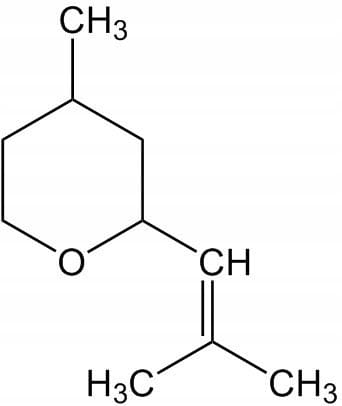
Rose Oxide 4-methyl-2-(2-methylprop-1-enyl)oxane
Regular price:
Regular price:
product unavailable
add to wish list
0

oxane "Pin It")
Description
4-Methyl-2-(2-methylprop-1-enyl)oxane (Rose Oxide)
Other Names: Rose Oxide, Rosenoxide, Rosoxide, Tetrahydro-4-methyl-2-(2-methylpropenyl)pyran, 4-Methyl-2-(2-methylprop-1-en-1-yl)tetrahydro-2H-pyran
Chemical Formula: C10H18O
Molar Mass: 154.25 g/mol
CAS Number: 16409-43-1
Appearance: Colorless to pale yellow liquid
Odor: Strong, floral, rosy and green odor with characteristic geranium-like notes
SMILES: CC1CCOC(C1)C=C(C)C
4-Methyl-2-(2-methylprop-1-enyl)oxane, commonly known as Rose Oxide, is an organic compound belonging to the monoterpenoid family of cyclic ethers. Its molecular structure consists of a six-membered oxygen-containing heterocyclic ring, known as oxane or tetrahydropyran, substituted with a methyl group and a 2-methylprop-1-enyl group. Rose Oxide is particularly recognized for its powerful floral fragrance, characterized by distinctive rose-like, green and geranium-like notes. It occurs naturally in several aromatic plants and essential oils, including those derived from roses and geraniums. The compound is also produced synthetically for industrial fragrance applications. Rose Oxide possesses two stereogenic centers and can exist as four stereoisomers, including cis and trans configurations. These stereoisomers exhibit differences in their olfactory properties, with certain cis isomers demonstrating particularly intense and characteristic rosy aromas. The relationship between molecular configuration and odor perception makes Rose Oxide an important model compound in stereochemistry, fragrance chemistry and molecular recognition research. Its molecular structure and pronounced stereochemical effects have also encouraged investigations into selective organic synthesis, catalytic transformations and analytical characterization of volatile organic compounds.
Chemical and physical properties
Rose Oxide is a clear, mobile liquid under normal ambient conditions. Published chemical reference data report a relative density of approximately 0.873–0.877 and a refractive index of approximately 1.453–1.457. A boiling point of approximately 182 °C has also been reported, although measured physical properties may vary with the stereoisomeric composition and purity of the material.
The compound exhibits limited solubility in water but dissolves more readily in organic solvents, including ethanol and various nonpolar organic media. Its relatively hydrophobic character is associated with the predominantly hydrocarbon structure and the presence of only one ether oxygen atom.
Rose Oxide contains a cyclic ether functional group and a carbon–carbon double bond within its substituted side chain. The unsaturated structure provides potential sites for oxidation and other transformations commonly encountered in monoterpenoid chemistry. Its chemical behavior is therefore relevant to studies of selective oxidation, catalytic cyclization and synthetic transformations of terpene-derived compounds.
One of the most important molecular characteristics of Rose Oxide is its stereoisomerism. The molecule contains two asymmetric carbon atoms, giving rise to four stereoisomers arranged into two pairs of enantiomers. Experimental studies have demonstrated that individual stereoisomers exhibit distinct odor characteristics and different olfactory intensities. The cis configuration is particularly important in fragrance chemistry because of its strong and recognizable floral odor.
Rose Oxide can be prepared through several synthetic approaches involving citronellol and related terpene derivatives. Published research describes stereoselective cyclization methods as well as oxidation-based synthetic routes. Studies have demonstrated photocatalytic aerobic epoxidation of citronellol using polymeric carbon nitride under visible-light irradiation as part of a multistep synthesis of Rose Oxide. These investigations highlight its importance as a target compound in modern catalytic and sustainable organic synthesis research.
Applications
Rose Oxide is primarily used in the fragrance industry as a powerful aromatic ingredient in perfume compositions. Its characteristic floral and green notes contribute to the creation of rose, geranium and other floral fragrance profiles. Because of its pronounced odor characteristics, it is particularly valuable in formulations requiring fresh, natural-smelling floral accents.
In cosmetic and personal care formulations, Rose Oxide is used as a fragrance component in scented soaps, shampoos, shower gels, body care products and other perfumed preparations. Its distinctive odor profile allows it to complement other fragrance materials and contribute to the overall complexity of aromatic compositions.
Rose Oxide is also employed in the development of fragrances for household and technical products, including air fresheners, detergents and scented cleaning formulations. Its strong floral character makes it a useful ingredient in fragrance systems designed to provide recognizable rose-like and green aromatic notes.
In organic chemistry, Rose Oxide is an important target molecule for the investigation and development of stereoselective synthetic methods. Research involving its preparation has contributed to studies of catalytic cyclization, asymmetric synthesis, terpene oxidation and photocatalytic transformations. The synthesis of individual stereoisomers is particularly relevant to understanding stereochemical control and its influence on molecular properties.
In analytical chemistry, Rose Oxide is investigated as a naturally occurring volatile organic compound and an important constituent of selected essential oils. Gas chromatography combined with mass spectrometry (GC-MS) is used to identify and characterize Rose Oxide in complex aromatic mixtures. Enantioselective chromatographic techniques also enable the separation and examination of its stereoisomeric forms, supporting research into natural-product composition and fragrance authenticity.
Rose Oxide additionally serves as a model compound in olfactory chemistry and structure–odor relationship studies. Its four stereoisomers provide a useful system for examining how three-dimensional molecular arrangement influences odor intensity and sensory character. These investigations contribute to a broader understanding of molecular recognition mechanisms and the development of new fragrance compounds with precisely controlled aromatic properties.
Scientific references
1. Mohammadi Ziarani, G., Mohajer, F., Jamali, S. M., & Ale Ebrahim, N. (2020). Quantitative and Qualitative Bibliometric Scope Toward the Synthesis of Rose Oxide as a Natural Product in Perfumery. Current Organic Synthesis, 17(8), 610–624.
https://doi.org/10.2174/1872208314666200722161044
2. Lorenz, F., Vuong, T. H., Peppel, T., Strunk, J., & Brasholz, M. (2025). Polymeric Carbon Nitride-Photocatalyzed Aerobic Epoxidation of Alkenes: Application to a Sustainable Synthesis of Rose Oxide. ChemSusChem, 18(15), e202500934.
https://doi.org/10.1002/cssc.202500934
3. Yamamoto, T., Matsuda, H., Utsumi, Y., Hagiwara, T., & Kanisawa, T. (2002). Synthesis and odor of optically active rose oxide. Tetrahedron Letters, 43(50), 9077–9080.
https://doi.org/10.1016/S0040-4039(02)02311-0
4. National Institute of Standards and Technology (NIST). NIST Chemistry WebBook, SRD 69: 2H-Pyran, tetrahydro-4-methyl-2-(2-methyl-1-propenyl)-.
https://webbook.nist.gov/cgi/cbook.cgi?ID=16409-43-1
5. National Center for Biotechnology Information (NCBI). PubChem Compound Summary for CID 27866, Rose Oxide. PubChem Database.
https://pubchem.ncbi.nlm.nih.gov/compound/27866
Safety

Signal Word: Warning
Hazard Statements
- H317: May cause an allergic skin reaction.
- H411: Toxic to aquatic life with long lasting effects.
Precautionary Statements
- P261: Avoid breathing mist, vapors or spray.
- P272: Contaminated work clothing should not be allowed out of the workplace.
- P273: Avoid release to the environment.
- P280: Wear protective gloves.
- P302 + P352: IF ON SKIN: Wash with plenty of soap and water.
- P333 + P313: If skin irritation or rash occurs: Get medical advice or attention.
- P362 + P364: Take off contaminated clothing and wash it before reuse.
- P391: Collect spillage.
- P501: Dispose of contents/container in accordance with local, regional, national and international regulations.
First Aid Measures
Eye contact: Rinse cautiously with water for several minutes. Remove contact lenses if present and easy to do. Continue rinsing. Seek medical advice if irritation persists.
Skin contact: Wash with plenty of water and soap. Remove contaminated clothing. Seek medical help in case of allergic reaction.
Inhalation: Move person to fresh air and keep at rest in a position comfortable for breathing. Seek medical attention if symptoms occur.
Ingestion: Rinse mouth with water. Do not induce vomiting. Seek medical advice if symptoms persist.
Handling and Storage
Keep in a tightly closed container in a cool, dry and well-ventilated place, away from direct sunlight and incompatible materials. Avoid contact with skin and eyes. Avoid breathing vapors or mist. Use with adequate ventilation and wear suitable protective clothing.
Intended Use
This product is intended exclusively for laboratory, technical, analytical and industrial applications. It is not intended for food, beverage, consumption, supplementation, medical, pharmaceutical or similar consumer use.