
 CATEGORIES
- ORGANIC COMPOUNDS(1135)
- Thiols(1)
- Metal-organic compounds(1)
- Sulfonic acids(6)
- Alcohols(74)
- Aldehydes(47)
- Alkyl nitrites(6)
- Amines(56)
- Aminoacids(59)
- Amides(33)
- Anhydrides(11)
- Acyl Halides(5)
- Carboxylic Acids(170)
- Dyes and Indicators(99)
- Esters(52)
- Ethers(17)
- Organic Halogens (Organohalides)(30)
- Flavonoids(5)
- Heterocycles(25)
- Hydrocarbons(38)
- Imides(2)
- Ketones(29)
- Mixed solvents(16)
- Nitro Compounds(5)
- Nitriles(9)
- Organic salts(74)
- Phenols(30)
- Polymers ( HMW compounds )(68)
- Sugars (Saccharides)(24)
- Silicoorgano and Phosphoorganocompounds(1)
- Peptides(2)
- Terpenes(16)
- Others(126)
- INORGANIC COMPOUNDS(1055)
- LAB EQUIPMENT(5176)
- *(1)
- Organic Synthesis(421)
- Industry(775)
Language
US version allows shipping to all available destinations


 MANUFACTURER
Procaine ( Novocain ) Hydrochloride >99%
Regular price:
Regular price:
product unavailable
add to wish list
0

 Hydrochloride >99% "Pin It")
Description
Procaine (>99%)
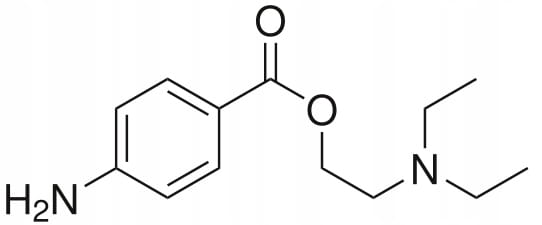
Other Names: Novocaine, 2-(Diethylamino)ethyl 4-aminobenzoate, Vitamin H3, Norocaine, Procainum, 4-Aminobenzoic acid diethylaminoethyl ester
CAS Number: 59-46-1
Sum Formula: C₁₃H₂₀N₂O₂
Molar Mass: 236.31 g/mol
Appearance: White crystalline powder or colorless crystals
Procaine is an organic compound belonging to the ester group, widely known for its use as a laboratory reagent and model compound in organic chemistry studies. It features a diethylamino group and a para-aminobenzoic acid moiety, offering interesting chemical reactivity for research purposes.
Chemical and Physical Properties
Density: Not precisely defined (solid crystalline material)
Melting Point: 153–158°C
Boiling Point: Decomposes before boiling
Solubility in Water: Slightly soluble (better in acidic aqueous solutions)
Solubility in Other Solvents: Soluble in ethanol, methanol, chloroform
Odor: Odorless or faint characteristic odor
Applications
Laboratory Reagent:
-
Used in research focusing on ester hydrolysis, amide bond chemistry, and anesthetic mechanisms.
-
Applied in studies of esterification, transesterification, and nucleophilic substitution reactions.
-
Employed as a reference material for analytical method development.
Organic Synthesis:
-
Investigated for its structural motifs useful in developing ester-based compounds and polymerizable systems.
Key Properties
-
High Purity: >99%, suitable for precision laboratory applications.
-
Stable Structure: Under proper storage, maintains chemical integrity for extended periods.
-
Research Value: Valuable for ester and aromatic amine functional group studies.
Important Note:
This product is intended strictly for laboratory use. It is not approved for human consumption or pharmaceutical use.
Safety

Signal Word: Warning
P264, P270, P301+P317, P330, and P501
Handling and Storage
Storage Conditions:
-
Store in a tightly closed container in a cool, dry, and well-ventilated area.
-
Recommended storage temperature: 2–8°C.
-
Protect from light and moisture to ensure stability.
Handling Precautions:
-
Avoid generating dust.
-
Use standard PPE including gloves, lab coat, and safety goggles during handling.