
 CATEGORIES
- ORGANIC COMPOUNDS(1063)
- Thiols(1)
- Metal-organic compounds(1)
- Sulfonic acids(6)
- Alcohols(73)
- Aldehydes(41)
- Alkyl nitrites(6)
- Amines(50)
- Aminoacids(58)
- Amides(29)
- Anhydrides(11)
- Acyl Halides(5)
- Carboxylic Acids(161)
- Dyes and Indicators(96)
- Esters(41)
- Ethers(18)
- Organic Halogens (Organohalides)(25)
- Flavonoids(5)
- Heterocycles(21)
- Hydrocarbons(31)
- Imides(2)
- Ketones(26)
- Mixed solvents(17)
- Nitro Compounds(5)
- Nitriles(9)
- Organic salts(74)
- Phenols(30)
- Polymers ( HMW compounds )(61)
- Sugars (Saccharides)(24)
- Silicoorgano and Phosphoorganocompounds(1)
- Peptides(2)
- Terpenes(12)
- Others(123)
- INORGANIC COMPOUNDS(1012)
- LAB EQUIPMENT(5176)
- *(1)
- Organic Synthesis(398)
- Industry(756)
Language
US version allows shipping to all available destinations


 MANUFACTURER
N-Methylpyrrolidone (NMP)
Regular price:
Regular price:
product unavailable
add to wish list
0

 "Pin It")
Description
N-Methyl-2-pyrrolidone (NMP)
Other Names: N-Methylpyrrolidone, 1-Methyl-2-pyrrolidinone, 1-Methylpyrrolidin-2-one, N-Methyl-2-pyrrolidinone, Methylpyrrolidone, NMP
Chemical Formula: C5H9NO
Molar Mass: 99.13 g/mol
CAS Number: 872-50-4
Appearance: Colorless, transparent liquid
Odor: Mild, characteristic amine-like odor
SMILES: CN1CCCC1=O
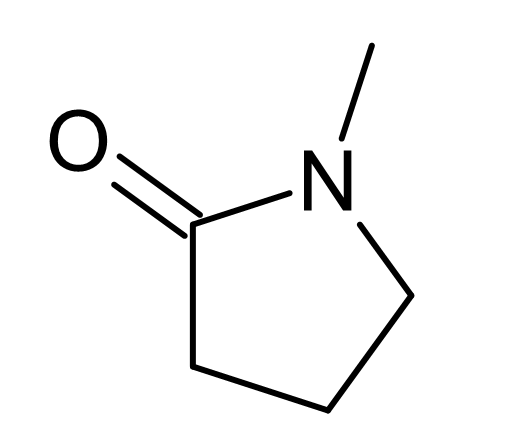
N-Methyl-2-pyrrolidone (NMP) is a polar aprotic organic solvent belonging to the class of cyclic amides known as lactams. Its molecular structure consists of a five-membered ring containing a carbonyl group and a nitrogen atom substituted with a methyl group. This structural arrangement gives NMP a combination of high polarity, strong solvent capacity, relatively low vapor pressure and a high boiling point. These characteristics make it an important solvent in organic synthesis, polymer chemistry, materials science and industrial chemical processing.
NMP is particularly valued for its ability to dissolve a wide range of organic compounds, polymers and resins. Its strong solvating properties arise from the polar carbonyl group and the ability of the molecule to interact with both polar and relatively nonpolar chemical species. As a result, it is extensively used in the preparation and processing of synthetic polymers, including polyvinylidene fluoride (PVDF), polysulfones and other high-performance polymeric materials. NMP also plays a significant role in the fabrication of lithium-ion battery electrodes, where it is used to dissolve polymer binders and produce homogeneous electrode slurries.
In scientific research, NMP is frequently investigated as a model polar aprotic solvent. Experimental and theoretical studies have examined its molecular interactions, hydrogen-bond accepting ability, dielectric properties and behavior in binary solvent mixtures. Its physicochemical characteristics make it especially relevant to investigations of solvation, polymer dissolution, membrane formation, electrochemical materials and solvent-dependent reaction processes.
Chemical and physical properties
N-Methyl-2-pyrrolidone is a colorless, hygroscopic liquid under ambient conditions. Published physicochemical data report a melting point of approximately −24 °C and a normal boiling point of approximately 202–204 °C.
The density of NMP is approximately 1.03 g/cm3 at 25 °C. Its dynamic viscosity is approximately 1.65 mPa·s at 25 °C, while its vapor pressure is approximately 0.3–0.4 mmHg near room temperature. These properties contribute to its usefulness in processes requiring controlled solvent evaporation and elevated processing temperatures.
NMP is completely miscible with water and many common organic solvents, including ethanol, acetone, diethyl ether and chloroform. Its ability to interact with substances of different polarities allows it to dissolve numerous organic compounds and polymeric materials.
The dielectric constant of NMP is approximately 32 at 25 °C, reflecting its strongly polar character. The carbonyl oxygen acts as a hydrogen-bond acceptor and participates in intermolecular interactions with water, alcohols and other hydrogen-bond donating compounds. These interactions strongly influence the thermodynamic and transport properties of NMP-containing mixtures.
NMP is a relatively high-boiling solvent with good thermal stability under many conventional processing conditions. Its combination of polarity, solvent strength and low volatility makes it suitable for polymer dissolution, coating formulations and specialized chemical processes. However, its high boiling point can increase the energy required for solvent removal and recovery.
Applications
N-Methyl-2-pyrrolidone is extensively used as a solvent in polymer chemistry and materials processing. It dissolves various synthetic polymers, including polyvinylidene fluoride (PVDF), polysulfone (PSf) and polyethersulfone (PES). This property makes it particularly valuable in the preparation of polymer solutions, thin films, coatings and advanced polymeric materials.
One of its most important technological applications is the manufacturing of lithium-ion battery electrodes. NMP is commonly used as a processing solvent for PVDF-based binders in cathode formulations. It enables the preparation of homogeneous mixtures containing active electrode materials, conductive additives and polymer binders. During electrode fabrication, the solvent is removed through controlled drying, leaving a consolidated electrode coating on the current collector.
NMP is also widely employed in the production of polymeric membranes. In non-solvent-induced phase separation (NIPS) processes, it serves as a solvent for polymers such as polysulfone, polyethersulfone and PVDF. The exchange of NMP with a nonsolvent, commonly water, induces phase separation and formation of porous membrane structures. The resulting membrane morphology depends on polymer concentration, solvent composition, diffusion rates and processing conditions. Such membranes are investigated for water purification, gas separation and other industrial separation technologies.
In organic synthesis, NMP is used as a polar aprotic reaction medium for selected nucleophilic substitution reactions, catalytic transformations and reactions involving poorly soluble organic substrates. Its high boiling point and strong solvating ability allow chemical transformations to be carried out under conditions where more volatile solvents may be unsuitable.
In industrial materials processing, NMP is used in selected coating formulations, resin processing and polymer removal applications. Its ability to dissolve or soften various polymeric materials has made it relevant to specialized cleaning, surface treatment and chemical processing operations.
In scientific research, NMP is used to investigate solvent–polymer interactions, phase equilibria, transport properties, molecular association and electrochemical material processing. It is also studied in the development of alternative solvent systems and more sustainable manufacturing methods, particularly in membrane fabrication and battery electrode production.
Safety information: N-Methyl-2-pyrrolidone is associated with reproductive and developmental toxicity and is classified as a reproductive toxicant in the European Union. It can be absorbed through the skin and may cause eye, skin and respiratory irritation. Appropriate protective equipment, ventilation and exposure controls are essential during handling. Its flash point is approximately 91 °C, and heating can generate combustible vapors.
Scientific references
- National Institute of Standards and Technology (NIST). NIST Chemistry WebBook, SRD 69: 2-Pyrrolidinone, 1-methyl-, CAS 872-50-4. Molecular structure, thermodynamic properties, phase-change data and spectroscopic characteristics.
https://webbook.nist.gov/cgi/cbook.cgi?ID=C872504 - National Center for Biotechnology Information (NCBI). PubChem Compound Summary: N-Methyl-2-pyrrolidone, CID 13387. Chemical identity, molecular formula, canonical SMILES, physicochemical properties and toxicological information.
https://pubchem.ncbi.nlm.nih.gov/compound/13387 - Polymers and Solvents Used in Membrane Fabrication: A Review Focusing on Sustainable Membrane Development. Membranes, 11(5), 309 (2021). Scientific review of polymer dissolution, solvent selection, phase inversion and membrane fabrication processes involving NMP.
https://doi.org/10.3390/membranes11050309 - A Review on Porous Polymeric Membrane Preparation. Part I: Production Techniques with Polysulfone and Poly (Vinylidene Fluoride). Polymers, 11(7), 1160 (2019). Investigation of membrane fabrication methods, solvent systems and the use of NMP in phase-separation processes.
https://doi.org/10.3390/polym11071160 - Investigating the Influence of Different Aprotic Processing Solvents for the PVdF Binder on the Microstructure and Electrochemical Performance of High-Load Positive Electrodes for Lithium Ion Batteries. ACS Applied Energy Materials (2025). Experimental investigation of NMP and alternative processing solvents in lithium-ion battery electrode manufacturing.
https://doi.org/10.1021/acsaem.4c02298 - Residual NMP and Its Impacts on Performance of Lithium-Ion Cells. Journal of The Electrochemical Society (2024). Investigation of residual NMP in battery electrodes and its influence on electrochemical cell performance.
https://doi.org/10.1149/1945-7111/ad4396 - Workplace Environmental Exposure Level Guide: n-Methyl-2-pyrrolidone. Toxicology and Industrial Health, 38(6), 309–329 (2022). Toxicological assessment of NMP, including developmental toxicity, dermal absorption and occupational exposure considerations.
https://doi.org/10.1177/07482337221093838 - An Evaluation of Reproductive Toxicity Studies and Data Interpretation of N-Methylpyrrolidone for Risk Assessment: An Expert Panel Review. Scientific review (2023). Evaluation of reproductive and developmental toxicity data and their interpretation for human health risk assessment.
https://pubmed.ncbi.nlm.nih.gov/36649819/
Safety Information

Signal Word: ⚠️ Danger
H315 (> 99.9%): Causes skin irritation [Warning Skin corrosion/irritation]
H319 (> 99.9%): Causes serious eye irritation [Warning Serious eye damage/eye irritation]
H335 (94.8%): May cause respiratory irritation [Warning Specific target organ toxicity, single exposure; Respiratory tract irritation]
H360 (94.2%): May damage fertility or the unborn child [Danger Reproductive toxicity]
P203, P261, P264, P264+P265, P271, P280, P302+P352, P304+P340, P305+P351+P338, P318, P319, P321, P332+P317, P337+P317, P362+P364, P403+P233, P405, and P501
Handling and Storage
-
Handling: Use only in well-ventilated areas. Avoid contact with skin and eyes
-
Storage: Keep in tightly closed containers in a cool, dry, well-ventilated place. Protect from heat and direct sunlight
Environmental Considerations
NMP is readily biodegradable but may pose a hazard to aquatic organisms in large concentrations. Avoid environmental release.