
 CATEGORIES
- ORGANIC COMPOUNDS(1135)
- Thiols(1)
- Metal-organic compounds(1)
- Sulfonic acids(6)
- Alcohols(74)
- Aldehydes(47)
- Alkyl nitrites(6)
- Amines(56)
- Aminoacids(59)
- Amides(33)
- Anhydrides(11)
- Acyl Halides(5)
- Carboxylic Acids(170)
- Dyes and Indicators(99)
- Esters(52)
- Ethers(17)
- Organic Halogens (Organohalides)(30)
- Flavonoids(5)
- Heterocycles(25)
- Hydrocarbons(38)
- Imides(2)
- Ketones(29)
- Mixed solvents(16)
- Nitro Compounds(5)
- Nitriles(9)
- Organic salts(74)
- Phenols(30)
- Polymers ( HMW compounds )(68)
- Sugars (Saccharides)(24)
- Silicoorgano and Phosphoorganocompounds(1)
- Peptides(2)
- Terpenes(16)
- Others(126)
- INORGANIC COMPOUNDS(1055)
- LAB EQUIPMENT(5176)
- *(1)
- Organic Synthesis(421)
- Industry(775)
Language
US version allows shipping to all available destinations


 MANUFACTURER
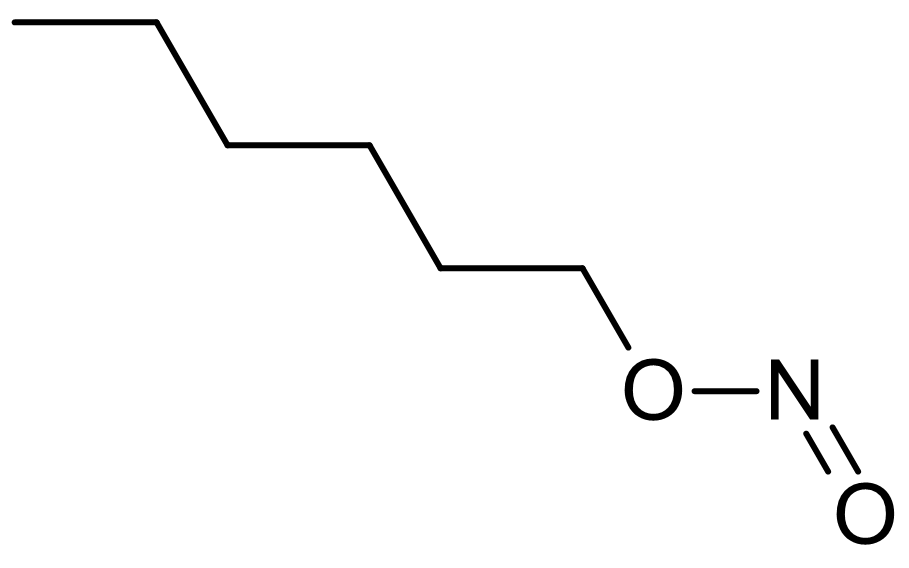
N-Hexyl Nitrite
Regular price:
Regular price:
product unavailable
add to wish list
0


Description
Hexyl Nitrite
Other Names: n-Hexyl nitrite, Nitrous acid hexyl ester, Nitrous acid, hexyl ester
Chemical Formula: C6H13NO2
Molar Mass: 131.17 g/mol
CAS Number: 638-51-7
SMILES: CCCCCCON=O
Appearance: Clear liquid
Hexyl nitrite is an organic nitrite ester derived structurally from 1-hexanol and nitrous acid. It belongs to the group of alkyl nitrites characterized by the functional group R–O–N=O. The presence of the nitrite ester group gives the molecule characteristic chemical reactivity associated with nitroso-group transfer, hydrolysis and photochemical bond cleavage. Hexyl nitrite has therefore been investigated in physical organic chemistry, reaction-mechanism studies, analytical chemistry and atmospheric chemistry. Experimental studies have also used n-hexyl nitrite to examine nucleophilic substitution at trivalent nitrogen and the reactivity of alkyl nitrite esters.
Chemical and physical properties
Hexyl nitrite is a relatively volatile organic liquid with a molecular weight of 131.17 g/mol. Experimental work published in the Journal of the American Chemical Society reported a boiling point of approximately 62 °C at 76 mmHg and a refractive index nD20 of approximately 1.3997.
The molecule contains a six-carbon linear alkyl chain connected through oxygen to a nitroso group. Its calculated topological polar surface area is approximately 38.7 Å2, while its calculated XlogP value is approximately 2.4. These molecular characteristics reflect the combination of a hydrophobic hydrocarbon chain with a comparatively polar nitrite ester group.
Alkyl nitrites undergo hydrolysis under both acidic and alkaline conditions. Mechanistic studies involving n-hexyl nitrite demonstrated that alkaline hydrolysis proceeds considerably more slowly than hydrolysis of structurally corresponding carboxylic esters. Experiments using oxygen-isotope labeling also showed no measurable exchange between the nitroso oxygen of n-hexyl nitrite and hydroxide during alkaline hydrolysis at 45.0 and 55.1 °C. These observations contributed to mechanistic models describing nucleophilic substitution at the nitrogen atom of alkyl nitrites.
The O–N bond of alkyl nitrites is also photochemically active. Irradiation can generate alkoxy radicals and nitric oxide, making alkyl nitrites useful experimental precursors in studies of radical chemistry, oxidation mechanisms and gas-phase reaction networks.
Applications
Hexyl nitrite can be used as a nitrosating reagent in organic chemistry. Alkyl nitrites provide a transferable nitroso functionality and have been investigated in reactions involving nitrogen-containing and carbon-based substrates. Historical synthetic studies specifically employed n-hexyl nitrite in reactions of aliphatic nitro compounds and demonstrated its usefulness as a reactive nitrite ester in organic transformation research.
It is used as a model compound in mechanistic physical-organic chemistry. Studies of n-hexyl nitrite hydrolysis have provided information about nucleophilic substitution at trivalent nitrogen, substituent effects, steric effects and oxygen-transfer mechanisms.
Hexyl nitrite is also useful as an analytical reference compound for the development and evaluation of chromatographic and mass-spectrometric methods for alkyl nitrites. Gas-chromatographic retention data for hexyl nitrite are included in the NIST Chemistry WebBook, while modern studies have examined n-hexyl nitrite using soft plasma ionization mass spectrometry for differentiation of structurally related alkyl nitrites.
In atmospheric and radical-chemistry research, n-hexyl nitrite has been employed as a photolytic precursor for generating defined alkoxy-radical systems. Such experiments allow researchers to investigate oxidation-product distributions, radical reaction pathways and secondary organic aerosol formation under controlled NO/NO2 conditions.
Scientific references
- PubChem. Nitrous acid, hexyl ester (Hexyl nitrite), CID 6365123. National Center for Biotechnology Information. Molecular formula, molecular weight, structural identifiers, SMILES and calculated molecular properties.
- Kornblum, N.; Blackwood, R. K.; Mooberry, D. D. The Reaction of Aliphatic Nitro Compounds with Nitrite Esters. Journal of the American Chemical Society, 1956, 78(7), 1501–1504. DOI: 10.1021/ja01588a060.
- Oae, S.; Asai, N.; Fujimori, K. Alkaline Hydrolyses of Alkyl Nitrites and Related Carboxylic Esters. Journal of the Chemical Society, Perkin Transactions 2, 1978, 571–577. DOI: 10.1039/P29780000571.
- Oae, S.; Asai, N.; Fujimori, K. No Oxygen Exchange in Alkaline Hydrolysis of n-Hexyl Nitrite. Tetrahedron Letters, 1977, 18(24), 2103–2104.
- Nihill, K. J.; Ye, Q.; Majluf, F.; Krechmer, J. E.; Canagaratna, M. R.; Kroll, J. H. Influence of the NO/NO2 Ratio on Oxidation Product Distributions under High-NO Conditions. Environmental Science & Technology, 2021, 55(10), 6594–6601. DOI: 10.1021/acs.est.0c07621.
- Nunome, Y.; Fujii, A.; Shimabukuro, C.; Kodama, K.; Kawabata, K.; Nishi, H. Enhanced Sensitivity and Isomer Differentiation of Alkyl Nitrites Using a Pulsed DC SPI-MS. AppliedChem, 2026, 6(2), 20. DOI: 10.3390/appliedchem6020020.
- NIST Chemistry WebBook, SRD 69. Hexyl nitrite. National Institute of Standards and Technology. Gas-chromatographic and molecular identification data.
Safety

Signal Word: Danger
H225 (100%): Highly Flammable liquid and vapor [Danger Flammable liquids]
H302 (100%): Harmful if swallowed [Warning Acute toxicity, oral]
H312+H332 (75%): Harmful in contact with skin or if inhaled [Warning Acute toxicity, dermal; acute toxicity, inhalation]
H312 (100%): Harmful in contact with skin [Warning Acute toxicity, dermal]
H332 (100%): Harmful if inhaled [Warning Acute toxicity, inhalation]
P210, P233, P240, P241, P242, P243, P261, P264, P270, P271, P280, P301+P317, P302+P352, P303+P361+P353, P304+P340, P317, P321, P330, P362+P364, P370+P378, P403+P235, and P501
Handling and Storage
Storage Conditions: Store in a cool, well-ventilated area in tightly closed containers away from heat, sparks, open flames, and incompatible materials (e.g., acids and oxidizers).
Handling Precautions: Avoid inhalation and prolonged exposure. Use explosion-proof equipment and ground all containers during transfer. Handle under well-ventilated conditions with appropriate PPE.