
 CATEGORIES
- ORGANIC COMPOUNDS(1134)
- Thiols(1)
- Metal-organic compounds(1)
- Sulfonic acids(6)
- Alcohols(74)
- Aldehydes(47)
- Alkyl nitrites(6)
- Amines(56)
- Aminoacids(59)
- Amides(33)
- Anhydrides(11)
- Acyl Halides(5)
- Carboxylic Acids(170)
- Aromatic Acids(11)
- Dyes and Indicators(99)
- Esters(52)
- Ethers(17)
- Organic Halogens (Organohalides)(30)
- Flavonoids(5)
- Heterocycles(25)
- Hydrocarbons(38)
- Imides(2)
- Ketones(29)
- Mixed solvents(16)
- Nitro Compounds(5)
- Nitriles(9)
- Organic salts(74)
- Phenols(30)
- Polymers ( HMW compounds )(68)
- Sugars (Saccharides)(24)
- Silicoorgano and Phosphoorganocompounds(1)
- Peptides(2)
- Terpenes(16)
- Others(125)
- INORGANIC COMPOUNDS(1055)
- LAB EQUIPMENT(5176)
- *(1)
- Organic Synthesis(421)
- Industry(775)
Language
US version allows shipping to all available destinations


 MANUFACTURER
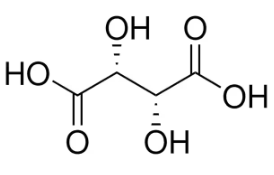
L(+)-Tartaric Acid
Regular price:
Regular price:
product unavailable
add to wish list
0

-Tartaric Acid "Pin It")
Description
L(+)-Tartaric Acid
Other Names: L-Tartaric Acid, (+)-Tartaric Acid, (2R,3R)-Tartaric Acid, (2R,3R)-2,3-Dihydroxybutanedioic Acid, L-2,3-Dihydroxysuccinic Acid
Chemical Formula: C4H6O6
Molar Mass: 150.09 g/mol
CAS Number: 87-69-4
Appearance: Colorless crystals or white crystalline powder
L(+)-Tartaric acid is an optically active dicarboxylic acid containing two hydroxyl groups and two carboxylic acid groups. Its naturally occurring enantiomer has the absolute configuration (2R,3R) and exhibits positive optical rotation. The molecule contains two stereogenic centers, making tartaric acid historically and scientifically important in stereochemistry and the study of molecular chirality. In addition to L(+)-tartaric acid, tartaric acid can exist as its D-enantiomer, a meso form and a racemic mixture. The molecular formula, molar mass, stereochemical configuration and CAS number of the L(+)-enantiomer are documented in the NIST Chemistry WebBook.
Chemical and physical properties
L(+)-Tartaric acid is a crystalline solid with a melting range of approximately 168–170 °C. Its specific optical rotation in aqueous solution is positive, with reference measurements typically giving [α]D20 values of approximately +11.5° to +13.5°, depending on concentration and measurement conditions. This optical activity results directly from the defined spatial arrangement of the two stereogenic carbon atoms.
The compound is a diprotic acid because both carboxyl groups can undergo successive dissociation. At 25 °C, reported dissociation constants correspond to approximately pKa1 = 2.98 and pKa2 = 4.34. Consequently, depending on solution pH, tartaric acid can occur as the neutral H2T species, hydrogen tartrate HT−, or tartrate T2−. The presence of two carboxyl groups and two hydroxyl groups also gives the molecule a strong ability to participate in hydrogen bonding and metal-ion coordination.
L(+)-Tartaric acid is highly soluble in water, and its crystallization from aqueous media has been studied extensively. Terahertz spectroscopy and analytical ultracentrifugation studies indicate that crystallization from water can proceed through intermediate hydrated structures rather than solely by a simple classical nucleation mechanism. Single-crystal studies show that L-tartaric acid crystallizes in a non-centrosymmetric monoclinic structure, a feature relevant to investigations of its optical and solid-state properties.
Applications
L(+)-Tartaric acid is widely used as a chiral resolving agent in organic and pharmaceutical chemistry. Reaction of a racemic basic compound, particularly an amine, with optically pure L(+)-tartaric acid can generate pairs of diastereomeric salts with different solubilities and crystallization behavior. Selective crystallization can therefore be used to isolate one enantiomer from a racemic mixture. Experimental studies have demonstrated this principle for compounds including α-phenylethylamine and other chiral amines.
The compound is also employed as a chiral selector in analytical chemistry. L-Tartaric acid has been investigated as a chiral modifier in chromatographic and electrophoretic methods and as a ligand in chiral NMR systems. For example, complexes generated from L-tartrate and samarium(III) have been used to differentiate enantiomeric NMR signals by creating a chiral magnetic environment around analyte molecules.
In coordination chemistry, the carboxylate and hydroxyl groups of tartaric acid enable formation of complexes with numerous metal ions. This multidentate coordination behavior makes L(+)-tartaric acid and its derivatives useful building blocks for studies of metal–ligand interactions, supramolecular structures and stereoselective recognition. Tartaric-acid-derived structures are also extensively investigated as precursors for chiral ligands and other stereochemically defined reagents used in asymmetric synthesis.
L(+)-Tartaric acid is additionally investigated in crystal engineering and materials science. Single crystals have been studied for their structural, optical and nonlinear optical characteristics. Because the L-enantiomer crystallizes in a non-centrosymmetric space group, its crystals are of interest in research involving nonlinear optical phenomena, crystal growth and structure–property relationships.
The compound is also useful as a laboratory reagent for preparation of tartrate salts, investigation of acid-base equilibria, metal complexation, crystallization and studies of stereochemical recognition. Its combination of defined chirality, two acidic functional groups and two hydroxyl groups provides a versatile molecular platform for physicochemical and synthetic research.
Scientific references
NIST Chemistry WebBook, SRD 69. (R,R)-Tartaric acid. CAS Registry Number 87-69-4.
Soltani, A.; et al. Crystallization Caught in the Act with Terahertz Spectroscopy: Non-Classical Pathway for L-(+)-Tartaric Acid. Chemistry – A European Journal, 2017. DOI: 10.1002/chem.201702218.
Growth and characterization of L-Tartaric acid, an NLO material. Journal of Crystal Growth, 2007.
Chiral resolution of racemic amines in μ-reactor-crystallizer. Chemical Engineering Journal, 2022.
Bhushan, R.; Tanwar, S. Direct enantiomeric TLC resolution of DL-penicillamine using (R)-mandelic acid and L-tartaric acid as chiral impregnating reagents and as chiral mobile phase additive. Biomedical Chromatography, 2008. DOI: 10.1002/bmc.1052.
Simple Resolution of Enantiomeric NMR Signals of α-Amino Acids by Using Samarium(III) Nitrate With L-Tartarate. Chirality, 2015. DOI: 10.1002/chir.22443.
Safety

Signal Word: Danger
Hazard Statements
- H318: Causes serious eye damage.
Precautionary Statements
- P280: Wear protective gloves, protective clothing, eye protection and face protection.
- P305 + P351 + P338: IF IN EYES: Rinse cautiously with water for several minutes. Remove contact lenses, if present and easy to do. Continue rinsing.
- P310: Immediately call a POISON CENTER or doctor.
Storage
Store in a tightly closed container in a cool, dry and well-ventilated area away from incompatible materials. Protect from moisture and contamination.
Intended Use
This product is intended exclusively for laboratory, technical, analytical and industrial applications. It is not intended for food, beverage, consumption, supplementation, medical, pharmaceutical, cosmetic or similar consumer use.