
 CATEGORIES
- ORGANIC COMPOUNDS(1135)
- Thiols(1)
- Metal-organic compounds(1)
- Sulfonic acids(6)
- Alcohols(74)
- Aldehydes(47)
- Alkyl nitrites(6)
- Amines(56)
- Aminoacids(59)
- Amides(33)
- Anhydrides(11)
- Acyl Halides(5)
- Carboxylic Acids(170)
- Dyes and Indicators(99)
- Esters(52)
- Ethers(17)
- Organic Halogens (Organohalides)(30)
- Flavonoids(5)
- Heterocycles(25)
- Hydrocarbons(38)
- Imides(2)
- Ketones(29)
- Mixed solvents(16)
- Nitro Compounds(5)
- Nitriles(9)
- Organic salts(74)
- Phenols(30)
- Polymers ( HMW compounds )(68)
- Sugars (Saccharides)(24)
- Silicoorgano and Phosphoorganocompounds(1)
- Peptides(2)
- Terpenes(16)
- Others(126)
- INORGANIC COMPOUNDS(1055)
- LAB EQUIPMENT(5176)
- *(1)
- Organic Synthesis(421)
- Industry(775)
Language
US version allows shipping to all available destinations


 MANUFACTURER
L-Cystine
Regular price:
Regular price:
product unavailable
add to wish list
0


Description
L-Cystine
Other Names: (-)-Cystine, L-Dicysteine, Cysteine Disulfide, Oxidized L-Cysteine, 3,3'-Dithiobis(2-aminopropanoic acid)
Chemical Formula: C6H12N2O4S2
Molar Mass: 240.30 g/mol
CAS Number: 56-89-3
Appearance: White crystalline solid or crystalline powder
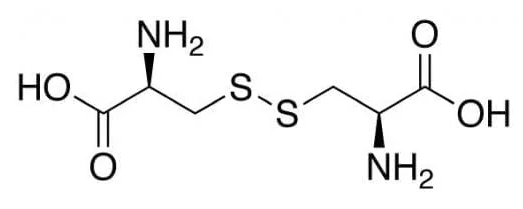
L-Cystine is a sulfur-containing amino acid derivative formed by oxidation of two L-cysteine molecules, whose sulfur atoms are connected by a covalent disulfide bond (S–S). It is therefore commonly described as the oxidized disulfide form of L-cysteine. The reversible relationship between cysteine thiol groups and cystine disulfide bonds is of fundamental importance in redox chemistry and in studies of the formation, stability and rearrangement of disulfide bridges. The molecular formula, molar mass and stereochemical identity of L-cystine are reported in the NIST Chemistry WebBook.
Chemical and physical properties
L-Cystine is a crystalline solid with two amino groups, two carboxylic acid groups and a central disulfide linkage. In the crystalline state, L-cystine occurs predominantly in zwitterionic form. Crystallographic investigations have demonstrated that hexagonal L-cystine forms an extensive hydrogen-bonded lattice in which molecular layers are interconnected through hydrogen bonds and the intramolecular disulfide bridge.
L-Cystine is only sparingly soluble in water near neutral pH. Experimental studies show that its solubility is strongly dependent on protonation state and therefore on solution pH. Solubility increases under sufficiently acidic or alkaline conditions, while ionic strength and the presence of dissolved salts can also significantly affect its behavior in aqueous solutions.
Experimental reference data place its thermal transition at approximately 260 °C, although L-cystine undergoes thermal decomposition rather than simple volatilization. Studies of solid L-cystine have investigated its decomposition between approximately 150 and 230 °C under vacuum, identifying gaseous decomposition products including ammonia, water, hydrogen sulfide and carbon dioxide.
The disulfide bond is the principal redox-active structural feature of L-cystine. Reduction of this bond produces two cysteine units containing free thiol groups. Electrochemical investigations have shown that the disulfide bond can undergo irreversible reduction at electrode surfaces, making L-cystine a useful model system for studying electron-transfer reactions involving organic disulfides.
Applications
L-Cystine is widely used as a laboratory reagent in biochemical, physicochemical and analytical investigations involving sulfur-containing amino acids and disulfide chemistry. Its well-defined cysteine–cystine redox relationship makes it particularly useful for studying oxidation-reduction equilibria, thiol–disulfide transformations and reaction mechanisms involving sulfur-containing compounds.
In electrochemical research, L-cystine is used as a model disulfide for investigations of electrode reduction, adsorption, charge-transfer kinetics and mass transport. Reduction of its S–S bond provides a convenient experimental system for examining the conversion of organic disulfides into corresponding thiol compounds.
L-Cystine is also employed in crystallographic and solid-state research. Its polymorphism, zwitterionic crystal structure, hydrogen-bonding network and response to elevated pressure have been studied using X-ray diffraction and related structural methods. Such investigations provide information about intermolecular interactions, disulfide geometry and the mechanical response of molecular crystals.
Because its aqueous solubility is highly sensitive to pH and ionic composition, L-cystine is additionally used as a model compound in studies of amino-acid solubility, protonation equilibria, crystallization and solution thermodynamics. Experimental measurements across broad pH and electrolyte-concentration ranges have been used to develop equilibrium models describing its behavior in aqueous systems.