
 CATEGORIES
- ORGANIC COMPOUNDS(1063)
- Sulfonic acids(6)
- Thiols(1)
- Metal-organic compounds(1)
- Alcohols(73)
- Aldehydes(41)
- Alkyl nitrites(6)
- Amines(50)
- Aminoacids(58)
- Amides(29)
- Anhydrides(11)
- Acyl Halides(5)
- Carboxylic Acids(161)
- Dyes and Indicators(96)
- Esters(41)
- Ethers(18)
- Organic Halogens (Organohalides)(25)
- Flavonoids(5)
- Heterocycles(21)
- Hydrocarbons(31)
- Imides(2)
- Ketones(26)
- Mixed solvents(17)
- Nitro Compounds(5)
- Nitriles(9)
- Organic salts(74)
- Phenols(30)
- Polymers ( HMW compounds )(61)
- Sugars (Saccharides)(24)
- Silicoorgano and Phosphoorganocompounds(1)
- Peptides(2)
- Terpenes(12)
- Others(123)
- INORGANIC COMPOUNDS(1012)
- LAB EQUIPMENT(5176)
- *(1)
- Organic Synthesis(398)
- Industry(756)
Language
US version allows shipping to all available destinations


 MANUFACTURER
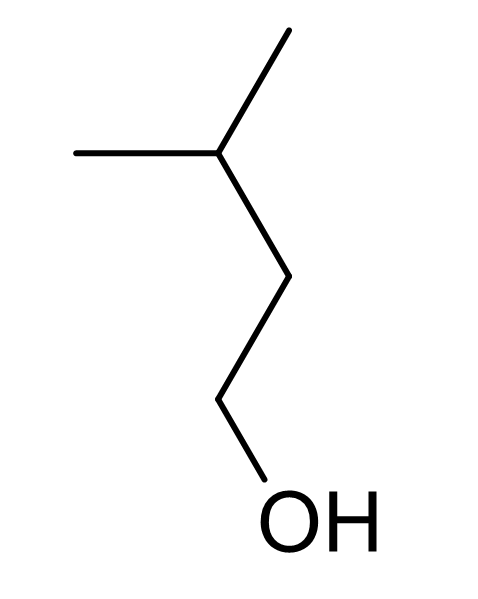
Isoamyl alcohol (3-methyl-1-butanol)
Regular price:
Regular price:
product unavailable
add to wish list
0

 "Pin It")
Description
Isoamyl Alcohol
Other Names: 3-Methyl-1-butanol, 3-Methylbutan-1-ol, Isopentyl Alcohol, Isopentanol, Isobutylcarbinol, Isoamylol, 3-Methylbutanol
Chemical Formula: C5H12O
Molar Mass: 88.15 g/mol
CAS Number: 123-51-3
EC Number: 204-633-5
Appearance: Clear, colorless liquid
Odor: Characteristic strong, pungent, alcoholic odor
SMILES: CC(C)CCO
Isoamyl alcohol, also known as 3-methyl-1-butanol or isopentyl alcohol, is a branched-chain primary aliphatic alcohol belonging to the group of pentanol isomers. Its molecular structure consists of a four-carbon chain with a methyl substituent at the third carbon atom and a terminal hydroxyl group. This arrangement combines the characteristic reactivity of primary alcohols with the physicochemical properties of a branched hydrocarbon chain. Isoamyl alcohol is an important organic compound used in chemical synthesis, industrial solvent systems, extraction processes and analytical laboratory procedures. Its hydroxyl group enables reactions such as esterification, oxidation and substitution, making it a versatile starting material for the preparation of numerous organic derivatives. The compound is particularly important in ester synthesis, where it reacts with carboxylic acids to form isoamyl esters with applications in fragrance chemistry, solvent development and specialty chemical manufacturing. In laboratory research, isoamyl alcohol is extensively used as a component of organic extraction mixtures for the purification of nucleic acids. Its ability to modify phase behavior, reduce foaming and facilitate the separation of aqueous and organic phases makes it valuable in molecular biology and analytical chemistry. Isoamyl alcohol is also investigated in studies of liquid–liquid equilibria, thermodynamic properties, reaction kinetics and catalytic transformations.
Chemical and physical properties
Isoamyl alcohol is a clear, colorless liquid under normal ambient conditions. Published experimental data report a melting point of approximately −117 °C and a normal boiling point of approximately 130–132 °C at atmospheric pressure. Its relatively high boiling point compared with lower molecular weight alcohols results from intermolecular hydrogen bonding involving the hydroxyl group.
The density of isoamyl alcohol is approximately 0.81 g/cm3 near room temperature. Its refractive index (nD20) is approximately 1.406. The compound has a vapor pressure of approximately 2 mmHg (0.27 kPa) at 20 °C and a flash point of approximately 43 °C, indicating that it is a flammable organic liquid requiring appropriate handling and storage precautions.
Isoamyl alcohol is partially soluble in water but is not completely miscible with it. Experimental investigations of the water–3-methyl-1-butanol system have demonstrated the formation of two liquid phases over a range of compositions. Published measurements report an isoamyl alcohol concentration of approximately 2.67 mass% in the water-rich phase at 25 °C. Its limited aqueous solubility is associated with the hydrophobic branched hydrocarbon chain, while its hydroxyl group enables hydrogen-bonding interactions with water molecules.
The compound is miscible with many common organic solvents, including ethanol, diethyl ether and chloroform. Its combination of moderate polarity, hydrogen-bonding capability and relatively low volatility compared with lighter alcohols makes it useful in organic solvent mixtures and extraction systems.
Isoamyl alcohol contains a primary hydroxyl group, which determines much of its chemical reactivity. Oxidation under suitable conditions can produce 3-methylbutanal, while further oxidation can yield 3-methylbutanoic acid. Esterification with carboxylic acids produces the corresponding 3-methylbutyl esters, including isoamyl acetate.
The branched molecular structure influences the compound's boiling point, viscosity, vapor–liquid equilibrium and interactions with other solvents. These properties have been investigated experimentally in thermodynamic studies of alcohol-containing binary and multicomponent mixtures. Such research provides essential information for the design of separation processes, solvent systems and chemical reactors.
Applications
Isoamyl alcohol is widely used as a chemical intermediate in organic synthesis, particularly in the preparation of esters. Its reaction with acetic acid produces isoamyl acetate, an organic ester employed in fragrance formulations and specialty solvent applications. Scientific studies have investigated this esterification using heterogeneous acid catalysts, including Amberlyst-15, Amberlyst-70 and Amberlite IR-120. These investigations examine reaction kinetics, catalytic activity, chemical equilibrium and mass-transfer limitations to optimize ester production and chemical process efficiency.
In industrial chemistry, isoamyl alcohol serves as a starting material for the synthesis of additional organic derivatives through oxidation, esterification and other functional-group transformations. Its primary alcohol functionality allows the preparation of aldehydes, carboxylic acids and substituted organic compounds. These reactions are relevant to the development of fine chemicals, specialty materials and synthetic intermediates.
Isoamyl alcohol is also employed as a component of organic extraction mixtures in molecular biology and biochemical research. It is commonly used with phenol and chloroform in a 25:24:1 volume ratio for the extraction and purification of nucleic acids. In these mixtures, isoamyl alcohol helps reduce foaming and stabilize the interface between aqueous and organic phases, thereby facilitating phase separation during centrifugation. This technique is used in laboratory protocols for isolating DNA and RNA from various biological and environmental samples.
Scientific research has demonstrated the usefulness of phenol–chloroform–isoamyl alcohol extraction in studies involving microbial communities, environmental sediments and other complex sample matrices. Isoamyl alcohol is also incorporated into chloroform–isoamyl alcohol mixtures, commonly in a 24:1 ratio, to assist in the removal of residual phenol and other organic contaminants during nucleic acid purification.
In solvent research, isoamyl alcohol is investigated because of its intermediate polarity, hydrogen-bonding characteristics and limited miscibility with water. Its physicochemical behavior makes it a useful model compound for studies of liquid–liquid extraction, phase equilibria and separation processes. Experimental measurements of the mutual solubility of isoamyl alcohol and water provide information relevant to the design of extraction equipment and multicomponent solvent systems.
Isoamyl alcohol is also studied in chemical engineering as a reactant in catalytic esterification processes. Research using Amberlyst-70 has examined the influence of temperature, reactant molar ratio and catalyst loading on the formation of isoamyl acetate. Mathematical models developed from these experiments have been applied to understand reaction kinetics, intraparticle diffusion and the design of reactors and reactive distillation systems.
In analytical chemistry, isoamyl alcohol is used as a laboratory reagent and solvent component for sample preparation, extraction and chemical analysis. Its characteristic molecular structure can be examined using infrared spectroscopy, nuclear magnetic resonance spectroscopy, gas chromatography and mass spectrometry. These techniques are used to confirm compound identity, evaluate purity and investigate reaction products.
Isoamyl alcohol is additionally important in physicochemical research as a representative branched primary alcohol. It is used in comparative studies of molecular association, hydrogen bonding, thermodynamic properties and structure–property relationships among aliphatic alcohols. Its relatively simple molecular structure and well-characterized behavior make it suitable for investigating the influence of carbon-chain branching on intermolecular interactions and solvent properties.
Scientific references
1. National Institute of Standards and Technology (NIST). Chemistry WebBook, SRD 69: 1-Butanol, 3-methyl-. Chemical identification, molecular formula, molecular mass, boiling point, thermodynamic properties and spectroscopic reference data.
https://webbook.nist.gov/cgi/cbook.cgi?ID=C123513
2. National Center for Biotechnology Information (NCBI). PubChem Compound Summary: Isoamyl Alcohol, CID 31260. Molecular structure, physicochemical properties, chemical identifiers, molecular descriptors and canonical SMILES representation.
https://pubchem.ncbi.nlm.nih.gov/compound/31260
3. Ginnings, P. M.; Baum, R. (1937). Aqueous Solubilities of the Isomeric Pentanols. Journal of the American Chemical Society, 59(6), 1111–1113. Experimental investigation of the aqueous solubility and phase behavior of pentanol isomers, including 3-methyl-1-butanol.
https://doi.org/10.1021/ja01285a043
4. Sánchez-Correa, C. A.; Gil-Chaves, I. D.; Rodríguez-Niño, G. (2023). Kinetics of acetic acid and isoamyl alcohol liquid esterification over Amberlyst-70. Chemical Engineering Research and Design, 196, 642–655. Research on catalytic esterification kinetics, intraparticle mass transfer and reactor design for isoamyl acetate synthesis.
https://doi.org/10.1016/j.cherd.2023.07.004
5. Lever, M. A.; Torti, A.; Eickenbusch, P.; Michaud, A. B.; Šantl-Temkiv, T.; Jørgensen, B. B. (2015). A modular method for the extraction of DNA and RNA, and the separation of DNA pools from diverse environmental sample types. Frontiers in Microbiology, 6, Article 476. Experimental study describing the application of phenol–chloroform–isoamyl alcohol mixtures in nucleic acid extraction and purification.
https://doi.org/10.3389/fmicb.2015.00476
6. Osorio-Viana, W.; Duque-Bernal, M.; Fontalvo, J.; Dobrosz-Gómez, I.; Gómez-García, M. Á. (2013). Kinetic study on the catalytic esterification of acetic acid with isoamyl alcohol over Amberlite IR-120. Chemical Engineering Science, 101, 755–763. Investigation of heterogeneous catalytic esterification, adsorption behavior and kinetic modeling.
https://doi.org/10.1016/j.ces.2013.07.009
7. International Union of Pure and Applied Chemistry (IUPAC) / National Institute of Standards and Technology (NIST). Solubility Data Series: 3-Methyl-1-butanol and Water. Compilation of experimental mutual-solubility measurements, including temperature-dependent phase compositions in the water–isoamyl alcohol system.
https://srdata.nist.gov/solubility/IUPAC/SDS-15/SDS-15.pdf

Safety
Signal Word: Danger
Hazard Statements:
H226: Flammable liquid and vapour
H315: Causes skin irritation
H318: Causes serious eye damage
H332: Harmful if inhaled
H335: May cause respiratory irritation
Precautionary Statements:
P210: Keep away from heat. No smoking
P233: Keep container tightly closed
P260: Do not breathe mist/vapours
First Aid Measures
Eye Contact: Rinse cautiously with water for several minutes. Remove contact lenses if easy to do. Seek immediate medical attention.
Skin Contact: Wash with soap and plenty of water. Remove contaminated clothing.
Inhalation: Remove person to fresh air. Seek medical attention if symptoms such as coughing or dizziness occur.
Ingestion: Rinse mouth. Do not induce vomiting. Seek medical advice if unwell.
Handling and Storage
Storage Conditions: Store in a well-ventilated place away from heat sources, sparks, and open flames. Keep container tightly closed.
Handling Precautions: Use protective equipment. Ensure good ventilation. Avoid inhalation of vapors and contact with skin and eyes.