
 CATEGORIES
- ORGANIC COMPOUNDS(1134)
- Thiols(1)
- Metal-organic compounds(1)
- Sulfonic acids(6)
- Alcohols(74)
- Aldehydes(47)
- Alkyl nitrites(6)
- Amines(56)
- Aminoacids(59)
- Amides(33)
- Anhydrides(11)
- Acyl Halides(5)
- Carboxylic Acids(170)
- Dyes and Indicators(99)
- Esters(52)
- Ethers(17)
- Organic Halogens (Organohalides)(30)
- Flavonoids(5)
- Heterocycles(25)
- Hydrocarbons(38)
- Imides(2)
- Ketones(29)
- Mixed solvents(16)
- Nitro Compounds(5)
- Nitriles(9)
- Organic salts(74)
- Phenols(30)
- Polymers ( HMW compounds )(68)
- Sugars (Saccharides)(24)
- Silicoorgano and Phosphoorganocompounds(1)
- Peptides(2)
- Terpenes(16)
- Others(125)
- INORGANIC COMPOUNDS(1055)
- LAB EQUIPMENT(5176)
- *(1)
- Organic Synthesis(421)
- Industry(775)
Language
US version allows shipping to all available destinations


 MANUFACTURER
Imidazole
Regular price:
Regular price:
product unavailable
add to wish list
0

Description
Imidazole
Other Names: 1H-Imidazole, 1,3-Diazole, Glyoxaline, Glyoxalin, Iminazole
Chemical Formula: C3H4N2
Molar Mass: 68.08 g/mol
CAS Number: 288-32-4
SMILES: C1=CN=CN1
Appearance: White to pale yellow crystalline solid
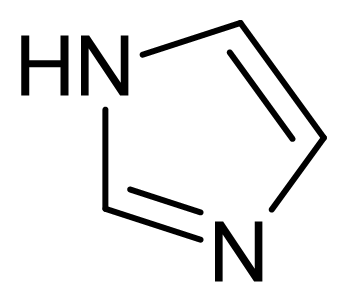
Imidazole is a five-membered aromatic heterocyclic compound containing two nitrogen atoms at the 1- and 3-positions of the ring. The two nitrogen atoms have different electronic characteristics: one is pyridine-like and provides a lone pair capable of protonation and coordination to metal ions, whereas the second is pyrrole-like and contributes its electron pair to the aromatic system. This combination gives imidazole distinctive acid-base, hydrogen-bonding and coordination properties. The molecular formula, molar mass and identity of imidazole are documented in the NIST Chemistry WebBook, while structural databases report its SMILES representation and tautomeric structure.
Chemical and physical properties
Imidazole is a crystalline solid under ambient conditions. Experimental thermodynamic data compiled by NIST report melting transitions at approximately 361.9–363.7 K, corresponding to about 88.8–90.6 °C. A normal boiling point of approximately 530.2 K, or 257 °C, has also been reported.
The compound is highly polar and readily participates in hydrogen bonding. Because imidazole contains both a proton-accepting nitrogen atom and an N–H group capable of proton donation, molecules can form extended hydrogen-bonded networks in the solid state and in solution. Proton transfer between the two nitrogen positions also permits tautomerism within the imidazole ring.
Imidazole is a weak organic base whose conjugate acid has a pKa of approximately 6.95 in aqueous systems. This value lies close to neutral pH and makes the imidazole/imidzolium system particularly useful for controlling proton-transfer equilibria in approximately neutral solutions. Scientific studies and analytical methods consequently employ imidazole-containing systems in the pH region around 6–8.
The nitrogen atoms of imidazole can coordinate transition-metal ions, including Ni2+, Co2+, Cu2+ and Zn2+. This coordination chemistry is closely related to the behavior of the imidazole side chain of histidine and has made the ring an important ligand motif in coordination chemistry, supramolecular chemistry and metal-organic materials. Imidazole-containing ligands can generate discrete complexes as well as extended metal-organic structures.
Applications
Imidazole is widely used as a laboratory reagent and buffering component in biochemical research. Because the pKa of its conjugate acid is close to physiological pH, imidazole can participate efficiently in proton-transfer processes within moderately acidic to slightly alkaline aqueous solutions. Its structural similarity to the imidazole side chain of histidine also makes it useful in studies of enzyme mechanisms, proton transport and metal coordination.
One of the most important biochemical applications of imidazole is immobilized metal affinity chromatography (IMAC) for purification of polyhistidine-tagged recombinant proteins. Histidine residues bind immobilized transition-metal ions through their imidazole rings. Addition of free imidazole competes for these coordination sites and can therefore be used to control nonspecific binding during washing and to elute His-tagged proteins from nickel- or cobalt-containing affinity matrices.
In polymer chemistry, imidazole and substituted imidazoles are extensively investigated as catalysts and accelerators for curing epoxy resins. Their nucleophilic nitrogen atoms can initiate reactions involving epoxide groups and accelerate formation of crosslinked polymer networks. Research on imidazole-based curing systems includes conventional low-molecular-weight compounds as well as polymer-bound latent accelerators designed to improve storage stability while retaining rapid curing at elevated temperature.
Imidazole is also an important synthetic building block. N-substitution, C-substitution and functionalization of the heteroaromatic ring provide access to a large family of imidazole derivatives. The imidazole framework is frequently employed in the synthesis of ligands, catalysts, functional polymers and other nitrogen-containing heterocyclic compounds. It is additionally a common precursor for imidazolium salts, which are extensively studied as components of ionic liquids and as precursors to N-heterocyclic carbene ligands.
In coordination and materials chemistry, imidazole functions as a nitrogen-donor ligand capable of binding a wide variety of metal centers. Imidazole-containing ligands have been used to construct metal-organic cages, coordination polymers and supramolecular assemblies with tunable structural, catalytic and molecular-recognition properties.
Imidazole has also been investigated as a corrosion inhibitor for carbon steel and related metallic materials. Electrochemical studies indicate that adsorption of imidazole onto metal surfaces can modify anodic and cathodic reactions and reduce corrosion under selected aqueous conditions. The efficiency of this effect depends strongly on imidazole concentration, solution composition, pH and the nature of the metal surface.
Handling and safety
Imidazole should be handled using appropriate laboratory protective equipment and with procedures that minimize contact with the skin, eyes and respiratory tract. The material should be kept in a tightly closed container under dry conditions and separated from incompatible reactive substances. Appropriate local safety documentation should always be consulted before laboratory or industrial use.
Scientific references
NIST Chemistry WebBook, SRD 69. 1H-Imidazole. CAS Registry Number 288-32-4.
Bornhorst, J. A.; Falke, J. J. Purification of Proteins Using Polyhistidine Affinity Tags. Methods in Enzymology, 2000, 326, 245–254. The method describes metal-affinity interactions involving histidine imidazole groups and competitive elution with free imidazole.
Farkas, A.; Strohm, P. F. Imidazole catalysis in the curing of epoxy resins. Journal of Applied Polymer Science, 1968, 12, 159–168. DOI: 10.1002/app.1968.070120115.
Schuh, C.; Hartmann, L. Thermally Controlled Acceleration of Epoxy Resin Curing through Polymer-Bound Imidazole Derivatives with High Latency. ACS Applied Polymer Materials, 2022, 4, 1150–1158. DOI: 10.1021/acsapm.1c01568.
Zhu, X.-W.; Luo, D.; Zhou, X.-P.; Li, D. Imidazole-based metal-organic cages: Synthesis, structures, and functions. Coordination Chemistry Reviews, 2022, 455, 214354. DOI: 10.1016/j.ccr.2021.214354.
Safety

Signal Word: Warning
H302: Harmful if swallowed [Warning Acute toxicity, oral]
H314: Causes severe skin burns and eye damage [Danger Skin corrosion/irritation]
H360D: May damage the unborn child [Danger Reproductive toxicity]
P203, P260, P264, P270, P280, P301+P317, P301+P330+P331, P302+P361+P354, P304+P340, P305+P354+P338, P316, P318, P321, P330, P363, P405, and P501
First Aid Measures
Eye Contact: Rinse with water for several minutes. Seek medical attention if irritation occurs
Skin Contact: Wash with soap and water. Remove contaminated clothing
Inhalation: Move to fresh air. Seek medical help if symptoms persist
Ingestion: Rinse mouth. Do not induce vomiting. Seek medical advice
Handling and Storage
Store in a tightly sealed container in a cool, dry, well-ventilated area
Protect from moisture, strong acids, and oxidizing agents
Avoid inhalation of dust and contact with skin and eyes