
 CATEGORIES
- ORGANIC COMPOUNDS(1305)
- Thiols(0)
- Metal-organic compounds(1)
- Sulfonic acids(6)
- Alcohols(82)
- Aldehydes(59)
- Alkyl nitrites(6)
- Amines(82)
- Aminoacids(78)
- Amides(33)
- Anhydrides(11)
- Acyl Halides(5)
- Carboxylic Acids(207)
- Dyes and Indicators(107)
- Esters(56)
- Ethers(17)
- Organic Halogens (Organohalides)(35)
- Flavonoids(5)
- Heterocycles(43)
- Hydrocarbons(42)
- Imides(2)
- Ketones(32)
- Mixed solvents(16)
- Nitro Compounds(13)
- Nitriles(9)
- Organic salts(74)
- Phenols(37)
- Polymers ( HMW compounds )(66)
- Sugars (Saccharides)(24)
- Silicoorgano and Phosphoorganocompounds(1)
- Peptides(2)
- Terpenes(19)
- Others(137)
- INORGANIC COMPOUNDS(1137)
- LAB EQUIPMENT(5179)
- *(1)
- Organic Synthesis(498)
- Industry(804)
Language
US version allows shipping to all available destinations


 MANUFACTURER
Histidine Powder (alkaline)
Regular price:
Regular price:
product unavailable
add to wish list
0

 "Pin It")
Description
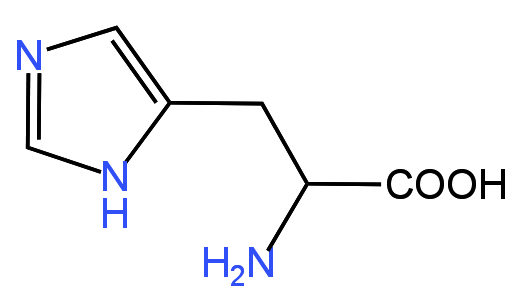
Histidine
Other Names: L-Histidine, H-His-OH, Glyoxaline-5-alanine, (S)-2-Amino-3-(1H-imidazol-4-yl)propanoic acid
CAS Number: 71-00-1
Sum Formula: C₆H₉N₃O₂
Molar Mass: 155.15 g/mol
Appearance: White to off-white crystalline powder
L-Histidine is a naturally occurring α-amino acid characterized by the presence of an imidazole functional group. It is one of the proteinogenic amino acids and plays a significant role in coordination chemistry, buffering systems, and as a ligand in metal-binding studies.
Chemical and Physical Properties
Density: ~1.43 g/cm³ (estimated)
Melting Point: ~287°C (decomposes)
Boiling Point: Not applicable (decomposes)
Solubility in Water: Soluble (~41 g/L at 25°C)
Solubility in Other Solvents: Slightly soluble in ethanol; insoluble in ether
Odor: Odorless
Applications
Buffer Systems: Used in the formulation of biological and biochemical buffers due to its imidazole side chain's pKa.
Coordination Chemistry: Acts as a bidentate ligand in metal complexation studies.
Peptide Synthesis: Building block in the synthesis of histidine-containing peptides and conjugates.
Analytical Chemistry: Studied for its chelating properties and UV-absorption characteristics.
Material Science: Investigated in biomimetic and functionalized polymer systems.
Safety

Signal Word: Warning
H302 (25.3%): Harmful if swallowed [Warning Acute toxicity, oral]
H315 (25.9%): Causes skin irritation [Warning Skin corrosion/irritation]
H319 (25.9%): Causes serious eye irritation [Warning Serious eye damage/eye irritation]
H332 (25.3%): Harmful if inhaled [Warning Acute toxicity, inhalation]
P261, P264, P264+P265, P270, P271, P280, P301+P317, P302+P352, P304+P340, P305+P351+P338, P317, P321, P330, P332+P317, P337+P317, P362+P364, and P501
Handling and Storage
Storage Conditions: Store in a tightly sealed container in a cool, dry, and well-ventilated area. Protect from light and moisture.
Handling Precautions: Avoid dust formation and contact with eyes or mucous membranes. Use appropriate PPE and standard laboratory practices.