
 CATEGORIES
- ORGANIC COMPOUNDS(1240)
- Thiols(1)
- Metal-organic compounds(1)
- Sulfonic acids(6)
- Alcohols(78)
- Aldehydes(52)
- Alkyl nitrites(6)
- Amines(67)
- Aminoacids(78)
- Amides(33)
- Anhydrides(11)
- Acyl Halides(5)
- Carboxylic Acids(192)
- Dyes and Indicators(107)
- Esters(52)
- Ethers(17)
- Organic Halogens (Organohalides)(35)
- Flavonoids(5)
- Heterocycles(37)
- Hydrocarbons(42)
- Imides(2)
- Ketones(29)
- Mixed solvents(16)
- Nitro Compounds(6)
- Nitriles(9)
- Organic salts(74)
- Phenols(35)
- Polymers ( HMW compounds )(66)
- Sugars (Saccharides)(24)
- Silicoorgano and Phosphoorganocompounds(1)
- Peptides(2)
- Terpenes(16)
- Others(137)
- INORGANIC COMPOUNDS(1103)
- LAB EQUIPMENT(5176)
- *(1)
- Organic Synthesis(438)
- Industry(783)
Language
US version allows shipping to all available destinations


 MANUFACTURER
Hexamine (Urotropine)
Regular price:
Regular price:
product unavailable
add to wish list
0
 "Pin It")
Description
Hexamine
Other Names: Hexamethylenetetramine, Methenamine, Urotropine, 1,3,5,7-Tetraazaadamantane, HMTA, HMT
Chemical Formula: C6H12N4
Molar Mass: 140.19 g/mol
CAS Number: 100-97-0
Appearance: White crystalline solid or crystalline powder
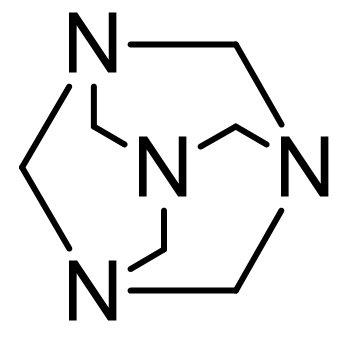
Hexamine, more formally known as hexamethylenetetramine (HMTA), is a polycyclic nitrogen-containing organic compound characterized by a compact cage-like molecular structure. Its framework is structurally related to adamantane, with nitrogen atoms occupying the 1,3,5,7 positions of the cage. The molecule contains four tertiary nitrogen atoms connected through six methylene bridges, giving it distinctive basic, coordination and chemical-reactivity properties. NIST reference data report the molecular formula C6H12N4, a molecular mass of 140.1863 g/mol and CAS Registry Number 100-97-0.
Chemical and physical properties
Hexamine is a crystalline solid with a relatively symmetrical, rigid molecular framework. It is readily soluble in water and is also soluble in several polar organic solvents. The four tertiary nitrogen atoms provide electron-donor sites and allow HMTA to behave as a Lewis base and as a ligand toward numerous metal ions.
Unlike many ordinary molecular solids, hexamine does not exhibit a conventional atmospheric boiling point. Upon strong heating it readily sublimes and may undergo decomposition. Reference chemical literature reports sublimation or thermal transition in approximately the 285–295 °C region, depending on experimental conditions. Thermodynamic measurements have also determined a standard enthalpy of sublimation of approximately 79.6 kJ/mol.
The cage structure of HMTA is stable under neutral and mildly alkaline conditions but becomes increasingly susceptible to cleavage in acidic media. Acid hydrolysis can ultimately generate formaldehyde-containing products, a property that has been exploited analytically for quantitative determination of hexamine. Modern NMR and computational studies have also demonstrated that its thermal decomposition proceeds through several structurally related intermediates rather than through a single elementary step.
Applications
Hexamine is widely used as a curing agent for novolac-type phenolic resins. During thermal curing it participates in formation of methylene-containing crosslinks between phenolic polymer chains, converting initially thermoplastic novolac structures into highly crosslinked thermosetting networks. NMR and X-ray scattering investigations have been used to characterize the evolution of these networks during HMTA-assisted curing.
In synthetic organic chemistry, hexamine is an important reagent in the Sommelet reaction. In this transformation, suitable benzyl halides are converted into corresponding aromatic aldehydes through reaction with HMTA followed by hydrolytic processing of the resulting intermediates. The reaction remains a useful method for introducing aldehyde functionality into aromatic compounds.
HMTA is also used in the Duff reaction for formylation of activated aromatic systems such as phenolic compounds. Interaction of the aromatic substrate with hexamine under acidic conditions generates intermediates that, after hydrolysis, yield aromatic aldehydes. The chemistry has been employed in the preparation of substituted salicylaldehydes and related aromatic carbonyl compounds.
Hexamine has additionally been investigated as a corrosion inhibitor for iron and steel in acidic environments. Electrochemical impedance and polarization studies show that HMTA can adsorb onto steel surfaces and reduce both anodic and cathodic corrosion processes. Its efficiency depends on concentration, acid composition and temperature.
Because of its four nitrogen donor atoms, hexamine is also used as a building block and ligand in coordination and materials chemistry. Its rigid geometry allows formation of metal-organic complexes and extended supramolecular structures, while its thermal reactivity makes it useful as a nitrogen- and carbon-containing precursor in selected materials-synthesis systems.
Handling and stability
Hexamine should be stored in a dry, well-ventilated location and protected from strong acids and excessive heat. Acidic conditions can accelerate decomposition of the cage structure, while strong heating promotes sublimation and formation of decomposition products. Scientific investigations of HMTA decomposition identify formaldehyde-related and nitrogen-containing species among products and intermediates formed under sufficiently reactive conditions.
Dust generation should be minimized during handling. Appropriate laboratory eye protection, protective gloves and ventilation are recommended, particularly when the substance is heated or used under acidic conditions.
Scientific references
NIST Chemistry WebBook, SRD 69. Methenamine. CAS Registry Number 100-97-0.
Dreyfors, J. M.; Jones, S. B.; Sayed, Y. Hexamethylenetetramine: a review. American Industrial Hygiene Association Journal, 1989, 50, 579–585. DOI: 10.1080/15298668991375191.
Simonetti, S. O.; Kaufman, T. S.; Rasia, R. M.; Sarotti, A. M.; Grimblat, N. Thermal decomposition of hexamethylenetetramine: mechanistic study and identification of reaction intermediates via a computational and NMR approach. Organic & Biomolecular Chemistry, 2021, 19, 7374–7378. DOI: 10.1039/D1OB01522B.
Izumi, A.; Shudo, Y.; Shibayama, M. Network structure evolution of a hexamethylenetetramine-cured phenolic resin. Polymer Journal, 2019, 51, 155–160.
Bouklah, M.; Hammouti, B.; Lagrenée, M.; Bentiss, F. The inhibitive effect of hexamethylenetetramine on the acid corrosion of steel. Materials Chemistry and Physics, 2007, 104, 74–82. DOI: 10.1016/j.matchemphys.2007.02.073.
Wang, Z. Sommelet Reaction. Comprehensive Organic Name Reactions and Reagents, Wiley, 2010. DOI: 10.1002/9780470638859.conrr590.
Safety

Signal Word: Warning
H228: Flammable solid [Danger Flammable solids]
H317: May cause an allergic skin reaction [Warning Sensitization, Skin]
P210, P240, P241, P261, P272, P280, P302+P352, P321, P333+P317, P362+P364, P370+P378, and P501
First Aid Measures
Eye Contact: Rinse with plenty of water. Seek medical attention if irritation persists
Skin Contact: Wash with soap and water
Inhalation: Move to fresh air. Seek medical help if respiratory symptoms appear
Ingestion: Rinse mouth. Do not induce vomiting. Contact medical personnel if unwell
Handling and Storage
Store in a tightly sealed container in a cool, dry, well-ventilated area
Avoid contact with strong acids, oxidizing agents, and moisture
Prevent dust formation and inhalation during handling
Use appropriate PPE including gloves and dust protection