
 CATEGORIES
- ORGANIC COMPOUNDS(1134)
- Thiols(1)
- Metal-organic compounds(1)
- Sulfonic acids(6)
- Alcohols(74)
- Aldehydes(47)
- Alkyl nitrites(6)
- Amines(56)
- Aminoacids(59)
- Amides(33)
- Anhydrides(11)
- Acyl Halides(5)
- Carboxylic Acids(170)
- Aromatic Acids(11)
- Dyes and Indicators(99)
- Esters(52)
- Ethers(17)
- Organic Halogens (Organohalides)(30)
- Flavonoids(5)
- Heterocycles(25)
- Hydrocarbons(38)
- Imides(2)
- Ketones(29)
- Mixed solvents(16)
- Nitro Compounds(5)
- Nitriles(9)
- Organic salts(74)
- Phenols(30)
- Polymers ( HMW compounds )(68)
- Sugars (Saccharides)(24)
- Silicoorgano and Phosphoorganocompounds(1)
- Peptides(2)
- Terpenes(16)
- Others(125)
- INORGANIC COMPOUNDS(1055)
- LAB EQUIPMENT(5176)
- *(1)
- Organic Synthesis(421)
- Industry(775)
Language
US version allows shipping to all available destinations


 MANUFACTURER
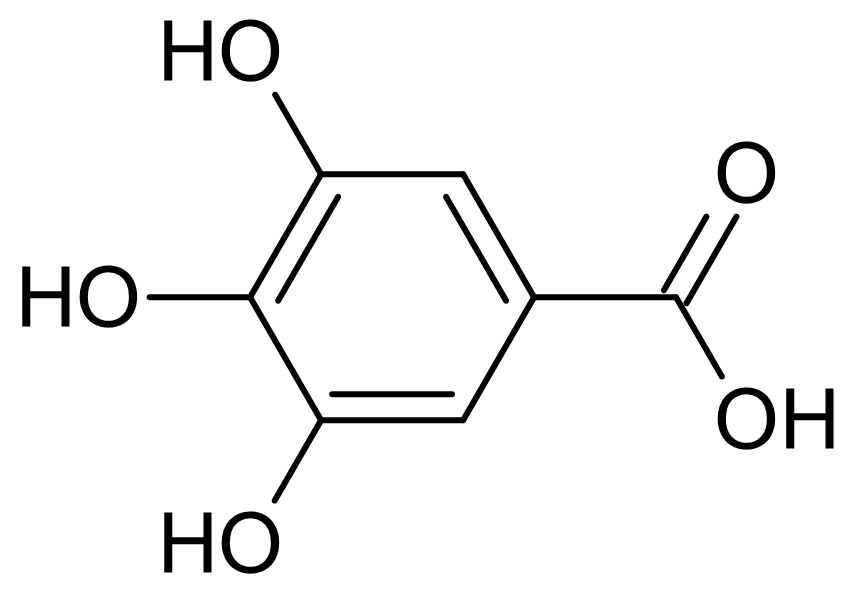
Gallic Acid (3,4,5-Trihydroxybenzoic acid)
Regular price:
Regular price:
product unavailable
add to wish list
0

 "Pin It")
Description
Gallic Acid
Other Names: 3,4,5-Trihydroxybenzoic acid, Gallate acid
Chemical Formula: C7H6O5
Molar Mass: 170.12 g/mol
CAS Number: 149-91-7
SMILES: C1=C(C=C(C(=C1O)O)O)C(=O)O
Appearance: White to pale beige crystalline powder
Odor: Odorless or nearly odorless
Gallic acid is an aromatic hydroxycarboxylic acid containing a benzoic acid framework substituted with three adjacent hydroxyl groups at the 3, 4 and 5 positions. The combination of a carboxylic acid group and a pyrogallol-type hydroxyl arrangement gives the molecule distinctive acid-base, redox, hydrogen-bonding and metal-coordination properties. Gallic acid is therefore widely investigated in organic chemistry, analytical chemistry, coordination chemistry, polymer science and materials research. Its phenolic groups can undergo oxidation and radical-transfer reactions, while the carboxyl group can participate in esterification and other derivatization reactions.
Chemical and physical properties
Gallic acid is a crystalline solid under ambient conditions. The anhydrous compound is commonly reported to decompose upon strong heating rather than undergoing simple distillation, with decomposition occurring at approximately 235–240 °C.
The compound is soluble in water, with its solubility increasing strongly as temperature rises. Experimental measurements between 273.15 and 363.15 K have demonstrated pronounced temperature-dependent aqueous solubility. Gallic acid is also soluble in several polar organic solvents, reflecting the presence of multiple hydroxyl groups and a carboxylic acid function.
Gallic acid is a weak polyprotic acid because both the carboxyl proton and, at sufficiently high pH, the phenolic protons can dissociate. Experimental studies report the first pKa, corresponding primarily to deprotonation of the carboxyl group, at approximately 4.2–4.5. Further deprotonation of the phenolic hydroxyl groups occurs at higher pH.
The three adjacent phenolic hydroxyl groups give gallic acid significant reducing ability. The molecule can donate hydrogen atoms or electrons to reactive radical species and can be oxidized to quinone-related products. Its redox behavior depends strongly on pH, metal ions and the surrounding chemical environment.
Gallic acid also exhibits complex solid-state behavior. Gallic acid monohydrate has several polymorphic forms with different hydrogen-bonding arrangements. X-ray crystallographic studies have demonstrated multiple crystalline hydrate structures, making gallic acid a useful model compound in crystal engineering and studies of polymorphism.
Applications
Gallic acid is used as a reagent and reference compound in analytical chemistry, particularly in studies of phenolic compounds, redox reactions and radical-scavenging mechanisms. Its well-characterized oxidation behavior makes it useful as a model molecule for investigating electron-transfer and proton-coupled electron-transfer processes.
In organic synthesis, gallic acid serves as a starting material for the preparation of gallate esters and other aromatic derivatives. Esterification of its carboxylic acid group with alcohols produces alkyl gallates, while selective modification of its hydroxyl groups enables the synthesis of more complex functional molecules.
Gallic acid is increasingly investigated as a renewable aromatic building block in polymer and materials chemistry. Protected gallic-acid derivatives can be converted into acrylate, methacrylate and acrylamide monomers and subsequently polymerized to produce materials containing pendant gallic-acid groups.
Gallic-acid-derived compounds have also been investigated as modifiers and plasticizer precursors for polymer systems. Research on polyvinyl chloride has demonstrated that appropriately functionalized gallic-acid derivatives can provide plasticizing behavior while also influencing thermal stability, ultraviolet absorption and resistance to migration from the polymer matrix.
The multiple oxygen donor groups of gallic acid allow interactions with metal ions. Such complexation behavior is studied in coordination chemistry, environmental chemistry and spectroscopic investigations. Formation of metal–gallic acid complexes depends on metal identity, oxidation state, solution pH and the degree of deprotonation of the ligand.
Gallic acid is additionally used as a model compound in crystallization and solid-state chemistry. Its hydrate polymorphism and extensive hydrogen-bonding network make it useful for investigating crystal packing, hydrate formation, polymorphic transformations and intermolecular interactions in molecular solids.
Scientific references
- Lu L.-L., Lu X.-Y. “Solubilities of Gallic Acid and Its Esters in Water.” Journal of Chemical & Engineering Data, 2007, 52(1), 37–39. DOI: 10.1021/je0601661.
- Demir S. et al. “Computation of the pKa Values of Gallic Acid and Its Anionic Forms in Aqueous Solution: A Self-Similar Transformation Approach for Accurate Proton Hydration Free Energy Estimation.” Molecules, 2025, 30, 742.
- Clarke H. D. et al. “Polymorphism in Multiple Component Crystals: Forms III and IV of Gallic Acid Monohydrate.” Crystal Growth & Design, 2011, 11(4), 964–966. DOI: 10.1021/cg2001865.
- Tan J. et al. “Synthesis of Gallic Acid-Derived Plasticizers for Polyvinyl Chloride Featuring Excellent Plasticization, Thermo-Stability, and Migration Resistance.” ACS Applied Polymer Materials, 2023, 5(10), 8608–8617. DOI: 10.1021/acsapm.3c01732.
- “Direct Esterification of Gallic Acid with Higher Alcohols.” Journal of the American Chemical Society, 1947, 69(8), 2003–2005. DOI: 10.1021/ja01200a050.
- “Polymers with one free gallic acid per monomer unit. Controlled synthesis and intrinsic properties.” European Polymer Journal, 2024, 211, 113022. DOI: 10.1016/j.eurpolymj.2024.113022.
SAFETY - GHS Classification:

Warning Pictograms GHS07
Hazard statements H315 Causes skin irritation H319 Causes serious eye irritation H335 May cause respiratory irritation Precautionary statements Precautionary statements - prevention P261 Avoid breathing dust/fume/gas/mist/vapours/spray P280 Wear protective gloves Precautionary statements - response P302+P352 IF ON SKIN: Wash with plenty of soap and water P305+P351+P338 IF IN EYES: Rinse cautiously with water for several minutes. Remove contact lenses, if present and easy to do. Continue rinsing P312 Call a POISON CENTRE/doctor if you feel unwell Precautionary statements - storage P403+P233 Store in a well-ventilated place. Keep container tightly closed Precautionary statements - disposal P501 Dispose of contents/container to industrial combustion plant
Pictograms:
- GHS07 (Exclamation Mark): Number 03 – Indicates irritation or toxicity.
Notes:
Although gallic acid is generally considered safe, prolonged exposure to dust or contact with eyes and skin should be avoided. It is important to wear appropriate personal protective equipment (PPE) when handling this compound. In case of accidental exposure, rinse the affected area with water and seek medical attention if necessary. Always refer to the Safety Data Sheet (SDS) for detailed safety information regarding gallic acid.