
 CATEGORIES
- ORGANIC COMPOUNDS(1240)
- Thiols(1)
- Metal-organic compounds(1)
- Sulfonic acids(6)
- Alcohols(78)
- Aldehydes(52)
- Alkyl nitrites(6)
- Amines(67)
- Aminoacids(78)
- Amides(33)
- Anhydrides(11)
- Acyl Halides(5)
- Carboxylic Acids(192)
- Dyes and Indicators(107)
- Esters(52)
- Ethers(17)
- Organic Halogens (Organohalides)(35)
- Flavonoids(5)
- Heterocycles(37)
- Hydrocarbons(42)
- Imides(2)
- Ketones(29)
- Mixed solvents(16)
- Nitro Compounds(6)
- Nitriles(9)
- Organic salts(74)
- Phenols(35)
- Polymers ( HMW compounds )(66)
- Sugars (Saccharides)(24)
- Silicoorgano and Phosphoorganocompounds(1)
- Peptides(2)
- Terpenes(16)
- Others(137)
- INORGANIC COMPOUNDS(1103)
- LAB EQUIPMENT(5176)
- *(1)
- Organic Synthesis(438)
- Industry(783)
Language
US version allows shipping to all available destinations


 MANUFACTURER
Eugenol (P-Allilguaiacol) Pure >99%
Regular price:
Regular price:
product unavailable
add to wish list
0

 Pure >99% "Pin It")
Description
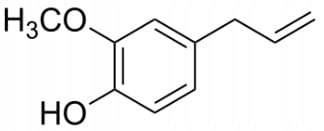
Eugenol
Other Names: 4-Allyl-2-methoxyphenol, 2-Methoxy-4-(2-propenyl)phenol, 4-Allylguaiacol, Allylguaiacol
Chemical Formula: C10H12O2
Molar Mass: 164.20 g/mol
CAS Number: 97-53-0
SMILES: Oc1ccc(cc1OC)CC=C
Appearance: Colorless to pale yellow oily liquid
Odor: Characteristic aromatic, clove-like odor
Eugenol is an aromatic phenolic compound containing a phenolic hydroxyl group, a methoxy group and an allyl substituent attached to a benzene ring. It is structurally classified as an allyl-substituted guaiacol and is an important model compound in phenol chemistry, natural-product chemistry and the development of bio-based functional materials. NIST reports the molecular formula C10H12O2, molecular mass 164.2011 g/mol and CAS Registry Number 97-53-0.
Chemical and physical properties
Eugenol is a liquid at ordinary room temperature. Experimental phase-change data compiled by NIST report a normal boiling point of approximately 526.4–526.7 K, corresponding to about 253–254 °C. Its melting point is approximately −7.5 °C, and its density is about 1.06 g/cm3 near room temperature.
Eugenol is only sparingly soluble in water, with reported aqueous solubility of approximately 2.46 g/L at 25 °C, but it dissolves readily in many organic solvents. The phenolic hydroxyl group can participate in hydrogen bonding and acid-base reactions, whereas the methoxy oxygen acts primarily as a hydrogen-bond acceptor. The allyl group provides an additional reactive site for oxidation, addition and polymer-forming reactions.
The phenolic group is responsible for much of the compound's radical-scavenging behavior. Donation of a hydrogen atom from the phenolic O–H group can generate a resonance-stabilized phenoxy radical, which underlies the antioxidant behavior extensively investigated for eugenol and eugenol-derived materials.
Applications
Eugenol is extensively used as a chemical building block in polymer and materials chemistry. Its phenolic hydroxyl and allyl groups can be selectively modified through etherification, esterification, epoxidation, hydrosilylation and thiol–ene reactions. These transformations allow the preparation of epoxy monomers, curing agents, reactive diluents, coupling agents and flame-retardant structures derived from eugenol.
Eugenol-based epoxy and thermosetting materials have been investigated as bio-derived alternatives to conventional petrochemical resin components. Scientific studies describe eugenol-derived monomers and additives for epoxy resins, bismaleimide systems, phthalonitrile resins and other crosslinked materials. Depending on molecular design, these derivatives can contribute to adhesion, thermal stability, corrosion resistance, flame retardancy and mechanical performance.
In dentistry, eugenol is used together with zinc oxide to form zinc oxide–eugenol materials. These systems have historically been employed in temporary restorative materials, luting cements and endodontic formulations. Biological studies show that low concentrations of released eugenol can produce local analgesic and anti-inflammatory effects, while substantially higher concentrations can be cytotoxic to dental tissues.
Eugenol is also investigated as an antimicrobial component of polymeric and biomedical materials. Incorporation into polymers, hydrogels, nanofibers, nanoparticles and surface coatings can reduce volatility and provide more controlled release than free molecular eugenol. Such systems are studied for antimicrobial surfaces, wound-related materials and other biomedical applications.
In synthetic organic chemistry, eugenol serves as a useful starting compound because its aromatic ring, phenolic group, methoxy substituent and terminal carbon-carbon double bond offer several independent reaction sites. It is therefore frequently employed in studies of selective functionalization and in the synthesis of more complex aromatic and polymerizable derivatives.
Handling and safety
Eugenol should be handled with appropriate laboratory protective measures. Although it is widely investigated in biomedical applications, concentrated eugenol can irritate skin and mucous membranes and may cause allergic contact sensitization. Scientific reviews also report concentration-dependent cytotoxic effects, particularly with prolonged or direct exposure to high local concentrations.
The compound is susceptible to oxidation during storage and should therefore be kept in tightly closed containers protected from excessive heat, light and oxidizing conditions. Suitable gloves, eye protection and adequate ventilation are recommended during laboratory and industrial handling.
Scientific references
NIST Chemistry WebBook, SRD 69. Eugenol. CAS Registry Number 97-53-0.
Kowalewska, A.; Majewska-Smolarek, K. Eugenol-Based Polymeric Materials—Antibacterial Activity and Applications. Antibiotics, 2023, 12, 1570. DOI: 10.3390/antibiotics12111570.
Matykiewicz, D.; Skórczewska, K. Characteristics and Application of Eugenol in the Production of Epoxy and Thermosetting Resin Composites: A Review. Materials, 2022, 15, 4824. DOI: 10.3390/ma15144824.
Hume, W. R. Biologic properties of eugenol and zinc oxide-eugenol: A clinically oriented review. Oral Surgery, Oral Medicine, Oral Pathology, 1992, 73, 729–737. DOI: 10.1016/0030-4220(92)90020-Q.
Di Consiglio, M.; Sturabotti, E.; Brugnoli, B.; Piozzi, A.; Migneco, L. M.; Francolini, I. Synthesis of sustainable eugenol/hydroxyethylmethacrylate-based polymers with antioxidant and antimicrobial properties. Polymer Chemistry, 2023.
Safety

Signal Word: Warning
Hazard Statements:
H317: May cause an allergic skin reaction.
H319: Causes serious eye irritation.
Precautionary Statements:
P101: If medical advice is needed, have product container or label at hand.
P102: Keep out of reach of children.
P280: Wear protective gloves.
P333+P313: If skin irritation or rash occurs: Get medical advice/attention.
P362+P364: Take off contaminated clothing and wash it before reuse.
P501: Dispose of contents/container to an authorized waste disposal facility or return to supplier.
First Aid Measures
Eye Contact: Rinse cautiously with water for several minutes. Remove contact lenses if easy to do. Continue rinsing.
Skin Contact: Wash with soap and water. If rash appears, seek medical help.
Inhalation: Remove to fresh air. Get medical attention if symptoms develop.
Ingestion: Rinse mouth. Do not induce vomiting. Seek medical attention if unwell.
Handling and Storage
Storage Conditions: Keep in tightly closed containers, in a dry, cool, and well-ventilated area.
Handling Precautions: Avoid contact with skin and eyes. Prevent prolonged exposure. Use with proper personal protective equipment.