
 CATEGORIES
- ORGANIC COMPOUNDS(1076)
- Metal-organic compounds(1)
- Sulfonic acids(6)
- Thiols(1)
- Alcohols(73)
- Aldehydes(41)
- Alkyl nitrites(6)
- Amines(51)
- Aminoacids(58)
- Amides(29)
- Anhydrides(11)
- Acyl Halides(5)
- Carboxylic Acids(161)
- Dyes and Indicators(96)
- Esters(46)
- Ethers(18)
- Organic Halogens (Organohalides)(29)
- Flavonoids(5)
- Heterocycles(24)
- Hydrocarbons(31)
- Imides(2)
- Ketones(26)
- Mixed solvents(17)
- Nitro Compounds(5)
- Nitriles(9)
- Organic salts(74)
- Phenols(30)
- Polymers ( HMW compounds )(61)
- Sugars (Saccharides)(24)
- Silicoorgano and Phosphoorganocompounds(1)
- Peptides(2)
- Terpenes(12)
- Others(123)
- INORGANIC COMPOUNDS(1012)
- LAB EQUIPMENT(5176)
- *(1)
- Organic Synthesis(410)
- Industry(756)
Language
US version allows shipping to all available destinations


 MANUFACTURER
Ethylvanillin (Bourbonal)
Regular price:
Regular price:
product unavailable
add to wish list
0

 "Pin It")
Description
Ethylvanillin
Other Names: Ethyl Vanillin, 3-Ethoxy-4-hydroxybenzaldehyde, 4-Hydroxy-3-ethoxybenzaldehyde, Bourbonal, Ethavan, Ethovan, Ethylprotal, Vanillal
Chemical Formula: C9H10O3
Molar Mass: 166.17 g/mol
CAS Number: 121-32-4
Appearance: White to slightly yellow crystalline powder or colorless crystals
Odor: Intense, sweet, warm, vanilla-like odor
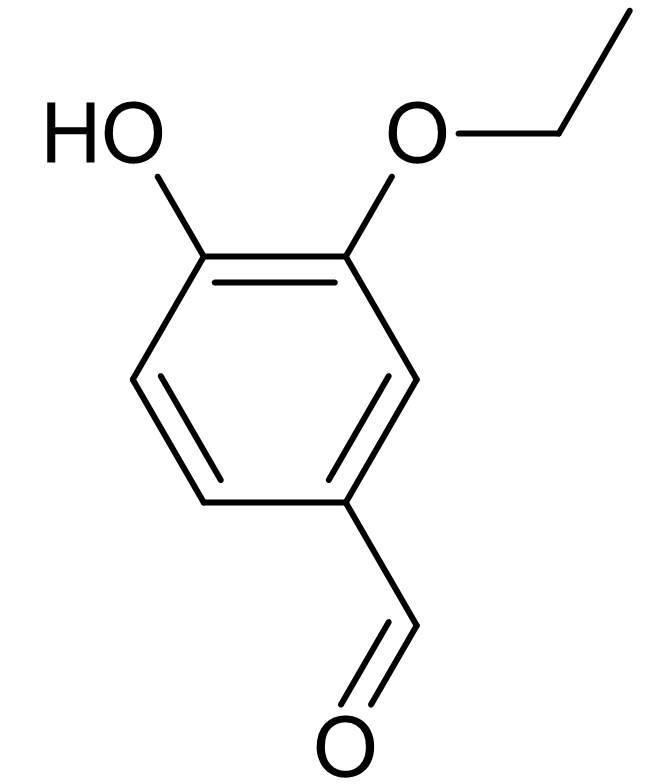
SMILES: CCOc1cc(C=O)ccc1O
Ethylvanillin is an aromatic organic compound belonging to the family of substituted benzaldehydes and phenolic ethers. It is structurally related to vanillin, differing by the replacement of the methoxy group with an ethoxy group at the third position of the aromatic ring. Its molecular structure contains three characteristic functional groups: an aldehyde group, a phenolic hydroxyl group and an ethoxy group. This combination contributes to its distinctive chemical reactivity, molecular interactions and intense aromatic properties. Ethylvanillin is primarily obtained through chemical synthesis and is recognized for its powerful vanilla-like fragrance, which is considerably more intense than that of vanillin. Beyond its importance in fragrance chemistry, ethylvanillin is investigated as a versatile aromatic building block in organic synthesis, coordination chemistry, analytical chemistry and molecular spectroscopy. Its aldehyde group enables condensation and reduction reactions, while the phenolic hydroxyl group can participate in hydrogen bonding and chemical functionalization. These characteristics make ethylvanillin a valuable starting material for synthesizing aromatic derivatives, Schiff bases, metal coordination compounds and specialized fragrance molecules.
Chemical and physical properties
Ethylvanillin is a crystalline solid under normal ambient conditions. Published chemical reference data report a melting point of approximately 76–79 °C and a boiling point close to 285 °C under atmospheric pressure.
Ethylvanillin is only slightly soluble in water but exhibits considerably greater solubility in organic solvents, including ethanol, diethyl ether and chloroform. Its octanol–water partition coefficient (log P) is approximately 1.6, reflecting the combined influence of its aromatic ring and polar oxygen-containing functional groups.
Single-crystal X-ray diffraction studies have demonstrated that ethylvanillin molecules possess an approximately planar molecular conformation. The crystalline structure is stabilized by intramolecular and intermolecular hydrogen-bonding interactions involving the phenolic hydroxyl group and oxygen-containing functional groups. Intermolecular hydrogen bonds connect neighboring molecules into extended arrangements within the crystal lattice. These structural features influence the organization and packing behavior of solid ethylvanillin.
Experimental gas electron diffraction studies combined with quantum chemical calculations have provided detailed information about the molecular geometry and conformational behavior of ethylvanillin. Computational investigations indicate the presence of several stable molecular conformers, with their relative stability influenced by the orientation of the ethoxy substituent and intramolecular interactions.
The aromatic aldehyde group of ethylvanillin participates in characteristic organic reactions, including reduction to the corresponding benzyl alcohol and condensation with primary amines to form imines or Schiff bases. Its phenolic hydroxyl group can also undergo etherification and other chemical transformations. These functional groups provide multiple pathways for the preparation of structurally diverse aromatic derivatives.
Ethylvanillin exhibits characteristic vibrational spectroscopic features associated with its aromatic ring, carbonyl group, hydroxyl group and ether linkage. Experimental terahertz spectroscopy combined with density functional theory calculations has been used to investigate its low-frequency molecular vibrations and intermolecular interactions. Such studies provide insight into the relationship between molecular structure, hydrogen bonding and vibrational behavior.
Applications
Ethylvanillin is widely used as an aromatic ingredient in the fragrance industry. Its intense vanilla-like odor makes it suitable for perfume compositions, cosmetic fragrances and aromatic formulations requiring warm, sweet and persistent notes. It is particularly valuable in compositions where a pronounced vanilla character is desired.
In cosmetic and personal care formulations, ethylvanillin is used as a fragrance component in scented soaps, shampoos, lotions and other perfumed preparations. Its characteristic aroma allows it to complement floral, woody, balsamic and oriental fragrance compositions. It can also be incorporated into fragrance systems for household and technical products.
In organic synthesis, ethylvanillin serves as an important intermediate for the preparation of substituted aromatic alcohols, ethers, imines and other benzaldehyde derivatives. A documented synthetic application involves its reduction to 3-ethoxy-4-hydroxybenzyl alcohol, followed by etherification to produce methyl diantilis and related aromatic ethers. These compounds are investigated for their distinctive fragrance properties.
Ethylvanillin is also used as a precursor for Schiff base ligands and related coordination compounds. Condensation reactions with suitable nitrogen-containing molecules produce ligands capable of coordinating metal ions. Such derivatives are studied in coordination chemistry, molecular structure characterization and investigations of their physicochemical and biological properties.
In analytical chemistry, ethylvanillin serves as a reference compound in the development and validation of chromatographic and spectroscopic analytical methods. Its defined molecular structure and characteristic spectral features make it suitable for compound identification, quantitative determination and comparative investigations involving aromatic aldehydes.
Ethylvanillin is additionally investigated in molecular spectroscopy and computational chemistry. Studies employing gas electron diffraction, terahertz spectroscopy and quantum chemical calculations explore its molecular geometry, vibrational modes, conformational stability and intermolecular interactions. The compound is also studied in olfactory receptor research, where its molecular recognition behavior contributes to understanding the relationship between chemical structure and odor perception.
Scientific references
1. Li, Y., Zhang, X., Zheng, J., & Wang, X. (2008). 3-Ethoxy-4-hydroxybenzaldehyde. Acta Crystallographica Section E: Structure Reports Online, 64, o2008.
https://doi.org/10.1107/S1600536808030419
2. Egawa, T., Kameyama, A., & Takeuchi, H. (2006). Structural determination of vanillin, isovanillin and ethylvanillin by means of gas electron diffraction and theoretical calculations. Journal of Molecular Structure, 794(1–3), 92–102.
https://doi.org/10.1016/j.molstruc.2006.01.042
3. Chen, T., Tang, Z., & Hu, C. (2022). The combination of terahertz spectroscopy and density functional theory for vibrational modes and weak interactions analysis of vanillin derivatives. Journal of Molecular Structure, 1265, 133404.
https://doi.org/10.1016/j.molstruc.2022.133404
4. Miles, W. H., & Connell, K. B. (2006). Synthesis of Methyl Diantilis, a Commercially Important Fragrance. Journal of Chemical Education, 83(2), 285.
https://doi.org/10.1021/ed083p285
5. Ramasubramanian, A. S., Bhat, B. R., & Dileep, R. (2010). Synthesis, characterization, and biological activity of metal complexes of 4-ethyl vanillideneamino-3-methyl-5-mercapto-1,2,4-triazole. Journal of Coordination Chemistry, 63(17), 3108–3116.
https://doi.org/10.1080/00958972.2010.505283
6. Ben Khemis, I., & Ben Lamine, A. (2021). Physico-chemical investigations of human olfactory receptors OR10G4 and OR2B11 activated by vanillin, ethyl vanillin, coumarin and quinoline molecules using statistical physics method. International Journal of Biological Macromolecules, 193, 915–922.
https://doi.org/10.1016/j.ijbiomac.2021.10.155
7. National Center for Biotechnology Information (NCBI). PubChem Compound Summary for CID 8467, Ethylvanillin. PubChem Database.
https://pubchem.ncbi.nlm.nih.gov/compound/8467
SAFETY

Signal Word: Warning
Hazard Statements:
H319: Causes serious eye irritation.
Precautionary Statements:
P264: Wash face, hands, and any exposed skin thoroughly after handling.
P280: Wear eye protection/face protection.
P305+P351+P338: IF IN EYES: Rinse cautiously with water for several minutes. Remove contact lenses if present and easy to do. Continue rinsing.
P337+P313: If eye irritation persists: Get medical advice/attention.
First Aid Measures
Eye Contact: Immediately rinse with plenty of water for at least 15 minutes, holding eyelids open. Remove contact lenses if present and easy to do. Seek medical attention if irritation persists.
Skin Contact: Wash affected area with soap and water. Remove contaminated clothing. Seek medical attention if symptoms occur.
Inhalation: Move person to fresh air. If symptoms persist, get medical attention.
Ingestion: Rinse mouth with water. Do not induce vomiting. Seek medical advice if feeling unwell.
Handling and Storage
Handling Precautions: Avoid contact with eyes and prolonged or repeated skin contact. Use appropriate personal protective equipment. Avoid the formation of dust. Ensure good ventilation at the workplace.
Storage Conditions: Store in a tightly closed container in a dry, cool, and well-ventilated area. Keep away from incompatible materials such as strong oxidizers. Protect from moisture and direct sunlight.