
 CATEGORIES
- ORGANIC COMPOUNDS(1129)
- Thiols(1)
- Metal-organic compounds(1)
- Sulfonic acids(6)
- Alcohols(74)
- Aldehydes(47)
- Alkyl nitrites(6)
- Amines(55)
- Aminoacids(59)
- Amides(33)
- Anhydrides(11)
- Acyl Halides(5)
- Carboxylic Acids(170)
- Dyes and Indicators(99)
- Esters(52)
- Ethers(17)
- Organic Halogens (Organohalides)(30)
- Flavonoids(5)
- Heterocycles(24)
- Hydrocarbons(34)
- Imides(2)
- Ketones(29)
- Mixed solvents(16)
- Nitro Compounds(5)
- Nitriles(9)
- Organic salts(74)
- Phenols(30)
- Polymers ( HMW compounds )(68)
- Sugars (Saccharides)(24)
- Silicoorgano and Phosphoorganocompounds(1)
- Peptides(2)
- Terpenes(16)
- Others(126)
- INORGANIC COMPOUNDS(1055)
- LAB EQUIPMENT(5176)
- *(1)
- Organic Synthesis(417)
- Industry(775)
Language
US version allows shipping to all available destinations


 MANUFACTURER
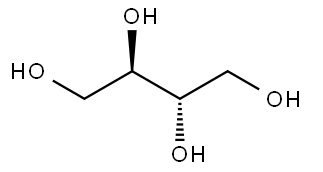
Erythritol (Erytrol)
Regular price:
Regular price:
product unavailable
add to wish list
0
 "Pin It")
Description
Erythritol
Other Names: meso-Erythritol, Erythrit, Phycitol, 1,2,3,4-Butanetetrol
Chemical Formula: C4H10O4
Molar Mass: 122.12 g/mol
CAS Number: 149-32-6
SMILES: C([C@H]([C@H](CO)O)O)O
Appearance: White crystalline powder
Odor: Odorless
Erythritol is a four-carbon polyhydric alcohol structurally classified as the meso form of butane-1,2,3,4-tetrol. Its molecule contains four hydroxyl groups, which are responsible for extensive intermolecular hydrogen bonding and strongly influence its crystal structure, solubility, thermal behavior and phase transitions. Erythritol has been investigated extensively as a model polyol in crystallization, solution thermodynamics, spectroscopy and thermal-energy-storage research. Studies using differential scanning calorimetry, X-ray diffraction and infrared spectroscopy have demonstrated that its solid-state behavior is strongly associated with hydrogen-bond organization and that different crystalline or amorphous states can be produced depending on the thermal history of the material.
Chemical and physical properties
Erythritol is a white, odorless crystalline solid. Experimental investigations of high-purity material have reported melting temperatures close to 118–122 °C. Solid-state studies have also identified a stable crystalline form with a melting point near 117 °C and a metastable form melting near 104 °C, demonstrating that thermal history and crystal structure can influence the observed phase-transition temperature.
Experimental thermophysical measurements have reported a solid density of approximately 1.4404 g/cm3 at 20 °C. Erythritol also possesses a relatively high phase-change enthalpy, which has led to considerable research interest in its use as an organic phase change material for medium-temperature thermal energy storage.
Erythritol is soluble in water, and its solubility increases substantially with increasing temperature. Experimental studies of aqueous mixtures containing methanol, ethanol or 1-propanol have shown that erythritol solubility increases both with temperature and with increasing water content of the solvent system. These properties are important in crystallization, purification and solution-processing studies.
The extensive hydrogen-bonding network within crystalline erythritol strongly affects melting, crystallization and heat transport. Erythritol can also exhibit pronounced supercooling during solidification, an important characteristic in phase-change-material research. Experimental studies have therefore investigated nucleating agents, encapsulation and thermally conductive matrices to improve crystallization behavior and heat-transfer performance.
Applications
Erythritol is extensively investigated as a phase change material for medium-temperature latent heat thermal energy storage. Its relatively high melting enthalpy and phase-transition temperature make it of interest for systems involving industrial waste-heat recovery, solar-thermal energy utilization and other thermal-storage technologies. Composite materials containing erythritol and thermally conductive supports such as expanded graphite have been studied to increase thermal conductivity and improve heat-storage and heat-release performance.
In materials research, erythritol is used as a model compound for studying crystallization, supercooling, hydrogen-bond rearrangement and solid-state phase transitions. Differential scanning calorimetry, X-ray diffraction, infrared spectroscopy and molecular-dynamics simulations have been applied to characterize its crystalline and amorphous states and to investigate the molecular mechanisms responsible for its thermal properties.
Erythritol powder has also been investigated as a low-abrasive material for air-polishing systems used in periodontal and dental surface treatment. Clinical studies have evaluated erythritol-based air polishing for biofilm removal and supportive periodontal procedures, with research demonstrating its suitability for repeated mechanical surface treatment under controlled clinical conditions.
In chemical research, erythritol can serve as a substrate for transformation reactions involving its multiple hydroxyl groups. For example, catalytic intramolecular dehydration in high-temperature carbonated water has been investigated as a route to 1,4-anhydroerythritol, illustrating its usefulness as a starting polyol in studies of selective chemical conversion.
Scientific references
1. Lopes Jesus, A.J.; Nunes, S.C.C.; Ramos Silva, M.; Matos Beja, A.; Redinha, J.S. “Erythritol: Crystal growth from the melt.” International Journal of Pharmaceutics, 2010, 388, 129–135. DOI: 10.1016/j.ijpharm.2009.12.043.
2. Hu, Y.; Jiang, X.; Yang, W.; Chen, Z.; Meng, X.; Shen, F. “Solubility of erythritol in different aqueous solvent mixtures.” Journal of Molecular Liquids, 2012, 169, 74–79. DOI: 10.1016/j.molliq.2012.02.017.
3. Höhlein, S.; König-Haagen, A.; Brüggemann, D. “Thermophysical Characterization of MgCl2·6H2O, Xylitol and Erythritol as Phase Change Materials (PCM) for Latent Heat Thermal Energy Storage (LHTES).” Materials, 2017, 10, 444. DOI: 10.3390/ma10040444.
4. Alferez Luna, M.P.; Neumann, H.; Gschwander, S. “Stability Study of Erythritol as Phase Change Material for Medium Temperature Thermal Applications.” Applied Sciences, 2021, 11, 5448. DOI: 10.3390/app11125448.
5. Feng, B.; Fan, L.-W.; Zeng, Y.; Ding, J.-Y.; Shao, X.-F. “Atomistic insights into the effects of hydrogen bonds on the melting process and heat conduction of erythritol as a promising latent heat storage material.” International Journal of Thermal Sciences, 2020, 149, 106103. DOI: 10.1016/j.ijthermalsci.2019.106103.
6. Hägi, T.T.; Hofmänner, P.; Eick, S.; Donnet, M.; Salvi, G.E.; Sculean, A.; Ramseier, C.A. “The effects of erythritol air-polishing powder on microbiologic and clinical outcomes during supportive periodontal therapy: Six-month results of a randomized controlled clinical trial.” Quintessence International, 2015, 46, 31–41. DOI: 10.3290/j.qi.a32817.
7. Taniguchi, K.; Nanao, H.; Sato, O.; Yamaguchi, A.; Shirai, M. “Dehydration of erythritol in high-temperature carbonated water.” Molecular Catalysis, 2019, 477, 110519. DOI: 10.1016/j.mcat.2019.110519.
8. PubChem, National Center for Biotechnology Information. “Erythritol, CID 222285.” Molecular formula, molecular weight, chemical identifiers and canonical SMILES.
Safety
According to available data, erythritol is not classified as a hazardous substance under GHS/CLP criteria.
Signal word: none
Hazard statements:
No GHS classification
Precautionary statements:
No specific P-statements resulting from GHS classification
First aid
Eye contact: rinse eyes carefully with water for several minutes. If irritation persists, seek medical advice.
Skin contact: wash skin with soap and water. If irritation occurs, consult a doctor.
Inhalation: move the affected person to fresh air. If symptoms occur, seek medical advice.
Ingestion: rinse mouth with water. If feeling unwell, seek medical advice.
Storage and handling
Store the product in a tightly closed container in a dry, cool and well-ventilated place. Protect from moisture, contamination and incompatible materials. During handling, avoid the formation and inhalation of dust. The use of standard personal protective equipment is recommended, such as protective gloves, safety goggles and respiratory protection in case of dust formation risk.