
 CATEGORIES
- ORGANIC COMPOUNDS(1240)
- Thiols(1)
- Metal-organic compounds(1)
- Sulfonic acids(6)
- Alcohols(78)
- Aldehydes(52)
- Alkyl nitrites(6)
- Amines(67)
- Aminoacids(78)
- Amides(33)
- Anhydrides(11)
- Acyl Halides(5)
- Carboxylic Acids(192)
- Dyes and Indicators(107)
- Esters(52)
- Ethers(17)
- Organic Halogens (Organohalides)(35)
- Flavonoids(5)
- Heterocycles(37)
- Hydrocarbons(42)
- Imides(2)
- Ketones(29)
- Mixed solvents(16)
- Nitro Compounds(6)
- Nitriles(9)
- Organic salts(74)
- Phenols(35)
- Polymers ( HMW compounds )(66)
- Sugars (Saccharides)(24)
- Silicoorgano and Phosphoorganocompounds(1)
- Peptides(2)
- Terpenes(16)
- Others(137)
- INORGANIC COMPOUNDS(1103)
- LAB EQUIPMENT(5176)
- *(1)
- Organic Synthesis(438)
- Industry(783)
Language
US version allows shipping to all available destinations


 MANUFACTURER
Dimethylformamide ( DMF ) N,N-Dimethylformamide


Regular price:
Regular price:
product unavailable
add to wish list
0

 N,N-Dimethylformamide "Pin It")
Description
N,N-Dimethylformamide (DMF)
Other Names: Dimethylformamide, DMF, N,N-Dimethylmethanamide, N-Formyldimethylamine
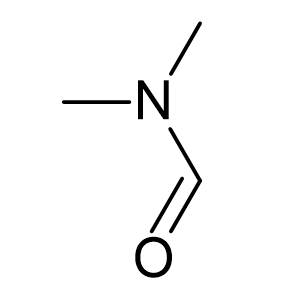
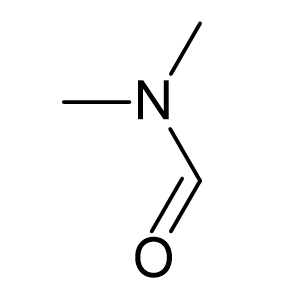
Chemical Formula: C3H7NO
Structural Formula: HCON(CH3)2
Molar Mass: 73.09 g/mol
CAS Number: 68-12-2
Appearance: Colorless liquid
N,N-Dimethylformamide (DMF) is a highly polar, aprotic organic solvent belonging to the class of substituted formamides. Its molecular structure consists of a formyl group bonded to a nitrogen atom carrying two methyl substituents. Resonance within the amide group gives the carbon–nitrogen bond partial double-bond character and contributes to the molecule's high polarity. DMF is widely used in laboratory and industrial chemistry because it dissolves numerous organic and inorganic substances and remains liquid over a broad temperature range.
Chemical and physical properties
DMF is a colorless liquid under ambient conditions. Experimental thermodynamic data report a normal boiling point of approximately 426 K, corresponding to about 153 °C. Its melting point is approximately −61 °C, providing a relatively broad liquid temperature range that is advantageous for its use as a reaction and processing solvent.
The density of DMF is approximately 0.94–0.95 g/cm3 near room temperature. It is miscible with water and with many common organic solvents, including alcohols, ethers, ketones and aromatic solvents. Its high dielectric constant and strong ability to solvate ions contribute to its effectiveness in reactions involving polar or ionic intermediates.
DMF is classified as a polar aprotic solvent. Unlike protic solvents, it does not contain an O–H or N–H bond capable of acting as a conventional hydrogen-bond donor. At the same time, the carbonyl oxygen is a strong hydrogen-bond acceptor and Lewis-basic site. These characteristics allow DMF to efficiently solvate cations while often leaving anions comparatively reactive, which can significantly affect reaction rates and mechanisms.
Applications
DMF is extensively used as a reaction solvent in organic synthesis. Its polarity and high boiling point make it especially useful for nucleophilic substitution reactions, coupling reactions, condensations and transformations involving ionic reagents or polar intermediates. It is commonly employed where less polar solvents do not provide sufficient substrate or reagent solubility.
In addition to acting as a solvent, DMF can participate directly in chemical reactions. Scientific literature describes its use as a source of formyl, dimethylamino, carbonyl and related structural fragments. One of its best-known synthetic roles involves reaction with chlorinating or activating reagents to generate Vilsmeier-type intermediates used in formylation and other electrophilic transformations.
DMF is also used in organometallic chemistry and catalysis. Its carbonyl oxygen can coordinate to metal centers, and the solvent can influence the structure, stability and reactivity of metal complexes. These properties are relevant in catalytic reactions involving palladium and other transition metals.
In polymer and materials chemistry, DMF is frequently employed as a processing and casting solvent because it dissolves numerous polymers and functional materials. It is used in the preparation of polymer solutions, membranes, coatings, electrospun fibers and composite materials, as well as in research involving polymer characterization and solution processing.
DMF has also been widely used in peptide synthesis because of its ability to dissolve protected amino-acid derivatives, coupling reagents and growing peptide chains. Current research increasingly evaluates alternative solvents because of the toxicological and environmental concerns associated with extensive DMF use.
Handling and safety
DMF requires careful handling because it can be absorbed through the skin and inhaled as vapor. Scientific toxicological studies identify the liver as an important target organ following significant or repeated exposure. Experimental studies have also demonstrated reproductive and developmental toxicity, which has led to restrictions on occupational exposure and increased interest in replacing DMF with safer solvents where technically feasible.
DMF should therefore be handled with appropriate ventilation and suitable personal protective equipment, with particular attention to preventing skin contact. Its relatively high boiling point does not eliminate inhalation risk, especially during heated processes or operations with large exposed liquid surfaces.
Scientific references
Heravi, M. M.; Ghavidel, M.; Mohammadkhani, L. Beyond a solvent: triple roles of dimethylformamide in organic chemistry. RSC Advances, 2018, 8, 27832–27862. DOI: 10.1039/C8RA04985H.
Ding, S.; Jiao, N. N,N-Dimethylformamide: A Multipurpose Building Block. Angewandte Chemie International Edition, 2012, 51, 9226–9237. DOI: 10.1002/anie.201200859.
Muzny, C. D. et al. NIST Chemistry WebBook, SRD 69: N,N-Dimethylformamide. National Institute of Standards and Technology. CAS 68-12-2.
Scognamiglio, A.; Magli, E.; Caliendo, G.; Perissutti, E.; Santagada, V.; Severino, B. Once Upon a Time Without DMF: Greener Paths in Peptide and Organic Synthesis. Molecules, 2026, 31, 536. DOI: 10.3390/molecules31030536.
Safety Information:

Signal Word: Danger
Hazard Statements:
-
H226: Flammable liquid and vapor.
-
H312: Harmful in contact with skin.
-
H319: Causes serious eye irritation.
-
H332: Harmful if inhaled.
-
H360D: May damage the unborn child.
Precautionary Statements:
-
P201: Obtain special instructions before use.
-
P210: Keep away from heat, hot surfaces, sparks, open flames, and other ignition sources. No smoking.
-
P280: Wear protective gloves/protective clothing/eye protection/face protection.
-
P304 + P340: IF INHALED: Remove person to fresh air and keep comfortable for breathing.
-
P308 + P313: IF exposed or concerned: Get medical advice/attention.
Health Hazards:
-
Acute Exposure: Inhalation or skin contact can cause irritation, headache, dizziness, nausea, and vomiting.
-
Chronic Exposure: Prolonged exposure may lead to liver and kidney damage.
-
Reproductive Toxicity: Potential risk to the unborn child; may cause developmental defects.
First Aid Measures:
-
Inhalation: Move the affected person to fresh air and keep them at rest in a position comfortable for breathing. Seek medical attention if symptoms persist.
-
Skin Contact: Remove contaminated clothing immediately. Wash skin thoroughly with soap and water. Seek medical advice if irritation develops.
-
Eye Contact: Rinse cautiously with water for several minutes. Remove contact lenses if present and easy to do. Continue rinsing and seek medical attention.
-
Ingestion: Rinse mouth. Do not induce vomiting. Seek immediate medical attention.
Fire Fighting Measures:
-
Suitable Extinguishing Media: Water spray, alcohol-resistant foam, dry chemical, or carbon dioxide.
-
Specific Hazards: Vapors may form explosive mixtures with air. Containers may explode when heated.
-
Protective Equipment: Firefighters should wear self-contained breathing apparatus and full protective gear.
Storage:
-
Store in a cool, dry, well-ventilated area away from heat sources, open flames, and incompatible materials such as strong acids and oxidizing agents.
-
Keep container tightly closed and grounded to prevent static discharge.
*Note: The information provided is based on general data. Always refer to the Safety Data Sheet (SDS) provided by the supplier for detailed and accurate information.*