
 CATEGORIES
- ORGANIC COMPOUNDS(1277)
- Thiols(1)
- Metal-organic compounds(1)
- Sulfonic acids(6)
- Alcohols(78)
- Aldehydes(59)
- Alkyl nitrites(6)
- Amines(75)
- Aminoacids(78)
- Amides(33)
- Anhydrides(11)
- Acyl Halides(5)
- Carboxylic Acids(203)
- Dyes and Indicators(107)
- Esters(56)
- Ethers(17)
- Organic Halogens (Organohalides)(35)
- Flavonoids(5)
- Heterocycles(39)
- Hydrocarbons(42)
- Imides(2)
- Ketones(29)
- Mixed solvents(16)
- Nitro Compounds(6)
- Nitriles(9)
- Organic salts(74)
- Phenols(37)
- Polymers ( HMW compounds )(66)
- Sugars (Saccharides)(24)
- Silicoorgano and Phosphoorganocompounds(1)
- Peptides(2)
- Terpenes(19)
- Others(137)
- INORGANIC COMPOUNDS(1149)
- LAB EQUIPMENT(5176)
- *(1)
- Organic Synthesis(476)
- Industry(796)
Language
US version allows shipping to all available destinations


 MANUFACTURER
Cyclohexylamine For Synthesis Pure >99%
Regular price:
Regular price:
product unavailable
add to wish list
0


Description
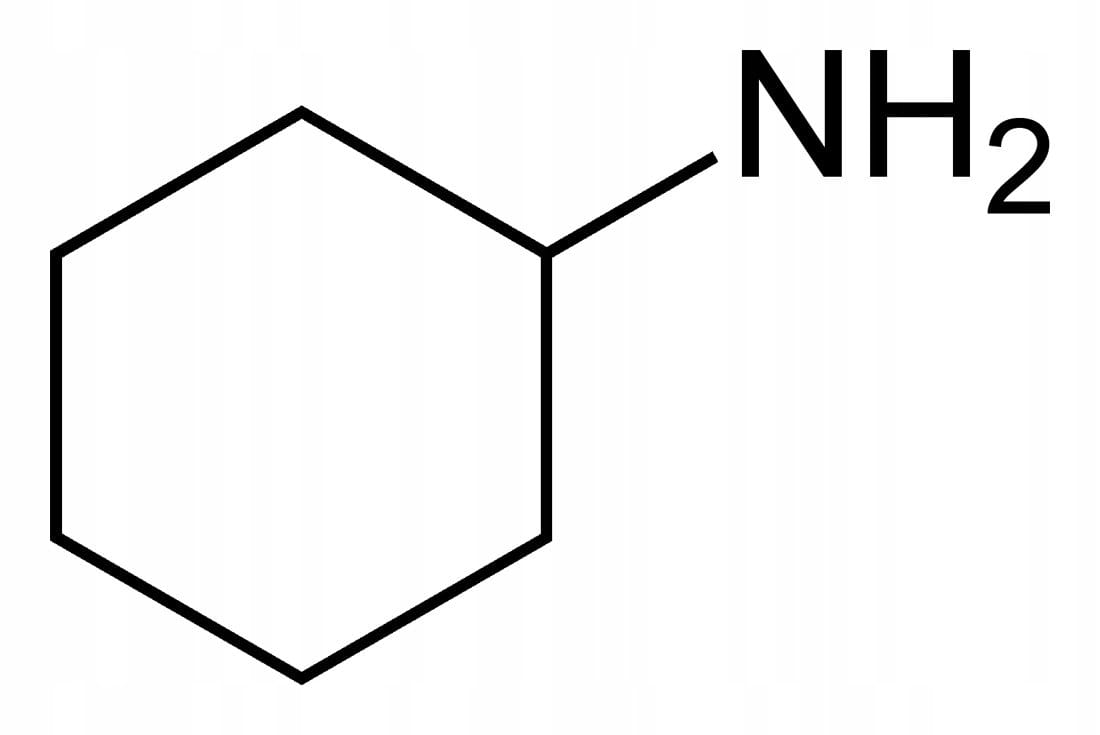
Cyclohexylamine
Other Names: Cyclohexanamine, Aminocyclohexane, Hexahydroaniline, 1-Aminocyclohexane, CHA
Chemical Formula: C6H13N
Structural Formula: C6H11NH2
Molar Mass: 99.17 g/mol
CAS Number: 108-91-8
Appearance: Colorless to pale yellow liquid
Odor: Characteristic amine-like odor
Cyclohexylamine is a primary cycloaliphatic amine consisting of a cyclohexane ring directly bonded to an amino group. It combines the nucleophilic and basic properties characteristic of primary aliphatic amines with the conformational properties of a saturated six-membered ring. Cyclohexylamine is an important chemical intermediate and laboratory reagent used in organic synthesis, materials chemistry and investigations of amine reactivity. NIST reference data identify the compound by CAS number 108-91-8 and report a molecular mass of 99.1741 g/mol.
Chemical and physical properties
Cyclohexylamine is a liquid under normal ambient conditions. Experimental thermodynamic data compiled by NIST give a normal boiling point of approximately 407 K, corresponding to about 134 °C. Reported melting-point measurements are approximately 252–255 K, equivalent to about −21 to −18 °C.
The compound is a relatively strong organic base compared with aromatic amines. The pKa of its conjugate acid, cyclohexylammonium, is approximately 10.6 in aqueous solution. Consequently, cyclohexylamine is predominantly protonated under neutral and moderately acidic aqueous conditions and readily forms cyclohexylammonium salts upon reaction with acids.
The primary amino group acts as both a Brønsted base and a nucleophile. Cyclohexylamine therefore undergoes characteristic reactions of primary amines, including salt formation, acylation, alkylation, condensation with carbonyl compounds and reactions with isocyanates or related electrophiles. The nitrogen atom also provides an electron-donating site capable of interacting with metal surfaces and metal ions.
Applications
Cyclohexylamine is widely used as an intermediate in synthetic organic chemistry. Its primary amino group can be converted into amides, sulfonamides, ureas, imines and numerous N-substituted derivatives. Industrial cycloaliphatic amines such as cyclohexylamine can be produced by catalytic hydrogenation of corresponding aromatic precursors or by amination processes involving cycloaliphatic alcohols and ketones.
An important industrial application of cyclohexylamine is the preparation of rubber-processing chemicals. It is used as a precursor for N-cyclohexyl-substituted benzothiazole sulfenamides, which constitute an important class of accelerators employed in sulfur vulcanization systems.
Cyclohexylamine has also been investigated as a corrosion inhibitor for metallic materials in acidic environments. Electrochemical impedance spectroscopy, polarization measurements and theoretical calculations have demonstrated adsorption of cyclohexylamine at carbon-steel surfaces, where interaction of the nitrogen atom with the metal contributes to formation of an adsorbed protective layer and reduction of corrosion rates.
In laboratory chemistry, cyclohexylamine can serve as a basic reagent, nucleophile and building block for the synthesis of cyclohexyl-containing organic compounds. Formation of crystalline cyclohexylammonium salts is also useful in studies of acid-base equilibria, ionic association and molecular crystallization.
Handling and safety
Cyclohexylamine requires careful handling because concentrated material can cause pronounced irritation and tissue damage following contact with the skin or eyes, and exposure to its vapors should be minimized. Cycloaliphatic amines are recognized as strong irritants, making appropriate ventilation, eye protection and chemically resistant gloves important when working with the substance.
Toxicological studies demonstrate that cyclohexylamine is biologically active and that its toxicokinetics and metabolic pathways vary considerably between species. Experimental investigations have identified renal elimination and metabolic transformations involving ring hydroxylation and oxidative deamination. These findings support the use of controlled exposure conditions when cyclohexylamine is handled in laboratory and industrial environments.
Scientific references
NIST Chemistry WebBook, SRD 69. Cyclohexylamine. CAS Registry Number 108-91-8.
Casey, J. P. Amines, Cycloaliphatic. Kirk-Othmer Encyclopedia of Chemical Technology. Wiley. DOI: 10.1002/0471238961.0325031203011905.a01.pub2.
Acyclic and cyclic hydrocarbons as acid corrosion inhibitor for carbon steel: A comparative (experimental and theoretical) study. Journal of Molecular Liquids, 2021.
Renwick, A. G.; Williams, R. T. The metabolites of cyclohexylamine in man and certain animals. Biochemical Journal, 1972, 129, 857–867. DOI: 10.1042/bj1290857.
Roberts, A.; Renwick, A. G. The pharmacokinetics and tissue concentrations of cyclohexylamine in rats and mice. Toxicology and Applied Pharmacology, 1989. DOI: 10.1016/0041-008X(89)90228-7.
Safety
H Statements (Hazards):
- H226: Flammable liquid and vapor.
- H302: Harmful if swallowed.
- H312: Harmful in contact with skin.
- H332: Harmful if inhaled.
- H314: Causes severe skin burns and eye damage.
- H335: May cause respiratory irritation.
P Statements (Precautions):
- P210: Keep away from heat, hot surfaces, sparks, open flames, and other ignition sources. No smoking.
- P261: Avoid breathing vapor.
- P280: Wear protective gloves/protective clothing/eye protection/face protection.
- P301+P312: IF SWALLOWED: Call a POISON CENTER/doctor if you feel unwell.
- P302+P352: IF ON SKIN: Wash with plenty of soap and water.
- P304+P340: IF INHALED: Remove person to fresh air and keep comfortable for breathing.
- P305+P351+P338: IF IN EYES: Rinse cautiously with water for several minutes. Remove contact lenses if present and easy to do. Continue rinsing.
- P310: Immediately call a POISON CENTER or doctor.
- P501: Dispose of contents/container in accordance with local regulations.
GHS Pictograms:
- GHS02: Flammable
- GHS06: Toxic
- GHS05: Corrosive