
 CATEGORIES
- ORGANIC COMPOUNDS(1134)
- Thiols(1)
- Metal-organic compounds(1)
- Sulfonic acids(6)
- Alcohols(74)
- Aldehydes(47)
- Alkyl nitrites(6)
- Amines(56)
- Aminoacids(59)
- Amides(33)
- Anhydrides(11)
- Acyl Halides(5)
- Carboxylic Acids(170)
- Aromatic Acids(11)
- Dyes and Indicators(99)
- Esters(52)
- Ethers(17)
- Organic Halogens (Organohalides)(30)
- Flavonoids(5)
- Heterocycles(25)
- Hydrocarbons(38)
- Imides(2)
- Ketones(29)
- Mixed solvents(16)
- Nitro Compounds(5)
- Nitriles(9)
- Organic salts(74)
- Phenols(30)
- Polymers ( HMW compounds )(68)
- Sugars (Saccharides)(24)
- Silicoorgano and Phosphoorganocompounds(1)
- Peptides(2)
- Terpenes(16)
- Others(125)
- INORGANIC COMPOUNDS(1055)
- LAB EQUIPMENT(5176)
- *(1)
- Organic Synthesis(421)
- Industry(775)
Language
US version allows shipping to all available destinations


 MANUFACTURER
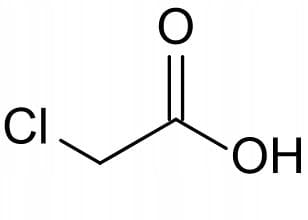
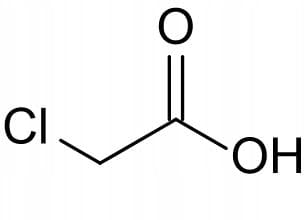
Chloroacetic Acid (Monochloroacetic Acid) MCA

Regular price:
Regular price:
product unavailable
add to wish list
0

 MCA "Pin It")
Description
Chloroacetic Acid
Other Names: Monochloroacetic acid, MCA, 2-Chloroacetic acid, Chloroethanoic acid
Chemical Formula: C2H3ClO2
Molar Mass: 94.50 g/mol
CAS Number: 79-11-8
SMILES: C(C(=O)O)Cl
Appearance: Colorless to white hygroscopic crystalline solid
Odor: Pungent, vinegar-like odor
Chloroacetic acid is the simplest chlorinated derivative of acetic acid and an important reactive intermediate in organic and industrial chemistry. Its molecular structure contains both a carboxylic acid group and a chloromethyl group, giving the compound two chemically useful reaction centers. The electron-withdrawing effect of chlorine significantly increases the acidity of the carboxyl group compared with acetic acid, while the carbon bearing chlorine is susceptible to nucleophilic substitution. These properties make chloroacetic acid a versatile starting material for the synthesis of cellulose derivatives, sulfur-containing compounds, surfactant intermediates and numerous other functional organic molecules.
Chemical and physical properties
Chloroacetic acid is a crystalline solid at room temperature. Published reference data report a melting point of approximately 61–63 °C and a normal boiling point close to 189 °C. The density of the solid is approximately 1.58 g/cm3 at 20 °C.
The compound is highly soluble in water and is also soluble in a range of polar organic solvents. Its aqueous solutions are acidic, with a reported pKa of approximately 2.86–2.87. The substantially greater acidity compared with acetic acid results primarily from the negative inductive effect of the chlorine substituent, which stabilizes the chloroacetate conjugate base.
The chloromethyl carbon of chloroacetic acid readily undergoes nucleophilic substitution. Reactions with oxygen-, sulfur- and nitrogen-containing nucleophiles can therefore generate a wide variety of substituted acetic acid derivatives. This combination of acidity and substitution reactivity accounts for much of its importance as a synthetic intermediate.
Chloroacetic acid is hygroscopic and corrosive. It can be handled industrially either as a crystalline material, in concentrated solution or in molten form. Its physical state and phase behavior must therefore be considered when designing storage, transfer and reaction systems.
Applications
Chloroacetic acid is widely used as an etherification reagent in the manufacture of carboxymethyl cellulose and related cellulose derivatives. In alkaline media, cellulose reacts with chloroacetic acid or sodium chloroacetate to introduce carboxymethyl groups onto the polymer backbone. Research has shown that reaction conditions such as alkali concentration, reagent ratio and temperature strongly affect the degree of substitution, solubility and viscosity of the resulting cellulose derivative.
It is also an important intermediate in the synthesis of thioglycolic acid and other sulfur-containing compounds. The chlorine atom can be displaced by sulfur nucleophiles, providing a convenient route to functionalized molecules used in industrial chemical synthesis.
Chloroacetic acid is used in the preparation of amphoteric and other functional surfactant intermediates through reactions with amines and related nucleophiles. Its high reactivity also makes it useful for introducing carboxymethyl groups into alcohols, phenols, polysaccharides and other hydroxyl-containing compounds.
In laboratory organic chemistry, chloroacetic acid serves as a model haloacetic acid for studies of nucleophilic substitution, acid dissociation, molecular conformation, solvation and spectroscopy. Modern microwave spectroscopic studies have also examined its gas-phase conformational structure and rotational constants.
Scientific references
- PubChem. Chloroacetic Acid, CID 300. National Center for Biotechnology Information. Molecular formula, molecular weight, CAS number, SMILES and experimental physicochemical data.
- Koenig G., Lohmar E., Rupprich N., Lison M., Gnass A. “Chloroacetic Acids.” Ullmann's Encyclopedia of Industrial Chemistry, Wiley-VCH, 2012. DOI: 10.1002/14356007.a06_537.pub3.
- Morris E. D., Bost J. C. “Acetic Acid, Halogenated Derivatives.” Kirk-Othmer Encyclopedia of Chemical Technology, Wiley, 2002. DOI: 10.1002/0471238961.0801121513151818.a01.pub2.
- Shui T., Feng S., Chen G., Li A., Yuan Z., Shui H., Kuboki T., Xu C. “Synthesis of sodium carboxymethyl cellulose using bleached crude cellulose fractionated from cornstalk.” Biomass and Bioenergy, 2017, 105, 51–58. DOI: 10.1016/j.biombioe.2017.06.016.
- Morozov I. I., Karpov G. V. “Chloroacetic Acids in Water: Structure of the Hydrated Ions from Mass Spectra of Electrolyte Solutions.” ACS Earth and Space Chemistry, 2025. DOI: 10.1021/acsearthspacechem.4c00358.
- “Microwave spectra of jet-cooled bromo- and chloroacetic acids.” Journal of Molecular Spectroscopy, 2025, 411–412, 112033. DOI: 10.1016/j.jms.2025.112033.
Safety and Handling:

Signal Word Danger
Hazard Statements H300 Fatal if swallowed. H311 + H331 Toxic in contact with skin or if inhaled. H314 Causes severe skin burns and eye damage. H335 May cause respiratory irritation. H410 Very toxic to aquatic life with long lasting effects.
Precautionary Statements Prevention P260 Do not breathe dust. P264 Wash skin thoroughly after handling. P273 Avoid release to the environment. P280 Wear protective gloves/ protective clothing/ eye protection/ face protection. Response P301 + P310 + P330 IF SWALLOWED: Immediately call a POISON CENTER/ doctor. Rinse mouth. P303 + P361 + P353 IF ON SKIN (or hair): Take off immediately all contaminated clothing. Rinse skin with water. P304 + P340 + P310 IF INHALED: Remove person to fresh air and keep comfortable for breathing. Immediately call a POISON CENTER/ doctor. P305 + P351 + P338 + P310 IF IN EYES: Rinse cautiously with water for several minutes. Remove contact lenses, if present and easy to do. Continue rinsing. Immediately call a POISON CENTER/ doctor. P391 Collect spillage. Storage P403 + P233 Store in a well-ventilated place. Keep container tightly closed.