
 CATEGORIES
- ORGANIC COMPOUNDS(1240)
- Thiols(1)
- Metal-organic compounds(1)
- Sulfonic acids(6)
- Alcohols(78)
- Aldehydes(52)
- Alkyl nitrites(6)
- Amines(67)
- Aminoacids(78)
- Amides(33)
- Anhydrides(11)
- Acyl Halides(5)
- Carboxylic Acids(192)
- Aromatic Acids(14)
- Dyes and Indicators(107)
- Esters(52)
- Ethers(17)
- Organic Halogens (Organohalides)(35)
- Flavonoids(5)
- Heterocycles(37)
- Hydrocarbons(42)
- Imides(2)
- Ketones(29)
- Mixed solvents(16)
- Nitro Compounds(6)
- Nitriles(9)
- Organic salts(74)
- Phenols(35)
- Polymers ( HMW compounds )(66)
- Sugars (Saccharides)(24)
- Silicoorgano and Phosphoorganocompounds(1)
- Peptides(2)
- Terpenes(16)
- Others(137)
- INORGANIC COMPOUNDS(1103)
- LAB EQUIPMENT(5176)
- *(1)
- Organic Synthesis(438)
- Industry(783)
Language
US version allows shipping to all available destinations


 MANUFACTURER
Butyric Acid (Butanoic Acid) Pure >99%
Regular price:
Regular price:
product unavailable
add to wish list
4.33

 Pure >99% "Pin It")
Description
Butyric Acid
Other Names: Butanoic Acid, n-Butyric Acid, n-Butanoic Acid, Ethylacetic Acid, Propylformic Acid
Chemical Formula: C4H8O2
Molar Mass: 88.11 g/mol
CAS Number: 107-92-6
Appearance: Colorless, oily liquid
Odor: Strong, penetrating, rancid odor
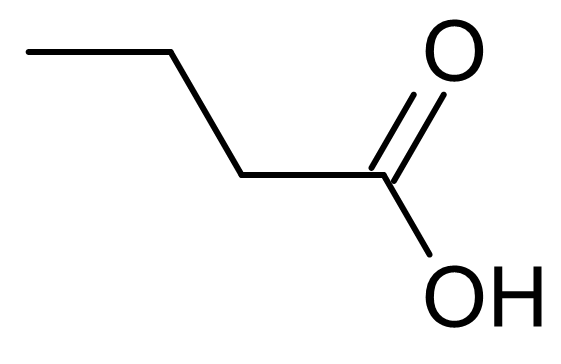
SMILES: CCCC(=O)O
Butyric acid, systematically known as butanoic acid, is a straight-chain saturated monocarboxylic acid containing four carbon atoms. Its molecular structure consists of a three-carbon alkyl chain attached to a terminal carboxyl group. The carboxyl group determines its acidic character, hydrogen-bonding behavior and reactivity toward alcohols, bases and other functional groups commonly used in organic synthesis.
In aqueous media, butyric acid behaves as a weak acid and establishes an equilibrium between the protonated acid and the butyrate anion. Its pKa is approximately 4.82. Because of the presence of both a polar carboxyl group and a short hydrocarbon chain, butyric acid exhibits properties intermediate between highly water-compatible lower carboxylic acids and more hydrophobic longer-chain fatty acids.
Chemical and physical properties
Butyric acid is a liquid under normal ambient conditions. Experimental thermodynamic data compiled by the NIST Chemistry WebBook report a normal boiling temperature of approximately 436 K, corresponding to about 163 °C.
Experimental measurements report a melting or fusion temperature near 267.6–267.9 K, corresponding to approximately −5.5 °C. Consequently, pure butyric acid remains liquid over a broad temperature range around room temperature.
The density of liquid butyric acid is approximately 0.96 g/cm3 near room temperature. It is a polar protic compound capable of forming intermolecular hydrogen bonds through its carboxyl group. As with other low-molecular-weight carboxylic acids, hydrogen-bonded association also influences its vapor-phase and liquid-phase thermodynamic behavior.
The carboxylic acid functionality readily undergoes neutralization with bases to form butyrate salts. It also participates in esterification reactions with alcohols. Experimental studies have demonstrated the conversion of butyric acid and n-butanol into butyl butyrate under both catalytic and biocatalytic conditions, illustrating its usefulness as a substrate in ester synthesis.
Thermodynamic studies of butyric acid include measurements of vapor pressure, enthalpy of vaporization, heat capacity, phase transitions and gas-phase ion chemistry. These properties make the compound useful as a reference molecule in investigations of short-chain carboxylic acid thermodynamics and intermolecular interactions.
Applications
Butyric acid is used as a chemical intermediate in organic synthesis, particularly for the preparation of butyrate esters, salts and other butyryl derivatives. Esterification with alcohols provides a versatile route to alkyl butyrates, which are subsequently used as intermediates in chemical and materials-related applications.
It can also serve as a starting reagent for the preparation of more reactive butyryl derivatives, including acid chlorides, anhydrides and activated esters. These compounds are useful in acylation reactions and in the synthesis of structurally more complex organic molecules.
In laboratory research, butyric acid is used as a representative short-chain carboxylic acid in studies of acid-base equilibria, vapor-liquid equilibria, molecular association, mass spectrometry, gas-phase ion chemistry and thermochemical properties.
Butyric acid and its butyrate derivatives are additionally investigated in biochemical and molecular-biology research, particularly in studies involving cellular signaling, enzyme regulation and epigenetic mechanisms. In such applications it is commonly employed as a defined laboratory reagent or as a precursor for butyrate salts and related derivatives.
Scientific references
- National Institute of Standards and Technology. NIST Chemistry WebBook, SRD 69: Butanoic Acid, CAS 107-92-6. Thermodynamic, phase-change and spectroscopic data.
- National Center for Biotechnology Information. PubChem Compound Summary for CID 264, Butyric Acid. Molecular structure, identifiers and physicochemical data.
- Clifford, S. L.; Ramjugernath, D.; Raal, J. D. “Subatmospheric Vapor Pressure Curves for Propionic Acid, Butyric Acid, Isobutyric Acid, Valeric Acid, Isovaleric Acid, Hexanoic Acid, and Heptanoic Acid.” Journal of Chemical & Engineering Data, 2004, 49, 1189–1192. DOI: 10.1021/je034180e.
- Verevkin, S. P. “Measurement and Prediction of the Monocarboxylic Acids Thermochemical Properties.” Journal of Chemical & Engineering Data, 2000, 45, 953–960. DOI: 10.1021/je990282m.
- Martin, J. F.; Andon, R. J. L. “Thermodynamic Properties of Organic Oxygen Compounds. Part LII. Molar Heat Capacity of Ethanoic, Propanoic, and Butanoic Acids.” The Journal of Chemical Thermodynamics, 1982, 14, 679–688.
- Salihu, A.; Alam, M. Z.; AbdulKarim, M. I.; Salleh, H. M. “Esterification for Butyl Butyrate Formation Using Candida cylindracea Lipase Produced from Palm Oil Mill Effluent Supplemented Medium.” Arabian Journal of Chemistry, 2014, 7, 1159–1165. DOI: 10.1016/j.arabjc.2013.08.012.
- Viidanoja, J.; Reiner, T.; Kiendler, A.; Grimm, F.; Arnold, F. “Laboratory Investigations of Negative Ion Molecule Reactions of Propionic, Butyric, Glyoxylic, Pyruvic, and Pinonic Acids.” International Journal of Mass Spectrometry, 2000, 194, 53–68. DOI: 10.1016/S1387-3806(99)00172-4.
Safety

Signal Word Danger
Hazard Statements Combustible liquid Harmful if swallowed Causes severe skin burns and eye damage May cause respiratory irritation
Precautionary Statements Prevention Wash face, hands and any exposed skin thoroughly after handling Do not eat, drink or smoke when using this product Do not breathe dust/fume/gas/mist/vapors/spray Wear protective gloves/protective clothing/eye protection/face protection Use only outdoors or in a well-ventilated area Keep away from heat/sparks/open flames/hot surfaces. - No smoking Keep cool Response Immediately call a POISON CENTER or doctor/physician Inhalation IF INHALED: Remove victim to fresh air and keep at rest in a position comfortable for breathing Skin IF ON SKIN (or hair): Take off immediately all contaminated clothing. Rinse skin with water/shower Wash contaminated clothing before reuse Eyes IF IN EYES: Rinse cautiously with water for several minutes. Remove contact lenses, if present and easy to do. ContinuerinsingIngestion Rinse mouth Do NOT induce vomiting Fire In case of fire: Use CO2, dry chemical, or foam for extinction Storage Store locked up Store in a well-ventilated place. Keep container tightly closed Disposal Dispose of contents/container to an approved waste disposal plant Hazards not otherwise classified (HNOC) None identified