
 CATEGORIES
- ORGANIC COMPOUNDS(1140)
- Thiols(1)
- Metal-organic compounds(1)
- Sulfonic acids(6)
- Alcohols(74)
- Aldehydes(47)
- Alkyl nitrites(6)
- Amines(61)
- Aminoacids(59)
- Amides(33)
- Anhydrides(11)
- Acyl Halides(5)
- Carboxylic Acids(170)
- Dyes and Indicators(99)
- Esters(52)
- Ethers(18)
- Organic Halogens (Organohalides)(30)
- Flavonoids(5)
- Heterocycles(25)
- Hydrocarbons(38)
- Imides(2)
- Ketones(29)
- Mixed solvents(16)
- Nitro Compounds(5)
- Nitriles(9)
- Organic salts(74)
- Phenols(30)
- Polymers ( HMW compounds )(68)
- Sugars (Saccharides)(24)
- Silicoorgano and Phosphoorganocompounds(1)
- Peptides(2)
- Terpenes(16)
- Others(125)
- INORGANIC COMPOUNDS(1055)
- LAB EQUIPMENT(5176)
- *(1)
- Organic Synthesis(421)
- Industry(775)
Language
US version allows shipping to all available destinations


 MANUFACTURER
Aniline (Aminobenzene) Pure
Regular price:
Regular price:
product unavailable
add to wish list
0

 Pure "Pin It")
Description
Aniline
Other Names: Aminobenzene, Benzenamine, Phenylamine
Chemical Formula: C6H7N
Molar Mass: 93.13 g/mol
CAS Number: 62-53-3
Appearance: Pale yellow liquid
Odor: Characteristic, unpleasant odor
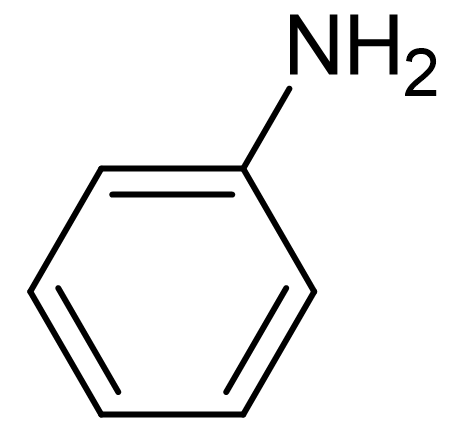
Aniline is the simplest aromatic primary amine and consists of a benzene ring directly bonded to an amino group. Its structure makes it an important model compound in studies of aromatic amines, including investigations of hydrogen bonding, molecular hydration, spectroscopy and excited-state dynamics. Experimental studies of aniline–water systems have shown that the amino group participates in intermolecular interactions and strongly influences the organization of molecular clusters. Aniline is also extensively investigated as a reactive aromatic monomer. Oxidative polymerization of aniline produces polyaniline and related oligomeric structures, with the composition and morphology of the products depending strongly on reaction conditions such as acidity and the oxidizing agent. Because of this behavior, aniline is widely studied in polymer chemistry, materials science and reaction-mechanism research. It is also used as a starting compound in the synthesis of numerous aromatic derivatives and other industrially relevant chemical intermediates.
Chemical and physical properties
Aniline is a liquid under ambient conditions. Published experimental data report a melting point of approximately −6 °C and a boiling point close to 184 °C.
Measurements at 293.15 K and atmospheric pressure have reported a density of approximately 1.021 g/cm3 and a dynamic viscosity of about 4.4 mPa·s.
Aniline is only partially miscible with water. Experimental solubility measurements report approximately 3.6 mass% aniline in water near 25 °C, with its solubility increasing as temperature rises.
The amino group of aniline can participate in hydrogen-bonding interactions, while the aromatic ring influences its electronic and spectroscopic properties. These features make aniline a frequently investigated model compound for aromatic amine interactions and molecular association.
Applications
Aniline is extensively used as a starting material in polymer chemistry. Its oxidative polymerization produces polyaniline, a conducting and responsive polymer investigated in the form of films, granules, nanotubes, nanowires and other micro- and nanostructures.
It is also used as a chemical intermediate in the synthesis of dyes, antioxidants, rubber-related chemicals and other aromatic compounds.
In research, aniline serves as a model aromatic amine in spectroscopic, photochemical and physicochemical studies, including investigations of hydrogen bonding, molecular clusters, reaction kinetics and intermolecular interactions.
Safety Information


Signal Word: ⚠️ Danger
H301+H311+H331 (31.2%): Toxic if swallowed, in contact with skin or if inhaled [Danger Acute toxicity, oral; acute toxicity, dermal; acute toxicity, inhalation]
H301 (98.2%): Toxic if swallowed [Danger Acute toxicity, oral]
H311 (99.4%): Toxic in contact with skin [Danger Acute toxicity, dermal]
H317 (99.4%): May cause an allergic skin reaction [Warning Sensitization, Skin]
H318 (99.3%): Causes serious eye damage [Danger Serious eye damage/eye irritation]
H330 (11.5%): Fatal if inhaled [Danger Acute toxicity, inhalation]
H331 (98.9%): Toxic if inhaled [Danger Acute toxicity, inhalation]
H341 (99.5%): Suspected of causing genetic defects [Warning Germ cell mutagenicity]
H351 (99.8%): Suspected of causing cancer [Warning Carcinogenicity]
H372 (99.8%): Causes damage to organs through prolonged or repeated exposure [Danger Specific target organ toxicity, repeated exposure]
H373 (26.6%): May causes damage to organs through prolonged or repeated exposure [Warning Specific target organ toxicity, repeated exposure]
H400 (99.7%): Very toxic to aquatic life [Warning Hazardous to the aquatic environment, acute hazard]
H410 (16.8%): Very toxic to aquatic life with long lasting effects [Warning Hazardous to the aquatic environment, long-term hazard]
P203, P260, P261, P262, P264, P264+P265, P270, P271, P272, P273, P280, P284, P301+P316, P302+P352, P304+P340, P305+P354+P338, P316, P317, P318, P319, P320, P321, P330, P333+P317, P361+P364, P362+P364, P391, P403+P233, P405, and P501
Handling and Storage
-
Handling: Avoid inhalation and skin contact. Use with adequate ventilation
-
Storage: Store in a tightly closed container in a cool, dry, well-ventilated place away from light, oxidizers, and acids
Environmental Considerations
Aniline is hazardous to aquatic environments. Prevent any release into waterways or soil. Dispose of waste responsibly.