
 CATEGORIES
- ORGANIC COMPOUNDS(1064)
- Metal-organic compounds(1)
- Sulfonic acids(6)
- Thiols(1)
- Alcohols(73)
- Aldehydes(41)
- Alkyl nitrites(6)
- Amines(51)
- Aminoacids(58)
- Amides(29)
- Anhydrides(11)
- Acyl Halides(5)
- Carboxylic Acids(161)
- Dyes and Indicators(96)
- Esters(41)
- Ethers(18)
- Organic Halogens (Organohalides)(25)
- Flavonoids(5)
- Heterocycles(21)
- Hydrocarbons(31)
- Imides(2)
- Ketones(26)
- Mixed solvents(17)
- Nitro Compounds(5)
- Nitriles(9)
- Organic salts(74)
- Phenols(30)
- Polymers ( HMW compounds )(61)
- Sugars (Saccharides)(24)
- Silicoorgano and Phosphoorganocompounds(1)
- Peptides(2)
- Terpenes(12)
- Others(123)
- INORGANIC COMPOUNDS(1012)
- LAB EQUIPMENT(5176)
- *(1)
- Organic Synthesis(398)
- Industry(756)
Language
US version allows shipping to all available destinations


 MANUFACTURER
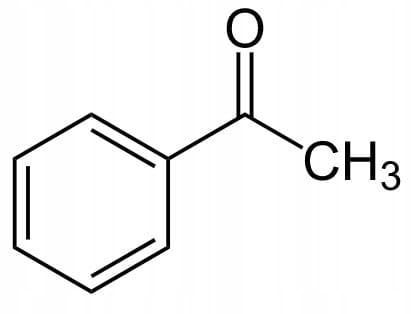
Acetophenone (1-Phenylethan-1-one)
Regular price:
Regular price:
product unavailable
add to wish list
0

 "Pin It")
Description
Acetophenone
Other Names: 1-Phenylethanone, Methyl Phenyl Ketone, Phenyl Methyl Ketone, Acetylbenzene, Benzoyl Methide, Phenylethanone, Hypnone
Chemical Formula: C8H8O
Molar Mass: 120.15 g/mol
CAS Number: 98-86-2
EC Number: 202-708-7
Appearance: Colorless to pale yellow liquid, which may crystallize at temperatures below approximately 20 °C
Odor: Characteristic sweet, floral, slightly almond-like odor
SMILES: CC(=O)C1=CC=CC=C1
Acetophenone, also known as 1-phenylethanone or methyl phenyl ketone, is an aromatic ketone consisting of a benzene ring directly bonded to an acetyl group. It is one of the simplest aromatic ketones and represents an important model compound in organic chemistry, catalysis, photochemistry and molecular spectroscopy. Its molecular structure combines the electronic characteristics of an aromatic ring with the reactivity of a carbonyl functional group, enabling numerous chemical transformations. Acetophenone is widely used as a starting material in organic synthesis and as an intermediate in the preparation of aromatic alcohols, α,β-unsaturated ketones, heterocyclic compounds and other functional organic derivatives. The presence of a methyl group adjacent to the carbonyl functionality allows the formation of enol and enolate intermediates, making acetophenone particularly suitable for carbon–carbon bond-forming reactions. Its reduction produces 1-phenylethanol, a chiral secondary alcohol extensively investigated in asymmetric catalysis and biocatalytic synthesis. Acetophenone is also an important reference compound in photochemical research because its aromatic carbonyl group exhibits well-characterized excited-state behavior, including intersystem crossing and triplet-state formation. These properties make it valuable for investigating molecular energy transfer, photoreduction and the mechanisms of light-induced chemical transformations.
Chemical and physical properties
Acetophenone is generally a clear, colorless liquid under normal ambient conditions. Published experimental data report a melting point of approximately 19–20 °C and a boiling point close to 202 °C at atmospheric pressure. Because its melting point is relatively close to room temperature, acetophenone may solidify or form crystals during storage in cooler environments. The solid material returns to the liquid state when warmed above its melting temperature.
The density of acetophenone is approximately 1.028 g/cm3 at 20 °C. Its refractive index (nD20) is approximately 1.534, reflecting the optical properties associated with its aromatic ring and polar carbonyl functionality. Published physicochemical data report a vapor pressure of approximately 0.05 kPa at 25 °C, indicating moderate volatility relative to many lower-boiling organic solvents.
Acetophenone is moderately soluble in water, with reported aqueous solubility values of approximately 5.5–6.2 g/L near 25 °C. It is readily soluble in numerous organic solvents, including ethanol, diethyl ether, acetone and chloroform. The aromatic ring contributes to its hydrophobic character, while the carbonyl oxygen can act as a hydrogen-bond acceptor in interactions with water and other polar molecules.
The carbonyl group of acetophenone is conjugated with the benzene ring, allowing electron delocalization between the aromatic system and the carbonyl functionality. This conjugation influences its electronic distribution, ultraviolet absorption and infrared spectroscopic characteristics. The carbonyl stretching vibration typically appears near 1680–1700 cm−1 in infrared spectra, at a lower frequency than that of many nonconjugated saturated ketones.
Acetophenone undergoes typical reactions of aromatic ketones, including nucleophilic addition, reduction, oxidation and condensation. Reduction of its carbonyl group produces 1-phenylethanol, which contains a stereogenic carbon atom and therefore exists as two enantiomers. The stereochemical outcome of this reaction can be controlled through suitable chiral catalysts or biocatalytic systems.
The methyl group adjacent to the carbonyl functionality contains α-hydrogen atoms that can participate in enolization and enolate formation. Under suitable reaction conditions, acetophenone undergoes aldol-type condensation reactions with aldehydes. For example, condensation with benzaldehyde produces chalcone, an α,β-unsaturated aromatic ketone extensively investigated in synthetic and materials chemistry.
Acetophenone also exhibits characteristic photophysical behavior. Upon absorption of ultraviolet radiation, the molecule can undergo electronic excitation followed by intersystem crossing to triplet excited states. Experimental and theoretical investigations have identified the importance of closely spaced nπ* and ππ* excited states in determining its photochemical reactivity. The relative energies and populations of these states depend on the surrounding solvent environment.
The compound is combustible and should be handled with appropriate laboratory precautions. Its vapor can cause irritation, and exposure should be controlled through suitable ventilation and protective equipment.
Applications
Acetophenone is extensively used as a starting material and intermediate in organic synthesis. Its aromatic ketone structure makes it suitable for the preparation of a wide range of functional compounds through carbonyl transformations, condensation reactions and aromatic substitution chemistry. It is particularly valuable in the synthesis of substituted aromatic ketones, secondary alcohols, imines and α,β-unsaturated carbonyl compounds.
One of the most important synthetic applications of acetophenone is the preparation of chalcones through Claisen–Schmidt condensation. In this reaction, acetophenone reacts with benzaldehyde or substituted aromatic aldehydes to form conjugated α,β-unsaturated ketones. Scientific research has investigated various catalytic systems for this transformation, including solid-base catalysts, activated hydrotalcites and functionalized ionic liquids. These studies demonstrate the importance of catalyst composition, reaction medium and temperature in controlling reaction efficiency and product formation.
Research published in the Journal of Catalysis demonstrated the use of activated hydrotalcites as heterogeneous catalysts for the condensation of acetophenone with benzaldehyde. The investigators examined the influence of catalyst composition and water content on catalytic performance. The results showed that the properties of the rehydrated magnesium–aluminium mixed oxide catalysts strongly affected reaction activity. These findings are relevant to the development of heterogeneous catalytic processes for carbon–carbon bond formation.
Acetophenone is also widely investigated as a model substrate in asymmetric hydrogenation. Its reduction to 1-phenylethanol provides a convenient method for evaluating the activity and enantioselectivity of chiral catalysts. Research involving ruthenium complexes has demonstrated highly selective hydrogenation of acetophenone to optically enriched secondary alcohols. A study published in Chemistry – An Asian Journal reported the preparation of (S)-1-phenylethanol with 96% enantiomeric excess using a chiral ruthenium catalyst. Such investigations contribute to the understanding of catalytic hydrogen transfer, stereoselectivity and metal–ligand cooperation.
In biocatalysis, acetophenone is frequently employed as a model ketone for investigating stereoselective enzymatic reductions. Alcohol dehydrogenases and whole-cell biocatalysts can convert acetophenone into optically active 1-phenylethanol under relatively mild reaction conditions. Experimental research using plant-derived biocatalysts has demonstrated the preparation of (S)-1-phenylethanol with high enantiomeric purity. Other investigations involving bacterial microorganisms have shown selective formation of the corresponding (R)-enantiomer. These studies are relevant to the development of sustainable methods for producing chiral organic intermediates.
In photochemistry, acetophenone serves as a reference compound for studying the behavior of electronically excited aromatic ketones. Its photophysical properties have been investigated using time-resolved spectroscopy, transient absorption measurements and theoretical calculations. Scientific studies have examined intersystem crossing, triplet-state formation, hydrogen-atom abstraction and photoreduction pathways. The compound's relatively simple molecular structure makes it particularly useful for comparing experimental observations with quantum chemical predictions.
Research published in the Journal of Physical Chemistry B examined the effects of solvent polarity on the low-lying excited triplet states of acetophenone derivatives. The investigators demonstrated that the relative populations of nπ* and ππ* triplet states are influenced by the solvent environment. These findings provide insight into the relationship between electronic structure, molecular surroundings and the photochemical reactivity of aromatic carbonyl compounds.
Acetophenone is also investigated in theoretical and computational chemistry. Its excited-state electronic structure provides a challenging model for evaluating quantum chemical methods used to describe photochemical reaction pathways. Studies using time-dependent density functional theory have examined the formation of triplet acetophenone through electronic-state crossings involving singlet and triplet states. Such investigations are relevant to the development and validation of computational methods for predicting molecular photochemistry.
In industrial chemistry, acetophenone can be used as an organic solvent and chemical intermediate in the processing of selected resins and specialty chemicals. Its relatively high boiling point, aromatic structure and carbonyl functionality contribute to its solvent characteristics. Compatibility with a particular polymer or resin depends on the material composition and operating conditions.
Acetophenone is additionally used in fragrance chemistry as an aromatic component and as an intermediate in the synthesis of fragrance-related compounds. Its characteristic sweet, floral odor makes it relevant to investigations of aromatic carbonyl compounds and their structure–odor relationships. Chemical modification of acetophenone can produce derivatives with different olfactory and physicochemical properties.
In analytical chemistry, acetophenone is used as a reference compound for studying aromatic ketones using gas chromatography, mass spectrometry, infrared spectroscopy, ultraviolet–visible spectroscopy and nuclear magnetic resonance spectroscopy. Its well-characterized molecular structure and spectroscopic behavior make it suitable for method development, compound identification and comparative studies of substituted acetophenone derivatives.
Acetophenone is also an important model compound in studies of reaction mechanisms, catalytic selectivity, molecular interactions and organic photochemistry. Its combination of aromatic conjugation, carbonyl reactivity and enolizable α-hydrogen atoms provides opportunities for investigating a broad range of fundamental and applied chemical processes.
Scientific references
1. National Institute of Standards and Technology (NIST). Chemistry WebBook, SRD 69: Acetophenone, CAS 98-86-2. Chemical identification, molecular formula, molecular mass, boiling point, thermodynamic properties and infrared, ultraviolet and mass spectrometric reference data.
https://webbook.nist.gov/cgi/cbook.cgi?ID=C98862
2. National Center for Biotechnology Information (NCBI). PubChem Compound Summary: Acetophenone, CID 7410. Molecular structure, physicochemical properties, chemical identifiers, solubility, density, vapor pressure and canonical SMILES representation.
https://pubchem.ncbi.nlm.nih.gov/compound/7410
3. Climent, M. J.; Corma, A.; Iborra, S.; Velty, A. (2004). Activated hydrotalcites as catalysts for the synthesis of chalcones of pharmaceutical interest. Journal of Catalysis, 221(2), 474–482. Experimental investigation of the Claisen–Schmidt condensation between acetophenone and benzaldehyde using heterogeneous solid-base catalysts.
https://doi.org/10.1016/j.jcat.2003.09.012
4. Sandoval, C. A.; Ohkuma, T.; Utsumi, N.; Tsutsumi, K.; Murata, K.; Noyori, R. (2006). Mechanism of asymmetric hydrogenation of acetophenone catalyzed by chiral η6-arene-N-tosylethylenediamine-ruthenium(II) complexes. Chemistry – An Asian Journal, 1(1–2), 102–110. Investigation of enantioselective acetophenone hydrogenation and the catalytic formation of optically active 1-phenylethanol.
https://doi.org/10.1002/asia.200600098
5. Atak, G. B.; Bayraktar, E.; Mehmetoglu, Ü. (2019). Optimization of the asymmetric synthesis of (S)-1-phenylethanol using Ispir bean as whole-cell biocatalyst. Green Processing and Synthesis, 8(1), 525–532. Experimental research on the asymmetric bioreduction of acetophenone using a plant-derived biocatalytic system.
https://doi.org/10.1515/gps-2019-0021
6. Berger, M.; Steel, C. (1975). Photochemical and photophysical processes in acetophenone. Journal of the American Chemical Society, 97(17), 4817–4821. Investigation of the electronic excited states and photophysical behavior of acetophenone.
https://doi.org/10.1021/ja00850a006
7. Huix-Rotllant, M.; Siri, D.; Ferré, N. (2013). Theoretical study of the photochemical generation of triplet acetophenone. Physical Chemistry Chemical Physics, 15, 19293–19300. Quantum chemical investigation of electronic excitation, intersystem crossing and triplet-state formation in acetophenone.
https://doi.org/10.1039/C3CP52703D
8. Huix-Rotllant, M.; Ferré, N. (2014). Triplet state photochemistry and the three-state crossing of acetophenone within time-dependent density-functional theory. The Journal of Chemical Physics, 140(13), 134305. Computational investigation of excited-state reaction pathways and electronic-state crossings in acetophenone.
https://doi.org/10.1063/1.4869802
9. Narra, S.; Shigeto, S. (2015). Direct observation of the solvent effects on the low-lying nπ* and ππ* excited triplet states of acetophenone derivatives in thermal equilibrium. The Journal of Physical Chemistry B, 119(9), 3808–3814. Time-resolved spectroscopic investigation of solvent-dependent electronic states and photochemical reactivity in acetophenone derivatives.
https://doi.org/10.1021/jp512494m
Safety Information

Signal Word: ⚠️ Warning
Hazard Statements:
-
H302: Harmful if swallowed
-
H319: Causes serious eye irritation
Precautionary Statements:
-
P261: Avoid breathing vapors
-
P280: Wear protective gloves and eye protection
-
P301+P312: IF SWALLOWED: Call a POISON CENTER or doctor if you feel unwell
-
P305+P351+P338: IF IN EYES: Rinse cautiously with water for several minutes. Remove contact lenses if present and easy to do. Continue rinsing
-
P501: Dispose of contents/container in accordance with local/regional/national regulations
Handling and Storage
-
Handling: Avoid contact with skin, eyes, and clothing. Prevent vapor buildup. Use in well-ventilated areas
-
Storage: Store in tightly closed containers in a cool, dry, and ventilated area. Keep away from oxidizing agents
Environmental Considerations
Acetophenone is toxic to aquatic organisms in large quantities. Avoid environmental release. Follow proper disposal procedures to minimize ecological risk.