
 CATEGORIES
- ORGANIC COMPOUNDS(1306)
- Thiols(0)
- Metal-organic compounds(1)
- Sulfonic acids(6)
- Alcohols(82)
- Aldehydes(59)
- Alkyl nitrites(6)
- Amines(82)
- Aminoacids(78)
- Amides(33)
- Anhydrides(11)
- Acyl Halides(5)
- Carboxylic Acids(207)
- Dyes and Indicators(107)
- Esters(56)
- Ethers(17)
- Organic Halogens (Organohalides)(35)
- Flavonoids(5)
- Heterocycles(43)
- Hydrocarbons(42)
- Imides(2)
- Ketones(32)
- Mixed solvents(16)
- Nitro Compounds(14)
- Nitriles(9)
- Organic salts(74)
- Phenols(37)
- Polymers ( HMW compounds )(66)
- Sugars (Saccharides)(24)
- Silicoorgano and Phosphoorganocompounds(1)
- Peptides(2)
- Terpenes(19)
- Others(137)
- INORGANIC COMPOUNDS(1136)
- LAB EQUIPMENT(5179)
- *(1)
- Organic Synthesis(498)
- Industry(804)
Language
US version allows shipping to all available destinations


 MANUFACTURER
1-(2-FLUOROPHENYL)-2-NITROPROPENE
Regular price:
Regular price:
product unavailable
add to wish list
0

-2-NITROPROPENE "Pin It")
Description
1-(2-Fluorophenyl)-2-nitropropene
Other Names:
-
1-Fluoro-2-[(1E)-2-nitroprop-1-en-1-yl]benzene
-
(E)-1-(2-Fluorophenyl)-2-nitropropene
-
2-Fluorophenyl-2-nitropropene
CAS Number: 705-60-2
Sum Formula: C₉H₈FNO₂
Molar Mass: 181.16 g/mol
Appearance: Yellow crystalline solid or powder
1-(2-Fluorophenyl)-2-nitropropene is a nitroalkene compound featuring a fluorine-substituted aromatic ring and a conjugated nitropropene side chain. It is used primarily in organic synthesis and structure–reactivity studies of substituted nitroalkenes.
Chemical and Physical Properties
Density: Approx. 1.25 g/cm³ (estimated)
Melting Point: ~54–58°C
Boiling Point: Decomposes before boiling
Solubility in Water: Practically insoluble
Solubility in Other Solvents: Soluble in ethanol, acetone, DCM, and other organic solvents
Odor: Mild aromatic odor
Applications
Organic Synthesis: Intermediate in the preparation of fluorinated aromatic derivatives.
Chemical Research: Used in studies involving conjugated nitroalkenes, electrophilic addition, and nucleophilic substitution reactions.
Fluorinated Building Blocks: Applied in synthesis of functional molecules and specialty chemical frameworks.
Safety

Signal Word: Warning
H302 (97.5%): Harmful if swallowed [Warning Acute toxicity, oral]
H315 (97.5%): Causes skin irritation [Warning Skin corrosion/irritation]
H319 (97.5%): Causes serious eye irritation [Warning Serious eye damage/eye irritation]
H335 (97.5%): May cause respiratory irritation [Warning Specific target organ toxicity, single exposure; Respiratory tract irritation]
P261, P264, P264+P265, P270, P271, P280, P301+P317, P302+P352, P304+P340, P305+P351+P338, P319, P321, P330, P332+P317, P337+P317, P362+P364, P403+P233, P405, and P501
Handling and Storage
Storage Conditions: Store in a tightly closed container in a cool, dry, and well-ventilated area. Protect from light, heat, and strong oxidizing agents.
Handling Precautions: Avoid dust formation and contact with skin or eyes. Use personal protective equipment and handle under appropriate ventilation.
Safety
Shipping costs
The price does not include any possible payment costs
Related products
1-(2,4,5-TRIMETHOXYPHENYL)-2-NITROPROPENE
Net price: €6.18
1-(3-FLUOROPHENYL)-2-NITROPROPENE
Net price: €6.18
1-(3,4,5-TRIMETHOXYPHENYL)-2-NITROPROPENE
Net price: €6.18
2,5-DIMETHOXY-BETA-NITROSTYRENE
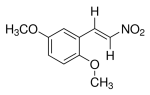
Net price: €6.18
Nitroethane C2H5NO2 [ CAS: 79-24-3 ] - 1000ml 1L
![Nitroethane C2H5NO2 [ CAS: 79-24-3 ] - 1000ml 1L](/environment/cache/images/productGfx_14874_150_150/2024-10-04_02h45_15.png?overlay=1)
Net price: €323.13
4-Fluoro-P2NP | 4F-P2NP | 1-(4-Fluorophenyl)-2-nitropropene )
Net price: €6.18