
 CATEGORIES
- ORGANIC COMPOUNDS(1135)
- Thiols(1)
- Metal-organic compounds(1)
- Sulfonic acids(6)
- Alcohols(74)
- Aldehydes(47)
- Alkyl nitrites(6)
- Amines(56)
- Aminoacids(59)
- Amides(33)
- Anhydrides(11)
- Acyl Halides(5)
- Carboxylic Acids(170)
- Dyes and Indicators(99)
- Esters(52)
- Ethers(17)
- Organic Halogens (Organohalides)(30)
- Flavonoids(5)
- Heterocycles(25)
- Hydrocarbons(38)
- Imides(2)
- Ketones(29)
- Mixed solvents(16)
- Nitro Compounds(5)
- Nitriles(9)
- Organic salts(74)
- Phenols(30)
- Polymers ( HMW compounds )(68)
- Sugars (Saccharides)(24)
- Silicoorgano and Phosphoorganocompounds(1)
- Peptides(2)
- Terpenes(16)
- Others(126)
- INORGANIC COMPOUNDS(1055)
- LAB EQUIPMENT(5176)
- *(1)
- Organic Synthesis(421)
- Industry(775)
Language
US version allows shipping to all available destinations


 MANUFACTURER
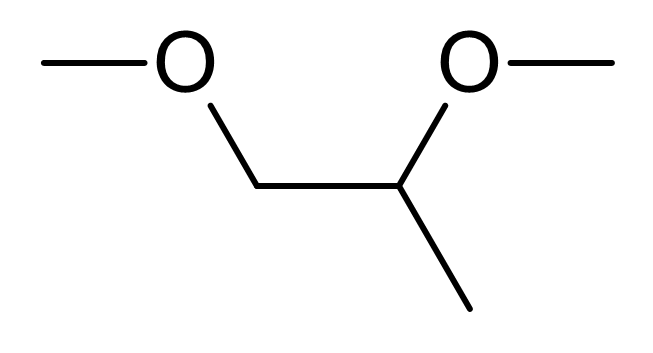
1,2-Dimethoxypropane
Regular price:
Regular price:
product unavailable
add to wish list
0

Description
1,2-Dimethoxypropane
Other Names: Propylene Glycol Dimethyl Ether, 1,2-DMP, PGDME
Chemical Formula: C5H12O2
Structural Formula: CH3CH(OCH3)CH2OCH3
Molar Mass: 104.15 g/mol
CAS Number: 7778-85-0
Appearance: Colorless liquid
1,2-Dimethoxypropane is an aliphatic diether structurally related to 1,2-dimethoxyethane (glyme). Its molecule contains two ether oxygen atoms separated by a two-carbon framework carrying an additional methyl substituent. The compound has the molecular formula C5H12O2, a molar mass of 104.15 g/mol and CAS Registry Number 7778-85-0.
The carbon atom at position 2 is bonded to four different substituents and therefore constitutes a stereogenic center. Consequently, 1,2-dimethoxypropane can exist as R and S enantiomers. Molecular-dynamics investigations have specifically examined chiral discrimination and solvation behavior of the two enantiomeric forms in different solvents.
Chemical and physical properties
1,2-Dimethoxypropane is a volatile liquid under ambient conditions. NIST reference data report a normal boiling point of approximately 369.2 K, corresponding to about 96 °C. Its relatively low boiling point makes it considerably more volatile than many higher glyme-type solvents.
Both ether oxygen atoms act as Lewis-basic and hydrogen-bond-accepting sites. The molecule contains no O–H bond and therefore behaves as an aprotic ether solvent. Molecular simulation studies have investigated its structure and dynamics in the neat liquid as well as in water, methanol, carbon tetrachloride and n-heptane, demonstrating that its conformational and solvation behavior depends strongly on the surrounding solvent environment.
Compared with 1,2-dimethoxyethane, introduction of the additional methyl group increases steric hindrance around the ether coordination environment. Electrochemical studies have shown that this structural modification decreases its effective solvating power toward lithium ions and promotes stronger participation of electrolyte anions in the lithium-ion solvation shell.
Applications
1,2-Dimethoxypropane can be used as an ether solvent and as a model compound in studies of molecular solvation, liquid structure and intermolecular interactions. Its close structural relationship to 1,2-dimethoxyethane makes it particularly useful for investigating how methyl substitution and steric effects modify ether coordination and solvent behavior.
The compound has attracted considerable interest as an electrolyte solvent for lithium-metal batteries. Research published in ACS Energy Letters demonstrated that electrolytes based on 1,2-dimethoxypropane exhibit weaker lithium-ion solvation than analogous 1,2-dimethoxyethane systems. This favors contact-ion-pair and aggregate-type structures and can promote formation of anion-derived electrode interphases. Such electrolyte systems have been investigated with LiFePO4 and high-nickel layered oxide cathodes at elevated operating voltages.
More recent research has investigated 1,2-dimethoxypropane as a functional component of carbonate-based lithium-metal battery electrolytes. Its combination of relatively weak solvation, steric hindrance and ability to assist dissolution of lithium salts such as LiNO3 has been used to modify electrolyte solvation structures and electrode-electrolyte interphases.
In organic chemistry, 1,2-dimethoxypropane can also serve as an ether-containing starting material or reaction medium in transformations where an aprotic, Lewis-basic solvent environment is required. Its two oxygen atoms provide coordination sites for cations and other Lewis-acidic species, while the absence of protic functional groups limits proton-donating interactions.
Handling and stability
1,2-Dimethoxypropane is a low-boiling and highly flammable ether. It should therefore be handled away from ignition sources and with appropriate ventilation. Ether compounds may undergo autoxidation during prolonged exposure to oxygen and light, potentially producing peroxide species; appropriate storage practices and periodic peroxide assessment are therefore important when material is stored for extended periods.
Scientific references
NIST Chemistry WebBook, SRD 69. Propane, 1,2-dimethoxy-. CAS Registry Number 7778-85-0.
Hezaveh, S.; Samanta, S.; Milano, G.; Roccatano, D. Structure and dynamics of 1,2-dimethoxyethane and 1,2-dimethoxypropane in aqueous and non-aqueous solutions: a molecular dynamics study. The Journal of Chemical Physics, 2011, 135, 164501. DOI: 10.1063/1.3643417.
Exploiting the Steric Effect and Low Dielectric Constant of 1,2-Dimethoxypropane for 4.3 V Lithium Metal Batteries. ACS Energy Letters, 2023. DOI: 10.1021/acsenergylett.2c02003.
Insights Into 1,2-Dimethoxypropane Mediated Dissolution of Low-Solubility LiNO3 in Carbonate Electrolytes Toward High-Voltage Lithium-Metal Batteries. Advanced Functional Materials, 2026. DOI: 10.1002/adfm.75598.
Safety

Signal Word: Danger
P210, P233, P240, P241, P242, P243, P280, P303+P361+P353, P370+P378, P403+P235, and P501
First Aid Measures
Eye Contact: Rinse cautiously with water for several minutes. Seek medical attention if irritation persists
Skin Contact: Wash with soap and water. Remove contaminated clothing
Inhalation: Move to fresh air. Seek medical help if symptoms occur
Ingestion: Rinse mouth with water. Do not induce vomiting. Seek medical advice immediately
Handling and Storage
Store in tightly sealed containers in a cool, dry, and well-ventilated place
Keep away from ignition sources, heat, and oxidizing agents
Use only under fume hood or with proper ventilation