
 CATEGORIES
- ORGANIC COMPOUNDS(1129)
- Thiols(1)
- Metal-organic compounds(1)
- Sulfonic acids(6)
- Alcohols(74)
- Aldehydes(47)
- Alkyl nitrites(6)
- Amines(55)
- Aminoacids(59)
- Amides(33)
- Anhydrides(11)
- Acyl Halides(5)
- Carboxylic Acids(170)
- Dyes and Indicators(99)
- Esters(52)
- Ethers(17)
- Organic Halogens (Organohalides)(30)
- Flavonoids(5)
- Heterocycles(24)
- Hydrocarbons(34)
- Imides(2)
- Ketones(29)
- Mixed solvents(16)
- Nitro Compounds(5)
- Nitriles(9)
- Organic salts(74)
- Phenols(30)
- Polymers ( HMW compounds )(68)
- Sugars (Saccharides)(24)
- Silicoorgano and Phosphoorganocompounds(1)
- Peptides(2)
- Terpenes(16)
- Others(126)
- INORGANIC COMPOUNDS(1055)
- LAB EQUIPMENT(5176)
- *(1)
- Organic Synthesis(417)
- Industry(775)
Language
US version allows shipping to all available destinations


 MANUFACTURER
Retinyl Palmitate Vitamin A
Regular price:
Regular price:
product unavailable
add to wish list
0

Description
Retinyl Palmitate
Other Names: Vitamin A Palmitate, Retinol Palmitate, Retinyl Hexadecanoate, Retinol Hexadecanoate, all-trans-Retinyl Palmitate
Chemical Formula: C36H60O2
Molar Mass: 524.86 g/mol
CAS Number: 79-81-2
SMILES: CCCCCCCCCCCCCCCC(=O)OC/C=C(\C)/C=C/C=C(\C)/C=C/C1=C(CCCC1(C)C)C
Appearance: Pale yellow, low-melting solid or oily material near room temperature
Odor: Not specifically characterized in standard scientific references
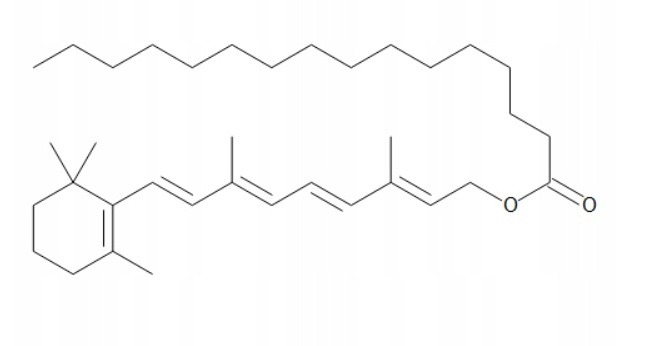
Retinyl palmitate is a lipophilic retinyl ester formed from retinol and palmitic acid. Structurally, it contains the conjugated polyene system and β-ionone-type ring characteristic of vitamin A compounds together with a long-chain hexadecanoate ester group. The extended system of conjugated double bonds is responsible for many of its characteristic spectroscopic properties but also contributes to sensitivity toward light and oxidative degradation. Retinyl palmitate is extensively investigated in retinoid chemistry, dermatological research, formulation science, photochemistry and analytical chemistry.
Chemical and physical properties
Retinyl palmitate has a molecular mass of approximately 524.86 g/mol and is a strongly lipophilic compound. Pure material has a relatively low melting range, typically reported at approximately 28–29 °C. Consequently, depending on storage temperature and formulation, it may occur as a low-melting solid, semi-solid or oily material.
The compound is practically insoluble in water but soluble in many organic solvents and lipid phases. Its long hydrocarbon ester chain and largely non-polar retinoid skeleton account for its high affinity for hydrophobic environments. This property is important in extraction, chromatographic separation and formulation studies involving retinyl esters.
Retinyl palmitate is sensitive to ultraviolet and visible light. Irradiation can cause degradation and geometrical isomerization of the conjugated polyene chain, including formation of cis-retinyl palmitate isomers. Experimental studies have therefore investigated stabilization using antioxidants, photoprotective formulation systems and matrices that restrict molecular mobility.
Oxidative degradation is another important stability consideration. The conjugated double-bond system is susceptible to reactions initiated by oxygen, light and free radicals. Antioxidants such as butylated hydroxytoluene have been shown experimentally to improve the stability of retinyl palmitate in model formulations. Protection from light, oxygen and elevated temperature is therefore important during physicochemical and analytical studies.
Applications
Retinyl palmitate is widely investigated as a retinoid ingredient in cosmetic and dermatological formulation research. Studies using human and animal skin models have examined its penetration into the stratum corneum and epidermis, as well as its enzymatic hydrolysis to retinol following topical application. Its relatively high lipophilicity strongly influences its penetration, distribution and metabolism in biological membranes and skin layers.
In formulation science, retinyl palmitate is used as a model light-sensitive and oxidation-sensitive lipophilic active compound. Emulsions, liposomes, gels, lipid matrices and other delivery systems have been evaluated for their ability to improve its chemical and photochemical stability. Such studies are useful for investigating stabilization strategies for chemically sensitive retinoids.
Retinyl palmitate is also used as an analytical reference compound in high-performance liquid chromatography and liquid chromatography–mass spectrometry. Reversed-phase HPLC methods have been developed for simultaneous determination of retinol, retinyl palmitate and other retinoids in biological samples and cosmetic formulations. Its strong ultraviolet absorption associated with the conjugated polyene chromophore permits sensitive chromatographic detection.
In biochemical research, retinyl palmitate is studied as an esterified storage and transport-related form of retinol. Hydrolysis of retinyl esters releases retinol, which can subsequently participate in retinoid metabolic pathways. This makes retinyl palmitate useful for studies of retinoid metabolism, esterification, hydrolysis, tissue distribution and vitamin A homeostasis.
Retinyl palmitate is additionally employed in photochemical research as a model conjugated retinoid. Controlled irradiation experiments are used to investigate photoisomerization, photodegradation kinetics, radical-mediated decomposition and interactions between retinoids and ultraviolet-filter systems.
Scientific references
- PubChem. Retinol Palmitate, CID 5280531. National Center for Biotechnology Information. Molecular formula, molecular weight, CAS number, structural identifiers and canonical chemical structure.
- Antille, C.; Tran, C.; Sorg, O.; Saurat, J. H. Penetration and metabolism of topical retinoids in ex vivo organ-cultured full-thickness human skin explants. Skin Pharmacology and Physiology, 2004, 17(3), 124–128. DOI: 10.1159/000077238.
- Hubinger, J. C. Determination of retinol, retinyl palmitate, and retinoic acid in consumer cosmetic products. Journal of Cosmetic Science, 2009, 60(5), 485–500.
- van Breemen, R. B.; Nikolic, D.; Xu, X.; Xiong, Y.; van Lieshout, M.; West, C. E.; Schilling, A. B. Development of a method for quantitation of retinol and retinyl palmitate in human serum using high-performance liquid chromatography-atmospheric pressure chemical ionization-mass spectrometry. Journal of Chromatography A, 1998, 794, 245–251. DOI: 10.1016/S0021-9673(97)01138-2.
- Carlotti, M. E.; Rossatto, V.; Gallarate, M. Vitamin A palmitate photostability and stability over time. Journal of Cosmetic Science, 2004, 55(3), 233–252.
- Scarpin, M. S.; Kawakami, C. M.; Rangel, K. C.; Pereira, K. C.; Benevenuto, C. G.; Gaspar, L. R. Effects of UV-filter photostabilizers in the photostability and phototoxicity of vitamin A palmitate combined with avobenzone and octyl methoxycinnamate. Photochemistry and Photobiology, 2021, 97(4), 700–709. DOI: 10.1111/php.13407.
- Yan, J.; Xia, S.; Wang, X.; Zhang, Z.; Tian, H. Kinetic study on photostability of retinyl palmitate entrapped in policosanol oleogels. Food Chemistry, 2018, 255, 144–150. DOI: 10.1016/j.foodchem.2018.02.025.
- Boerman, M. H. E. M.; Napoli, J. L. Cellular retinol-binding protein-supported retinoic acid synthesis. Journal of Biological Chemistry, 1996, 271, 5610–5616.
Safety

Signal word: Danger
Hazard statements:
H360D May damage the unborn child.
H413 May cause long-lasting harmful effects to aquatic life.
Precautionary statements:
P201
P280
P308+P313
P501
Storage and handling
Store the product in a tightly closed container in a dry, cool and well-ventilated place, away from heat sources, light and incompatible materials. During handling, use appropriate personal protective equipment, avoid inhalation of dust and contact with skin and eyes. Wash hands thoroughly after handling. The product should be used only by persons properly trained to work with chemical substances.