
 CATEGORIES
- ORGANIC COMPOUNDS(1100)
- Thiols(1)
- Metal-organic compounds(1)
- Sulfonic acids(6)
- Alcohols(74)
- Aldehydes(44)
- Alkyl nitrites(6)
- Amines(55)
- Aminoacids(58)
- Amides(34)
- Anhydrides(11)
- Acyl Halides(5)
- Carboxylic Acids(161)
- Dyes and Indicators(99)
- Esters(52)
- Ethers(17)
- Organic Halogens (Organohalides)(29)
- Flavonoids(5)
- Heterocycles(24)
- Hydrocarbons(31)
- Imides(2)
- Ketones(29)
- Mixed solvents(17)
- Nitro Compounds(5)
- Nitriles(9)
- Organic salts(74)
- Phenols(30)
- Polymers ( HMW compounds )(61)
- Sugars (Saccharides)(24)
- Silicoorgano and Phosphoorganocompounds(1)
- Peptides(2)
- Terpenes(12)
- Others(123)
- INORGANIC COMPOUNDS(1010)
- LAB EQUIPMENT(5176)
- *(1)
- Organic Synthesis(414)
- Industry(755)
Language
US version allows shipping to all available destinations


 MANUFACTURER
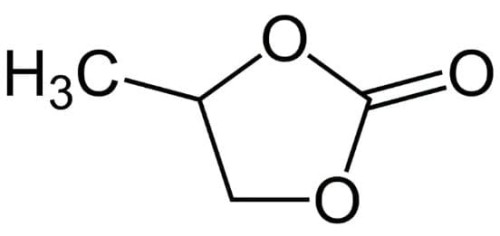
Propylene Carbonate ( 4-Methyl-1,3-dioxolan-2-one)


Regular price:
Regular price:
product unavailable
add to wish list
0

 "Pin It")
Description
Propylene Carbonate
Other Names: 1,2-Propylene carbonate, 4-Methyl-1,3-dioxolan-2-one, Propane-1,2-diol cyclic carbonate, PC
Chemical Formula: C4H6O3
Molar Mass: 102.09 g/mol
CAS Number: 108-32-7
Appearance: Clear, colorless liquid
Odor: Mild characteristic odor
SMILES: CC1COC(=O)O1
Propylene carbonate is a cyclic organic carbonate belonging to the five-membered 1,3-dioxolan-2-one family. Its molecular structure contains a strongly polar carbonate group incorporated into a cyclic framework and a methyl substituent that creates a stereogenic center. Commercial propylene carbonate is generally supplied as a racemic mixture unless a specific enantiomer is prepared. The combination of high molecular polarity, a substantial dielectric constant, low volatility and broad liquid temperature range makes propylene carbonate an important polar aprotic solvent in physical chemistry, electrochemistry and materials science.
The carbonate group provides strong dipolar interactions and effective solvation of many ionic and polar species, while propylene carbonate does not contain an O–H or N–H hydrogen-bond donor. These characteristics distinguish it from polar protic solvents and are important in studies of ion solvation, electrolyte conductivity and electrochemical reactions. Its physicochemical properties have therefore been investigated extensively in connection with non-aqueous electrolytes and energy-storage materials.
Chemical and physical properties
Propylene carbonate is a clear liquid under ambient conditions. Experimental thermophysical data report a melting point of approximately −49 °C and a normal boiling point close to 242 °C. Its combination of a low melting point and relatively high boiling point provides a broad liquid-phase temperature range.
The density of propylene carbonate is approximately 1.20 g/cm3 near room temperature. It has a substantially lower vapor pressure than highly volatile organic solvents, which contributes to reduced evaporative losses during handling and during its use as a reaction or electrolyte medium.
Propylene carbonate has a high relative permittivity, commonly reported near 64 at room temperature. This high dielectric constant promotes dissociation and solvation of many ionic species and is one of the principal reasons for its importance as a solvent for non-aqueous electrolyte systems.
The molecule is strongly polar and possesses a significant molecular dipole moment. Its carbonyl and ether-type oxygen atoms can act as electron-pair donors and hydrogen-bond acceptors. Consequently, propylene carbonate interacts effectively with metal cations, salts and other polar solutes.
Propylene carbonate is chemically stable under many ordinary storage and processing conditions, although the cyclic carbonate group can participate in ring-opening and nucleophilic reactions under appropriate catalytic or strongly reactive conditions. Electrochemical reduction of propylene carbonate is also an important subject in battery research because its decomposition behavior at electrode interfaces depends strongly on electrode composition, electrolyte formulation and operating conditions.
Applications
Propylene carbonate is extensively used as a high-polarity aprotic solvent in chemical synthesis and materials processing. Its high boiling point, low volatility and strong solvating ability make it useful for dissolving polar organic compounds, polymers and selected inorganic salts and for carrying out reactions that require a polar non-protic medium.
One of the most extensively investigated applications of propylene carbonate is as a solvent component in non-aqueous electrolytes. Its high dielectric constant facilitates salt dissociation, making it suitable for electrolyte formulations containing lithium and other metal salts. Propylene carbonate has consequently played an important role in fundamental studies of ion transport, electrolyte conductivity, solvation structures and electrochemical interfaces.
In lithium-based electrochemical systems, propylene carbonate is particularly useful for studying solvent–electrode interactions and solid-electrolyte interphase formation. Its compatibility depends strongly on the electrode material. For example, electrochemical reduction of propylene carbonate on graphitic carbon can lead to solvent co-intercalation and decomposition, whereas appropriate electrode materials, additives or interfacial modifications can substantially alter this behavior.
Propylene carbonate is also used in polymer and materials science as a solvent, processing medium and plasticizing component. Its polarity enables interaction with a variety of polymer matrices, while its low volatility can be advantageous when prolonged solvent retention or controlled evaporation is required.
The cyclic carbonate functionality additionally makes propylene carbonate useful as a model compound and chemical intermediate in studies of carbonate chemistry. Ring-opening reactions with nucleophiles and catalytic transformations of cyclic carbonates are investigated in organic synthesis, catalysis and polymer chemistry.
In physical chemistry, propylene carbonate is frequently employed as a model polar aprotic liquid for studies of dielectric relaxation, molecular dynamics, viscosity, diffusion, ion association and solvation. Its unusually broad liquid range and pronounced dielectric properties make it especially valuable for temperature-dependent investigations of molecular and ionic transport.
Scientific references
Barthel, J.; Buchner, R.; Münsterer, M. Electrolyte Data Collection, Part 2: Dielectric Properties of Water and Aqueous Electrolyte Solutions. DECHEMA Chemistry Data Series, Frankfurt am Main.
Xu, K. “Nonaqueous Liquid Electrolytes for Lithium-Based Rechargeable Batteries.” Chemical Reviews, 2004, 104, 4303–4418. DOI: 10.1021/cr030203g.
Xu, K. “Electrolytes and Interphases in Li-Ion Batteries and Beyond.” Chemical Reviews, 2014, 114, 11503–11618. DOI: 10.1021/cr500003w.
Aurbach, D.; Ein-Eli, Y.; Chusid, O.; Carmeli, Y.; Babai, M.; Yamin, H. “The Correlation Between the Surface Chemistry and the Performance of Li-Carbon Intercalation Anodes for Rechargeable ‘Rocking-Chair’ Type Batteries.” Journal of The Electrochemical Society, 1994, 141, 603–611. DOI: 10.1149/1.2054782.
National Institute of Standards and Technology. NIST Chemistry WebBook, SRD 69. Propylene carbonate, CAS Registry Number 108-32-7.
National Center for Biotechnology Information. PubChem Compound Summary for CID 7924, Propylene Carbonate. PubChem, U.S. National Library of Medicine.