
 CATEGORIES
- ORGANIC COMPOUNDS(1076)
- Metal-organic compounds(1)
- Sulfonic acids(6)
- Thiols(1)
- Alcohols(73)
- Aldehydes(41)
- Alkyl nitrites(6)
- Amines(51)
- Aminoacids(58)
- Amides(29)
- Anhydrides(11)
- Acyl Halides(5)
- Carboxylic Acids(161)
- Dyes and Indicators(96)
- Esters(46)
- Ethers(18)
- Organic Halogens (Organohalides)(29)
- Flavonoids(5)
- Heterocycles(24)
- Hydrocarbons(31)
- Imides(2)
- Ketones(26)
- Mixed solvents(17)
- Nitro Compounds(5)
- Nitriles(9)
- Organic salts(74)
- Phenols(30)
- Polymers ( HMW compounds )(61)
- Sugars (Saccharides)(24)
- Silicoorgano and Phosphoorganocompounds(1)
- Peptides(2)
- Terpenes(12)
- Others(123)
- INORGANIC COMPOUNDS(1012)
- LAB EQUIPMENT(5176)
- *(1)
- Organic Synthesis(410)
- Industry(756)
Language
US version allows shipping to all available destinations


 MANUFACTURER
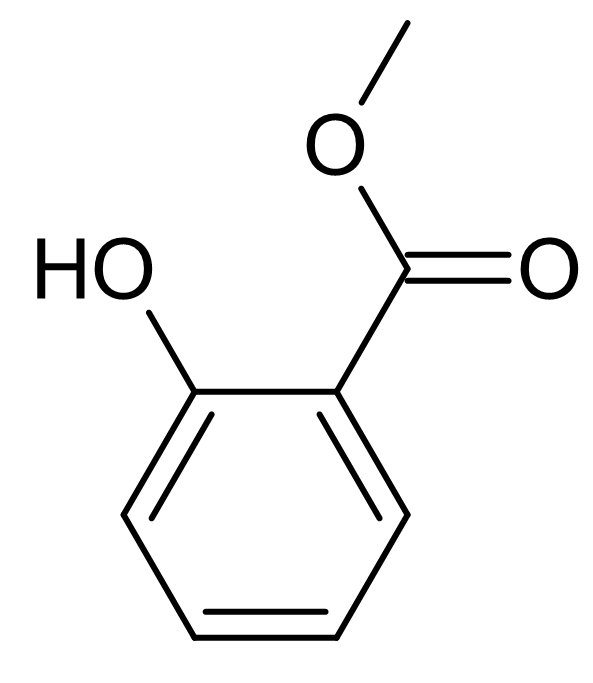
Methyl Salicylate (oil of wintergreen)
Regular price:
Regular price:
product unavailable
add to wish list
0

 "Pin It")
Description
Methyl Salicylate
Other Names: Methyl 2-Hydroxybenzoate, Salicylic Acid Methyl Ester, Methyl o-Hydroxybenzoate, 2-Hydroxybenzoic Acid Methyl Ester, Oil of Wintergreen
Chemical Formula: C8H8O3
Molar Mass: 152.15 g/mol
CAS Number: 119-36-8
EC Number: 204-317-7
Appearance: Colorless to pale yellow, clear oily liquid
Odor: Strong, characteristic wintergreen odor with sweet, minty and aromatic notes
SMILES: COC(=O)C1=CC=CC=C1O
Methyl salicylate is an aromatic organic compound belonging to the family of salicylic acid esters. Its molecular structure consists of a benzene ring containing a hydroxyl group and a methyl ester group in adjacent positions. This arrangement gives the compound distinctive physicochemical, spectroscopic and olfactory properties. Methyl salicylate occurs naturally in several plant species, particularly wintergreen plants and sweet birch, where it contributes to their characteristic aroma. It can also be manufactured synthetically through the esterification of salicylic acid with methanol. The compound is widely used in fragrance chemistry, cosmetic formulations, topical pharmaceutical preparations and organic synthesis. Its molecular structure enables intramolecular hydrogen bonding between the phenolic hydroxyl group and the adjacent ester functionality, influencing its conformational stability and photophysical behavior. Experimental studies have demonstrated that methyl salicylate undergoes excited-state intramolecular proton transfer, making it an important model compound in molecular spectroscopy and photochemistry. It is also investigated as a naturally occurring volatile signaling molecule involved in plant responses to environmental stress and biological interactions.
Chemical and physical properties
Methyl salicylate is a clear, oily liquid under ambient conditions. Published physicochemical data report a melting point of approximately −8.6 °C and a boiling point of approximately 221–223 °C at atmospheric pressure. Its relatively high boiling point reflects intermolecular interactions and the molecular characteristics of the aromatic ester.
The compound has a density of approximately 1.18 g/cm3 at 25 °C and a dynamic viscosity of approximately 1.535 mPa·s at 25 °C. Its vapor pressure is approximately 13 Pa at 20 °C, indicating relatively low volatility compared with many smaller organic solvents. Nevertheless, its strong characteristic odor is readily detectable because of its pronounced olfactory properties.
Methyl salicylate is only slightly soluble in water. Published reference data report aqueous solubility values of approximately 0.6–0.75 g/L near 30 °C. It is readily soluble in many organic solvents, including ethanol, acetone, diethyl ether and chloroform. Its experimental octanol-water partition coefficient, expressed as log P, is approximately 2.55, indicating a preference for organic phases over aqueous environments.
A particularly important structural characteristic of methyl salicylate is the formation of an intramolecular hydrogen bond between its phenolic hydroxyl group and the carbonyl oxygen of the ester functionality. Rotational spectroscopy and quantum chemical calculations have identified this hydrogen-bonded structure as a particularly stable molecular conformation in the electronic ground state.
Methyl salicylate exhibits characteristic ultraviolet absorption and fluorescence behavior. Experimental photophysical studies have demonstrated excited-state intramolecular proton transfer following electronic excitation. Femtosecond time-resolved spectroscopy has shown that proton-transfer dynamics can occur on an ultrafast timescale. These properties make the compound valuable for investigating hydrogen bonding, excited-state molecular rearrangements and energy relaxation processes.
From a chemical perspective, methyl salicylate undergoes reactions characteristic of aromatic esters and phenolic compounds. Its ester group can undergo hydrolysis under suitable acidic or alkaline conditions, producing salicylic acid and methanol. It can also participate in transesterification reactions with alcohols, providing access to structurally related salicylate esters. The phenolic hydroxyl group contributes additional reactivity and allows further chemical modification.
Methyl salicylate is generally stable under appropriate storage conditions but can react with strong oxidizing agents and strong bases. It should be protected from incompatible chemicals and excessive heat. Because concentrated methyl salicylate can be harmful through excessive dermal absorption or ingestion, its handling and formulation require appropriate safety precautions.
Applications
Methyl salicylate is widely used in the fragrance industry because of its intense wintergreen aroma. It serves as a fragrance ingredient in perfumes, aromatic compositions and scented consumer products. Its sweet, minty and slightly medicinal odor characteristics make it particularly useful in fresh, herbal and aromatic fragrance accords. It can also function as a modifying component in complex fragrance formulations, contributing distinctive aromatic intensity.
In cosmetic chemistry, methyl salicylate is employed as a fragrance component in selected personal care preparations, including lotions, creams, soaps and other scented formulations. Its use is determined by the intended product category, concentration and applicable safety requirements. Scientific safety assessments have investigated its dermal absorption, sensitization potential and toxicological characteristics.
Methyl salicylate is also used in formulated topical pharmaceutical preparations, where it functions as a counterirritant ingredient. Such preparations are investigated for their effects on localized sensory perception and the temporary relief of minor musculoskeletal discomfort. Its use in medicinal formulations requires controlled concentrations because excessive exposure may lead to systemic salicylate toxicity.
In organic synthesis, methyl salicylate serves as an intermediate for the preparation of salicylic acid derivatives and other aromatic compounds. Its ester and phenolic functional groups provide opportunities for selective chemical modification. Experimental research has demonstrated its use in catalytic transesterification reactions with different alcohols, producing a range of salicylate esters. These transformations are investigated in the development of efficient catalytic systems and more sustainable chemical synthesis methods.
The compound is extensively studied in physical chemistry and molecular spectroscopy. Its ability to form intramolecular hydrogen bonds makes it a model system for investigating conformational equilibria, molecular vibrations, fluorescence and excited-state proton-transfer reactions. Research techniques applied to methyl salicylate include infrared spectroscopy, rotational spectroscopy, fluorescence spectroscopy, quantum chemical calculations and ultrafast time-resolved measurements.
In analytical chemistry, methyl salicylate is used as a reference analyte in chromatographic and spectrometric investigations of aromatic esters and volatile organic compounds. Its characteristic mass spectrum, infrared absorption features and chromatographic behavior facilitate compound identification and method development.
Methyl salicylate is additionally investigated in biochemical and plant physiology research as a volatile signaling compound. Scientific studies have demonstrated its participation in plant defense signaling and communication between neighboring plants. These investigations contribute to the understanding of biological responses to environmental stress, molecular signaling pathways and the ecological functions of volatile organic compounds.
Scientific references
- Lapczynski, A., Jones, L., McGinty, D., Bhatia, S. P., Letizia, C. S., Api, A. M. "Fragrance material review on methyl salicylate." Food and Chemical Toxicology, 45(Suppl. 1), S428–S452 (2007). https://doi.org/10.1016/j.fct.2007.09.053
- Api, A. M. et al. "RIFM fragrance ingredient safety assessment, methyl salicylate, CAS registry number 119-36-8." Food and Chemical Toxicology, 194(Suppl. 1), 115047 (2024). https://doi.org/10.1016/j.fct.2024.115047
- Melandri, S., Giuliano, B. M., Maris, A., Favero, L. B., Ottaviani, P., Velino, B., Caminati, W. "Methylsalicylate: A rotational spectroscopy study." Journal of Physical Chemistry A, 111(37), 9076–9079 (2007). https://doi.org/10.1021/jp0723970
- Catalán, J. "On the fluorescence of methyl salicylate: The significance of its IMHB." Physical Chemistry Chemical Physics, 14, 8903–8909 (2012). https://doi.org/10.1039/C2CP23742C
- Ling, F., Liu, D., Li, S., Li, W., Zhang, B., Wang, P. "Femtosecond real-time probing of the excited-state intramolecular proton transfer reaction in methyl salicylate." Journal of Chemical Physics, 151, 094302 (2019). https://doi.org/10.1063/1.5115307
- "Tandem Transesterification–Esterification Reactions Using a Hydrophilic Sulfonated Silica Catalyst for the Synthesis of Wintergreen Oil from Acetylsalicylic Acid Promoted by Microwave Irradiation." Molecules, 27(15), 4767 (2022). https://doi.org/10.3390/molecules27154767
- "Zinc-mediated efficient and environmentally benign synthesis of salicylate esters." Flavour and Fragrance Journal, 39(5), 293–301 (2024). https://doi.org/10.1002/ffj.3800
- Singewar, K., Fladung, M., Robischon, M. "Methyl salicylate as a signaling compound that contributes to forest ecosystem stability." Trees, 35, 1755–1769 (2021). https://doi.org/10.1007/s00468-021-02191-y
- National Institute of Standards and Technology (NIST). "Methyl salicylate." NIST Chemistry WebBook, Standard Reference Database 69. Thermochemical properties, phase-change data, infrared spectra and mass spectra. https://webbook.nist.gov/cgi/cbook.cgi?ID=119-36-8
end="1172">Safety Information

Signal Word: ⚠️ Warning
H302 (97.5%): Harmful if swallowed [Warning Acute toxicity, oral]
H319 (91.1%): Causes serious eye irritation [Warning Serious eye damage/eye irritation]
P264, P264+P265, P270, P280, P301+P317, P305+P351+P338, P330, P337+P317, and P501
Handling and Storage
-
Handling: Avoid contact with skin, eyes, and clothing. Ensure good ventilation during use
-
Storage: Store in a cool, dry, well-ventilated place in tightly closed containers. Protect from light and incompatible substances such as oxidizing agents