Glacial Acetic Acid
Other Names: Acetic Acid, Ethanoic Acid, Methanecarboxylic Acid, Anhydrous Acetic Acid
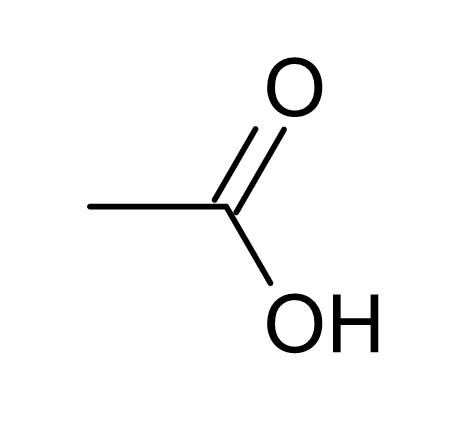
Chemical Formula: C2H4O2 (CH3COOH)
Molar Mass: 60.05 g/mol
CAS Number: 64-19-7
Appearance: Clear, colorless liquid; forms colorless crystalline material below its freezing point
Odor: Strong, characteristic pungent acidic odor
Density: Approximately 1.044 g/cm3 at 25 °C
Melting Point: Approximately 16.6 °C
Boiling Point: Approximately 118 °C
SMILES: CC(=O)O
Glacial acetic acid is the highly concentrated, essentially water-free form of acetic acid, a simple monocarboxylic acid containing a methyl group attached to a carboxyl group. The term “glacial” originates from the tendency of concentrated acetic acid to crystallize near 16.6 °C, producing clear, ice-like crystals. Commercial glacial acetic acid is generally supplied at very high purity, although the exact assay depends on the specified reagent or industrial grade.
The carboxyl group gives acetic acid its characteristic acidic and strongly polar behavior. It can act both as a hydrogen-bond donor through the hydroxyl group and as a hydrogen-bond acceptor through the carbonyl oxygen. Acetic acid molecules consequently exhibit pronounced intermolecular association, including the formation of cyclic hydrogen-bonded dimers in the gas phase and in less strongly competing environments.
Chemical and physical properties
Glacial acetic acid is a colorless liquid near room temperature but solidifies readily when cooled below approximately 16.6 °C. The unusually high freezing point relative to many other small organic liquids is one of the physical characteristics from which the term “glacial” is derived.
Experimental thermodynamic measurements report a normal boiling temperature close to 391.1 K, corresponding to approximately 118 °C. The relatively high boiling point for a molecule of its size is strongly influenced by intermolecular hydrogen bonding.
Experimental density measurements give a density of approximately 1.044 g/cm3 at 298.15 K. At 293.15 K, values close to 1.049 g/cm3 have been reported. The density decreases progressively with increasing temperature.
Acetic acid is miscible with water and with numerous polar organic solvents. Addition of water strongly changes its hydrogen-bonding environment and physicochemical properties, including viscosity, density and molecular association.
In aqueous solution, acetic acid is a weak acid with a pKa of approximately 4.76 at 25 °C. It establishes the equilibrium CH3COOH ⇌ H+ + CH3COO−. Although only partially dissociated in dilute aqueous solution, concentrated glacial acetic acid is a strongly acidic and chemically reactive medium.
The carboxyl functional group participates readily in esterification, amidation, salt formation and acyl-transfer chemistry. Reaction with alcohols can produce acetate esters, while neutralization with suitable bases produces acetate salts. Acetic acid can also serve as a precursor to more reactive derivatives such as acetic anhydride, acetyl halides and activated acetate compounds.
Gas-phase electron-diffraction studies have demonstrated both monomeric and cyclic dimeric forms of acetic acid. Significant structural changes in the carboxyl group occur upon hydrogen-bonded dimer formation, illustrating the strong influence of intermolecular association on the physical behavior of concentrated acetic acid.
Applications
Glacial acetic acid is extensively used as a reagent and solvent in organic and inorganic synthesis. Its combination of acidity, polarity and complete miscibility with many common solvents makes it useful as a reaction medium for acid-catalyzed transformations, substitution reactions, condensation processes and preparation of acetyl-containing compounds.
It is an important starting material for the synthesis of acetate esters. Reaction with alcohols produces compounds such as ethyl acetate, butyl acetate and other acetate derivatives used as solvents, chemical intermediates and components of industrial formulations.
Glacial acetic acid is also employed in the preparation of acetic anhydride and numerous acetylating reagents. These compounds are widely used for introducing acetyl groups into alcohols, amines and other nucleophilic functional groups in laboratory and industrial organic synthesis.
In polymer and materials chemistry, acetic acid and its derivatives are involved in the manufacture and processing of acetate-containing polymers and monomers. It is also used as a solvent, catalyst component or pH-adjusting reagent in selected polymerization, coating and surface-treatment processes.
In analytical chemistry, glacial acetic acid is employed as a solvent and acidic medium for non-aqueous titration, sample preparation and chromatographic procedures. Its low water content is particularly advantageous when the presence of water would interfere with the analytical reaction or alter the behavior of weak bases and other analytes.
Glacial acetic acid is additionally used in crystallization and materials research. Scientific studies have demonstrated its ability to function as a recrystallization medium and to influence crystal growth, molecular association and the formation of specific solid-state structures.
Scientific references
- National Institute of Standards and Technology. NIST Chemistry WebBook, SRD 69: Acetic Acid, CAS 64-19-7. Thermodynamic, phase-transition and spectroscopic data.
- González, B.; Domínguez, A.; Tojo, J. “Dynamic Viscosities, Densities, and Speed of Sound and Derived Properties of the Binary Systems Acetic Acid with Water, Methanol, Ethanol, Ethyl Acetate and Methyl Acetate at T = (293.15, 298.15, and 303.15) K at Atmospheric Pressure.” Journal of Chemical & Engineering Data, 2004, 49, 1590–1596. DOI: 10.1021/je0342825.
- “Densities and Viscosities of Binary Mixtures of Acetic Acid with Acetic Anhydride and Methenamine at Different Temperatures.” Journal of Chemical & Engineering Data, 2008, 53, 2892–2896. DOI: 10.1021/je8003782.
- Derissen, J. L. “A Reinvestigation of the Molecular Structure of Acetic Acid Monomer and Dimer by Gas Electron Diffraction.” Journal of Molecular Structure, 1971, 7, 67–80. DOI: 10.1016/0022-2860(71)90008-1.
- Pašalić, H.; Aquino, A. J. A.; Tunega, D.; Haberhauer, G.; Gerzabek, M. H.; Lischka, H. “Thermodynamic Stability of Hydrogen-Bonded Systems in Polar and Nonpolar Environments.” Journal of Computational Chemistry, 2010, 31, 2046–2055. DOI: 10.1002/jcc.21491.
- Deng, H.; Yuan, P.; Lao, K.; Fu, Q.; Teo, B. K.; Zheng, N. “Glacial Acetic Acid as a Resolution Solvent for Growing Enantiopure Crystals from Racemic Mixtures.” Inorganic Chemistry Frontiers, 2025, 12, 171–178. DOI: 10.1039/D4QI01944J.
- Serjeant, E. P.; Dempsey, B. Ionisation Constants of Organic Acids in Aqueous Solution. IUPAC Chemical Data Series No. 23, Pergamon Press, 1979.



 Pure >99% "Pin It")

