
 CATEGORIES
- ORGANIC COMPOUNDS(1109)
- Metal-organic compounds(1)
- Sulfonic acids(6)
- Thiols(1)
- Alcohols(74)
- Aldehydes(44)
- Alkyl nitrites(6)
- Amines(55)
- Aminoacids(58)
- Amides(33)
- Anhydrides(11)
- Acyl Halides(5)
- Carboxylic Acids(164)
- Dyes and Indicators(99)
- Esters(52)
- Ethers(17)
- Organic Halogens (Organohalides)(29)
- Flavonoids(5)
- Heterocycles(24)
- Hydrocarbons(34)
- Imides(2)
- Ketones(29)
- Mixed solvents(16)
- Nitro Compounds(5)
- Nitriles(9)
- Organic salts(74)
- Phenols(30)
- Polymers ( HMW compounds )(61)
- Sugars (Saccharides)(24)
- Silicoorgano and Phosphoorganocompounds(1)
- Peptides(2)
- Terpenes(16)
- Others(124)
- INORGANIC COMPOUNDS(1042)
- LAB EQUIPMENT(5176)
- *(1)
- Organic Synthesis(413)
- Industry(771)
Language
US version allows shipping to all available destinations


 MANUFACTURER
Diethyl Ether Pure
Regular price:
Regular price:
product unavailable
add to wish list
0


Description
Diethyl Ether
Other Names: Ethoxyethane, Ethyl ether, Diethyl oxide, Ethyl oxide
Chemical Formula: C4H10O
Molar Mass: 74.12 g/mol
CAS Number: 60-29-7
Appearance: Clear, colorless, highly volatile liquid
Odor: Characteristic sweet, ethereal odor
SMILES: CCOCC
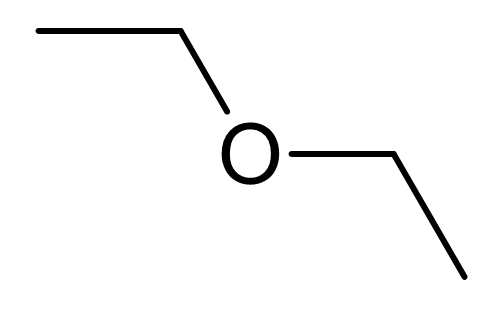
Diethyl ether is a simple aliphatic ether composed of two ethyl groups connected through an oxygen atom. It is one of the most extensively studied members of the ether class and is characterized by high volatility, relatively low polarity and the ability of its oxygen atom to act as a hydrogen-bond acceptor. The molecule contains no hydrogen-bond donor groups, which contributes to its relatively low boiling point compared with alcohols of comparable molecular mass. Its combination of volatility and solvent properties has made diethyl ether an important compound in organic chemistry, physical chemistry and laboratory research.
The ether oxygen possesses two lone electron pairs and can coordinate to Lewis acids, metal ions and organometallic species. This characteristic is particularly important in synthetic chemistry because diethyl ether can stabilize reactive organometallic compounds through coordination. Its comparatively low dielectric constant and moderate electron-donor ability also make it useful for investigating ion pairing, solvation and molecular interactions in non-aqueous systems.
Chemical and physical properties
Diethyl ether is a colorless, mobile liquid under ambient conditions. It has a boiling point of approximately 34.6 °C and a melting point of approximately −116 °C. Its low boiling point results in rapid evaporation at room temperature and makes it considerably more volatile than many commonly used organic solvents.
The density of liquid diethyl ether near room temperature is approximately 0.71 g/cm3, making it substantially less dense than water. It has a relatively low viscosity and surface tension, properties that contribute to its high mobility and rapid spreading over surfaces.
Diethyl ether is only moderately soluble in water, while water itself has limited solubility in the ether phase. In contrast, diethyl ether is miscible with numerous organic solvents and readily dissolves many nonpolar and moderately polar organic compounds. The oxygen atom functions as a hydrogen-bond acceptor, allowing interactions with compounds containing O–H and N–H groups despite the relatively low overall polarity of the molecule.
The compound is highly flammable and has a very low flash point. Its vapors can form flammable mixtures with air. Another chemically important property of diethyl ether is its susceptibility to atmospheric oxidation during prolonged storage. Exposure to oxygen and light can lead to the formation of ether hydroperoxides and other peroxide species, which can become hazardous when concentrated. This behavior is extensively recognized in laboratory chemistry and requires appropriate storage and handling procedures.
Applications
Diethyl ether is extensively used as an organic solvent in laboratory and synthetic chemistry. Its ability to dissolve a broad range of organic compounds while remaining only partially miscible with water makes it particularly useful in liquid–liquid extraction, phase separation, purification and reaction work-up procedures.
It is an important reaction medium for organometallic chemistry. Diethyl ether is commonly used with Grignard reagents and related organomagnesium compounds because the ether oxygen coordinates to magnesium centers and contributes to stabilization of these highly reactive species in solution. Similar coordination behavior is relevant to other Lewis-acidic metals and organometallic reagents.
Diethyl ether is also used as a solvent and reaction medium in organic synthesis involving reductions, additions, substitutions and carbon–carbon bond-forming reactions. Its low boiling point facilitates removal from reaction mixtures by evaporation under controlled conditions, making it particularly useful when a volatile solvent is required.
In physical chemistry and spectroscopy, diethyl ether is studied as a model weakly polar solvent and as a molecular system for investigations of intermolecular interactions, conformational behavior, gas-phase structure, hydrogen-bond acceptance and solvation phenomena. Its relatively simple molecular structure also makes it suitable for comparison between experimental spectroscopic measurements and theoretical calculations.
Diethyl ether additionally serves as a solvent for crystallization, precipitation and isolation of chemical compounds. Its relatively low polarity can promote precipitation of compounds that remain soluble in more polar solvents, while its volatility facilitates subsequent solvent removal.
Scientific references
Linstrom, P. J.; Mallard, W. G., Eds. NIST Chemistry WebBook, NIST Standard Reference Database Number 69. National Institute of Standards and Technology, Gaithersburg, MD. Entry: Ethane, 1,1'-oxybis- (Diethyl ether), CAS 60-29-7.
National Center for Biotechnology Information. PubChem Compound Summary for CID 3283, Diethyl Ether. PubChem, U.S. National Library of Medicine.
Riddick, J. A.; Bunger, W. B.; Sakano, T. K. Organic Solvents: Physical Properties and Methods of Purification, 4th ed.; Wiley-Interscience: New York, 1986.
Wiberg, K. B.; Marquez, M. “The Rotational Barriers for Ethane, Methylamine, Methanol, Methylphosphine, and Methylsilane.” Journal of the American Chemical Society, 1998, 120, 2932–2938.
Smith, M. B.; March, J. March's Advanced Organic Chemistry: Reactions, Mechanisms, and Structure, 6th ed.; Wiley-Interscience: Hoboken, 2007.
SAFETY

H224 Extremely flammable liquid and vapour H302 Harmful if swallowed H336 May cause drowsiness or dizziness Precautionary statements Precautionary statements - prevention P210 Keep away from heat, hot surfaces, sparks, open flames and other ignition sources. No smoking P243 Take action to prevent static discharges P261 Avoid breathing dust/fume/gas/mist/vapours/spray Precautionary statements - response P303+P361+P353 IF ON SKIN (or hair): Take off immediately all contaminated clothing. Rinse skin with water [or shower] P304+P340 IF INHALED: Remove person to fresh air and keep comfortable for breathing P312 Call a POISON CENTRE/doctor if you feel unwell Supplemental hazard information EUH019 May form explosive peroxides. EUH066 Repeated exposure may cause skin dryness or cracking.