
 CATEGORIES
- ORGANIC COMPOUNDS(1102)
- Thiols(1)
- Metal-organic compounds(1)
- Sulfonic acids(6)
- Alcohols(74)
- Aldehydes(44)
- Alkyl nitrites(6)
- Amines(55)
- Aminoacids(58)
- Amides(34)
- Anhydrides(11)
- Acyl Halides(5)
- Carboxylic Acids(161)
- Dyes and Indicators(99)
- Esters(52)
- Ethers(17)
- Organic Halogens (Organohalides)(29)
- Flavonoids(5)
- Heterocycles(24)
- Hydrocarbons(34)
- Imides(2)
- Ketones(29)
- Mixed solvents(16)
- Nitro Compounds(5)
- Nitriles(9)
- Organic salts(74)
- Phenols(30)
- Polymers ( HMW compounds )(61)
- Sugars (Saccharides)(24)
- Silicoorgano and Phosphoorganocompounds(1)
- Peptides(2)
- Terpenes(12)
- Others(123)
- INORGANIC COMPOUNDS(1020)
- LAB EQUIPMENT(5176)
- *(1)
- Organic Synthesis(413)
- Industry(758)
Language
US version allows shipping to all available destinations


 MANUFACTURER
Cyclohexanone pimelic ketone ketocyclohexane
Regular price:
Regular price:
product unavailable
add to wish list
0


Description
Cyclohexanone
Other Names: Cyclohexyl ketone, Ketohexamethylene, Pimelic ketone, Anone
Chemical Formula: C6H10O
Molar Mass: 98.14 g/mol
CAS Number: 108-94-1
SMILES: C1CCC(=O)CC1
Appearance: Colorless to pale yellow liquid
Odor: Characteristic peppermint-like or acetone-like odor
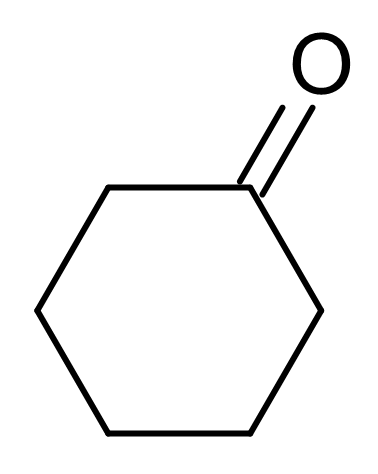
Cyclohexanone is a six-membered cyclic ketone containing a carbonyl group incorporated into a saturated carbon ring. It is an important organic compound used extensively in chemical synthesis, polymer production and industrial solvent applications. The presence of the reactive carbonyl group makes cyclohexanone a versatile starting material for numerous chemical transformations, including oxidation, reduction, condensation and oxime formation. One of its most significant industrial applications is the production of cyclohexanone oxime, which undergoes Beckmann rearrangement to form ε-caprolactam, an essential monomer for the manufacture of nylon-6. Cyclohexanone is also an important precursor in the synthesis of adipic acid, a major intermediate used in the production of nylon-6,6 and other polymeric materials. In addition, its chemical structure enables Baeyer–Villiger oxidation to ε-caprolactone, a valuable intermediate in polyester synthesis. Because of its solvent properties and chemical reactivity, cyclohexanone is widely investigated in organic chemistry, catalysis, industrial chemical technology and materials science.
Chemical and physical properties
Cyclohexanone is a liquid under ambient conditions, with a melting point of approximately −30 °C and a normal boiling point close to 155 °C. Experimental thermodynamic investigations have established its phase-transition behavior, including solid-state transformations and vaporization properties.
Experimental measurements at 298.15 K (25 °C) report a density of approximately 0.942–0.943 g/cm3 and a dynamic viscosity of approximately 2.0 mPa·s. These properties make cyclohexanone a useful solvent and reaction medium in a variety of chemical processes.
Cyclohexanone is partially soluble in water and exhibits good compatibility with numerous organic solvents, including ethanol, diethyl ether and other common organic liquids. Its polar carbonyl group contributes to intermolecular dipole interactions and allows the molecule to act as a hydrogen-bond acceptor.
The carbonyl functionality is responsible for much of the chemical reactivity of cyclohexanone. It readily undergoes reactions with nucleophilic reagents and can be converted into oximes, imines and other carbonyl derivatives. Oxidative transformations can produce adipic acid or ε-caprolactone, depending on the oxidizing system and reaction conditions.
Cyclohexanone is a combustible organic liquid with a reported closed-cup flash point of approximately 44 °C. Its volatility and solvent properties are important considerations in chemical processing and laboratory applications.
Applications
Cyclohexanone is extensively used as a chemical intermediate in the manufacture of polyamide materials. Its reaction with hydroxylamine produces cyclohexanone oxime, which can subsequently undergo Beckmann rearrangement to yield ε-caprolactam. This transformation is an important step in the industrial production of nylon-6.
Another major application is the synthesis of adipic acid, a key starting material for nylon-6,6 and other polymer systems. Scientific studies have investigated the oxidation of cyclohexanone using hydrogen peroxide, molecular oxygen and catalytic systems based on transition metals to improve reaction efficiency and product selectivity.
Cyclohexanone also serves as a precursor for ε-caprolactone through Baeyer–Villiger oxidation. This reaction is important in the synthesis of polycaprolactone and related polyester materials. Research has demonstrated that oxidation with peracids can be combined with subsequent oligomerization to obtain ε-caprolactone-based oligomeric products.
In industrial formulations, cyclohexanone is used as an organic solvent for certain resins, coatings, lacquers and polymer-processing systems. Its ability to dissolve various organic substances makes it useful in chemical manufacturing and materials processing.
In laboratory research, cyclohexanone is employed as a model cyclic ketone in studies of reaction mechanisms, catalytic oxidation, carbonyl chemistry, solvent interactions and chemical thermodynamics. It is also used as a starting compound in the synthesis of substituted cyclohexanones, nitrogen-containing organic derivatives and other functional chemical intermediates.
Scientific references
- National Institute of Standards and Technology (NIST). Cyclohexanone: Thermochemical and Phase Change Data. NIST Chemistry WebBook, Standard Reference Database 69. https://webbook.nist.gov/cgi/cbook.cgi?ID=C108941&Mask=4
- National Center for Biotechnology Information. PubChem Compound Summary for CID 7967, Cyclohexanone. https://pubchem.ncbi.nlm.nih.gov/compound/7967
- Densities and Excess Molar Volumes of the Binary Mixtures of Cyclohexanone with Chloroalkanes at Temperatures between (288.15 and 318.15) K. Journal of Chemical & Engineering Data, 2010. https://doi.org/10.1021/je900404r
- Insights from Virtual Chemistry: Shear and Bulk Viscosity of Organic Liquids via Molecular Simulations. The Journal of Chemical Physics, 2025. https://doi.org/10.1063/5.0251585
- Wang, K. et al. Application of Zeolite in Beckmann Rearrangement of Cyclohexanone Oxime. Molecular Catalysis, 2023, 535, 112881. https://www.sciencedirect.com/science/article/pii/S2468823122007672
- Usui, Y.; Sato, K. A Green Method of Adipic Acid Synthesis: Organic Solvent- and Halide-Free Oxidation of Cycloalkanones with 30% Hydrogen Peroxide. Green Chemistry, 2003, 5, 373. https://doi.org/10.1039/B305847F
- Lisicki, D. et al. Selective Oxidation of Cyclohexanone to Adipic Acid Using Molecular Oxygen in the Presence of Alkyl Nitrites and Transition Metals as Catalysts. Materials, 2023, 16(16), 5722. https://doi.org/10.3390/ma16165722
- Bińczak, J. et al. Oxidation of Cyclohexanone with Peracids—A Straight Path to the Synthesis of ε-Caprolactone Oligomers. Materials, 2022, 15(19), 6608. https://doi.org/10.3390/ma15196608
Safety

Safety
Signal Word: Danger
Hazard Statements:
H226: Flammable liquid and vapor.
H302 + H312 + H332: Harmful if swallowed, in contact with skin, or if inhaled.
H315: Causes skin irritation.
H318: Causes serious eye damage.
H335: May cause respiratory irritation.
Precautionary Statements:
P210: Keep away from heat, hot surfaces, sparks, open flames, and other ignition sources. No smoking.
P280: Wear protective gloves, protective clothing, eye protection, and face protection.
P301 + P312: IF SWALLOWED: Call a POISON CENTER or doctor if you feel unwell.
P303 + P361 + P353: IF ON SKIN (or hair): Take off immediately all contaminated clothing. Rinse skin with water.
P304 + P340 + P312: IF INHALED: Remove person to fresh air and keep comfortable for breathing. Call a POISON CENTER or doctor if you feel unwell.
P305 + P351 + P338: IF IN EYES: Rinse cautiously with water for several minutes. Remove contact lenses, if present and easy to do. Continue rinsing.