
 CATEGORIES
- ORGANIC COMPOUNDS(1063)
- Thiols(1)
- Metal-organic compounds(1)
- Sulfonic acids(6)
- Alcohols(73)
- Aldehydes(41)
- Alkyl nitrites(6)
- Amines(50)
- Aminoacids(58)
- Amides(29)
- Anhydrides(11)
- Acyl Halides(5)
- Carboxylic Acids(161)
- Dyes and Indicators(96)
- Esters(41)
- Ethers(18)
- Organic Halogens (Organohalides)(25)
- Flavonoids(5)
- Heterocycles(21)
- Hydrocarbons(31)
- Imides(2)
- Ketones(26)
- Mixed solvents(17)
- Nitro Compounds(5)
- Nitriles(9)
- Organic salts(74)
- Phenols(30)
- Polymers ( HMW compounds )(61)
- Sugars (Saccharides)(24)
- Silicoorgano and Phosphoorganocompounds(1)
- Peptides(2)
- Terpenes(12)
- Others(123)
- INORGANIC COMPOUNDS(1012)
- LAB EQUIPMENT(5176)
- *(1)
- Organic Synthesis(398)
- Industry(756)
Language
US version allows shipping to all available destinations


 MANUFACTURER
Cinnamaldehyde (Cinnamal) >98%
Regular price:
Regular price:
product unavailable
add to wish list
0

 >98% "Pin It")
Description
Cinnamaldehyde
Other Names: Cinnamic Aldehyde, Cinnamal, trans-Cinnamaldehyde, (E)-3-Phenylprop-2-enal, 3-Phenylacrylaldehyde, Benzylideneacetaldehyde, Phenylacrolein
Chemical Formula: C9H8O
Molar Mass: 132.16 g/mol
CAS Number: 104-55-2
Appearance: Pale yellow to yellow liquid
Odor: Strong, characteristic sweet, spicy, cinnamon-like odor
SMILES: C1=CC=C(C=C1)/C=C/C=O
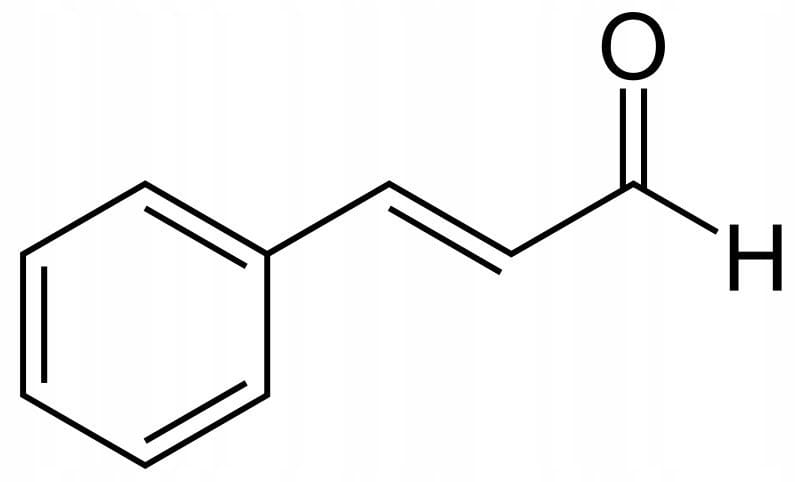
Cinnamaldehyde is an aromatic α,β-unsaturated aldehyde consisting of a benzene ring connected to a conjugated carbon–carbon double bond and an aldehyde functional group. The compound occurs predominantly as the trans (E) geometric isomer, which is the more stable configuration. Its conjugated molecular structure gives cinnamaldehyde distinctive electronic properties and makes it an important model compound in studies of organic reaction mechanisms, catalytic transformations and molecular interactions. The presence of both a carbonyl group and an alkene functionality enables cinnamaldehyde to participate in a wide variety of chemical reactions, including hydrogenation, oxidation, nucleophilic addition and condensation. In particular, its selective hydrogenation has attracted considerable scientific interest because different catalytic systems can promote the reduction of either the carbonyl group or the carbon–carbon double bond. These reactions provide access to compounds such as cinnamyl alcohol, hydrocinnamaldehyde and hydrocinnamyl alcohol. Cinnamaldehyde is also used as a starting material for the synthesis of Schiff bases, functional organic derivatives and other chemical intermediates. Its well-defined structure and versatile reactivity make it valuable in synthetic chemistry, catalysis, materials science and physicochemical research.
Chemical and physical properties
Cinnamaldehyde is a liquid under normal ambient conditions. Published physicochemical data report a melting point of approximately −7.5 °C and a boiling point of approximately 246–250 °C at atmospheric pressure.
The density of cinnamaldehyde is approximately 1.05 g/cm3 near 25 °C. Its refractive index is approximately 1.62 at 20 °C, reflecting the optical characteristics associated with its aromatic and conjugated molecular structure.
Cinnamaldehyde is only slightly soluble in water but dissolves in various organic solvents, including ethanol, diethyl ether and chloroform. Its limited aqueous solubility is influenced by the hydrophobic aromatic ring and the relatively small polar carbonyl group. The calculated octanol–water partition coefficient (log P) is approximately 1.9.
The molecule contains a conjugated system formed by the aromatic ring, carbon–carbon double bond and aldehyde group. This electronic arrangement influences its ultraviolet absorption, infrared vibrational characteristics and chemical reactivity. The aldehyde group exhibits characteristic carbonyl absorption in infrared spectroscopy, while the conjugated double bond contributes to the compound's electronic transitions.
As an α,β-unsaturated aldehyde, cinnamaldehyde can undergo both direct nucleophilic addition to the carbonyl carbon and conjugate addition at the β-position. The relative preference for these reaction pathways depends on the reagents, catalysts and reaction conditions. Reduction of the carbonyl group produces cinnamyl alcohol, whereas hydrogenation of the carbon–carbon double bond produces hydrocinnamaldehyde. Further hydrogenation may yield hydrocinnamyl alcohol.
The aldehyde group can also undergo oxidation to form cinnamic acid or participate in condensation reactions with primary amines to produce imines and related Schiff base derivatives. These transformations make cinnamaldehyde a versatile substrate for investigating chemoselectivity, reaction kinetics and catalyst performance.
Applications
Cinnamaldehyde is extensively investigated as a starting material in organic synthesis. Its aldehyde and alkene functional groups enable numerous chemical transformations, including reduction, oxidation, condensation and carbon–carbon bond-forming reactions. It can be used to prepare substituted aromatic derivatives, unsaturated alcohols, imines and other intermediates employed in fine chemical synthesis.
One of the most extensively studied applications of cinnamaldehyde is its use as a model substrate in heterogeneous catalysis. Selective hydrogenation of cinnamaldehyde is frequently employed to evaluate the activity, selectivity and stability of supported metal catalysts. Scientific studies have investigated platinum, palladium, copper, iridium and bimetallic catalytic systems to determine how catalyst composition, surface structure and reaction conditions influence the distribution of hydrogenation products.
Researchers have demonstrated that supported bimetallic catalysts can selectively transform cinnamaldehyde into cinnamyl alcohol. For example, investigations involving cobalt–rhenium catalysts supported on titanium dioxide have shown high selectivity toward cinnamyl alcohol using formic acid as a hydrogen donor. Such studies provide important information about carbonyl activation, surface adsorption and catalytic hydrogen-transfer mechanisms.
Cinnamaldehyde is also used in the preparation of Schiff base compounds through condensation reactions with suitable primary amines. The resulting imine-containing derivatives are investigated in coordination chemistry and materials science because their nitrogen-containing functional groups can interact with metal ions and surfaces. Schiff bases derived from cinnamaldehyde have been studied as corrosion inhibitors for metallic materials exposed to acidic environments.
In corrosion research, cinnamaldehyde-derived compounds have been investigated for their ability to inhibit the degradation of mild steel in hydrochloric acid solutions. Experimental electrochemical measurements, adsorption studies and theoretical calculations have demonstrated that certain cinnamaldehyde-based Schiff bases can interact with metal surfaces and reduce corrosion rates. This application illustrates the potential of cinnamaldehyde as a structural building block for the development of functional surface-protective compounds.
In analytical and physicochemical research, cinnamaldehyde serves as a reference substrate for studying the behavior of conjugated aldehydes. It is examined using techniques such as infrared spectroscopy, nuclear magnetic resonance spectroscopy, gas chromatography and mass spectrometry. These methods are used to characterize molecular structure, monitor reaction pathways, identify transformation products and evaluate the selectivity of chemical reactions.
Cinnamaldehyde is additionally employed in studies of reaction kinetics, molecular adsorption and catalyst–substrate interactions. Its combination of an aromatic ring, an unsaturated carbon–carbon bond and a carbonyl group makes it particularly useful for understanding competitive reaction pathways and structure–reactivity relationships in organic chemistry.
Scientific references
1. National Institute of Standards and Technology (NIST). Chemistry WebBook, SRD 69: 2-Propenal, 3-phenyl- (Cinnamaldehyde). Chemical identification, molecular formula, molecular mass and spectroscopic reference data.
https://webbook.nist.gov/cgi/cbook.cgi?ID=C104552
2. National Center for Biotechnology Information (NCBI). PubChem Compound Summary: Cinnamaldehyde, CID 637511. Molecular structure, physicochemical properties, chemical identifiers, solubility and molecular descriptors.
https://pubchem.ncbi.nlm.nih.gov/compound/637511
3. Chen, M.; Wang, Y.; Jiang, L.; Cheng, Y.; Liu, Y.; Wei, Z. (2023). Highly Efficient Selective Hydrogenation of Cinnamaldehyde to Cinnamyl Alcohol over CoRe/TiO2 Catalyst. Molecules, 28(8), 3336. Research on selective catalytic hydrogenation using supported cobalt–rhenium catalysts.
https://doi.org/10.3390/molecules28083336
4. Szőllősi, G.; Török, B.; Baranyi, L.; Bartók, M. (1998). Chemoselective Hydrogenation of Cinnamaldehyde to Cinnamyl Alcohol over Pt/K-10 Catalyst. Journal of Catalysis, 179(2), 619–623. Experimental investigation of selective carbonyl hydrogenation using a platinum-based catalyst.
https://doi.org/10.1006/jcat.1998.2219
5. Satpati, S.; Suhasaria, A.; Ghosal, S.; Saha, A.; Dey, S.; Sukul, D. (2021). Amino acid and cinnamaldehyde conjugated Schiff bases as proficient corrosion inhibitors for mild steel in 1 M HCl at higher temperature and prolonged exposure: Detailed electrochemical, adsorption and theoretical study. Journal of Molecular Liquids, 324, 115077. Investigation of cinnamaldehyde-derived Schiff bases as corrosion inhibitors.
https://doi.org/10.1016/j.molliq.2020.115077
6. Chambers, A.; Jackson, S. D.; Stirling, D.; Webb, G. (1997). Selective Hydrogenation of Cinnamaldehyde over Supported Copper Catalysts. Journal of Catalysis, 168(2), 301–314. Study of the influence of catalyst preparation and support properties on selective hydrogenation pathways.
https://doi.org/10.1006/jcat.1997.1683
7. Mirea, A. G.; Chirică, I. M.; Ciobotaru, I. C.; Radu, C.; Neaţu, Ş.; Neaţu, F.; Florea, M.; Trandafir, M. M. (2026). Insights into the selective hydrogenation of cinnamaldehyde on low-loading Pd based catalysts. Journal of Materials Chemistry A, 14, 20972–20983. Investigation of palladium-based catalysts and reaction pathways in cinnamaldehyde hydrogenation.
https://doi.org/10.1039/D6TA00748A

Safety
Signal Word: Warning
Hazard Statements:
H312: Harmful in contact with skin.
H315: Causes skin irritation.
H317: May cause an allergic skin reaction.
H319: Causes serious eye irritation.
H412: Harmful to aquatic life with long-lasting effects.
Precautionary Statements:
P261: Avoid breathing mist or vapors.
P264: Wash skin thoroughly after handling.
P273: Avoid release to the environment.
P280: Wear protective gloves/ protective clothing/ eye protection/ face protection.
P302+P352+P312: IF ON SKIN: Wash with plenty of water. Call a POISON CENTER/doctor if you feel unwell.
P305+P351+P338: IF IN EYES: Rinse cautiously with water for several minutes. Remove contact lenses, if present and easy to do. Continue rinsing.
First Aid Measures
Eye Contact: Rinse cautiously with water for several minutes. Seek medical attention if irritation occurs.
Skin Contact: Wash with soap and water. Remove contaminated clothing.
Inhalation: Move to fresh air. Seek medical help if symptoms persist.
Ingestion: Rinse mouth with water. Do not induce vomiting. Seek medical advice if feeling unwell.
Handling and Storage
Storage Conditions: Store in a cool, dry, well-ventilated area. Protect from moisture and direct sunlight.
Handling Precautions: Avoid inhalation of vapors or mist. Wear suitable personal protective equipment, including gloves and safety glasses.
Signal Word Hazard Statements
H226: Flammable liquid and vapor.
H302: Harmful if swallowed.
H312: Harmful in contact with skin.
H315: Causes skin irritation.
H318: Causes serious eye damage.
H335: May cause respiratory irritation.
Precautionary Statements
P210: Keep away from heat, hot surfaces, sparks, open flames, and other ignition sources. No smoking.
P280: Wear protective gloves/ protective clothing/ eye protection/ face protection.
P301+P312: IF SWALLOWED: Call a POISON CENTER/doctor if you feel unwell.
P303+P361+P353: IF ON SKIN (or hair): Take off immediately all contaminated clothing. Rinse skin with water.
P304+P340: IF INHALED: Remove victim to fresh air and keep at rest in a position comfortable for breathing.
P305+P351+P338: IF IN EYES: Rinse cautiously with water for several minutes. Remove contact lenses, if present and easy to do. Continue rinsing.