
 CATEGORIES
- ORGANIC COMPOUNDS(1064)
- Thiols(1)
- Metal-organic compounds(1)
- Sulfonic acids(6)
- Alcohols(73)
- Aldehydes(41)
- Alkyl nitrites(6)
- Amines(51)
- Aminoacids(58)
- Amides(29)
- Anhydrides(11)
- Acyl Halides(5)
- Carboxylic Acids(161)
- Dyes and Indicators(96)
- Esters(41)
- Ethers(18)
- Organic Halogens (Organohalides)(25)
- Flavonoids(5)
- Heterocycles(21)
- Hydrocarbons(31)
- Imides(2)
- Ketones(26)
- Mixed solvents(17)
- Nitro Compounds(5)
- Nitriles(9)
- Organic salts(74)
- Phenols(30)
- Polymers ( HMW compounds )(61)
- Sugars (Saccharides)(24)
- Silicoorgano and Phosphoorganocompounds(1)
- Peptides(2)
- Terpenes(12)
- Others(123)
- INORGANIC COMPOUNDS(1012)
- LAB EQUIPMENT(5176)
- *(1)
- Organic Synthesis(398)
- Industry(756)
Language
US version allows shipping to all available destinations


 MANUFACTURER
Aldehyde C-16 (Ethyl methylphenylglycidate) Wild Strawberry Fragrance
Regular price:
Regular price:
product unavailable
add to wish list
0

 Wild Strawberry Fragrance "Pin It")
Description
Aldehyde C-16
Other Names: Ethyl Methylphenylglycidate, Strawberry Aldehyde, Ethyl 3-Methyl-3-phenylglycidate, Ethyl 3-Methyl-3-phenyloxirane-2-carboxylate, Ethyl 2,3-Epoxy-3-phenylbutyrate, Fraise Aldehyde, Fraeseol, EMPG
Chemical Formula: C12H14O3
Molar Mass: 206.24 g/mol
CAS Number: 77-83-8
Appearance: Colorless to pale yellow liquid
Odor: Strong, sweet, fruity, strawberry-like odor
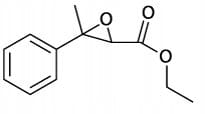
SMILES: CCOC(=O)C1OC1(C)c1ccccc1
Aldehyde C-16, chemically known as ethyl methylphenylglycidate, is a synthetic aromatic organic compound belonging to the family of glycidic acid esters. Despite its traditional commercial name, the compound does not contain an aldehyde functional group. Instead, its molecular structure consists of a three-membered oxirane ring, commonly referred to as an epoxide, substituted with a phenyl group, a methyl group and an ethyl carboxylate group. This structural arrangement gives the molecule distinctive chemical reactivity and aromatic properties. Aldehyde C-16 is particularly recognized for its intense, sweet, strawberry-like fragrance and is an important ingredient in synthetic fragrance compositions. The compound contains two stereogenic centers and can exist as four stereoisomers, forming two pairs of enantiomers with cis and trans configurations. The stereochemical composition has a significant influence on its odor characteristics and intensity. Scientific investigations have demonstrated that the cis and trans forms exhibit different sensory properties, making ethyl methylphenylglycidate an important model compound in studies of stereochemistry and structure–odor relationships. In addition to its fragrance applications, Aldehyde C-16 is investigated in organic synthesis, asymmetric catalysis and analytical chemistry. Its epoxide and ester functional groups provide opportunities for chemical transformations, while its well-defined stereochemical properties make it useful in research involving stereoselective reactions and the characterization of organic compounds.
Chemical and physical properties
Aldehyde C-16 is a clear, colorless to pale yellow liquid under normal ambient conditions. Published physicochemical reference data report a boiling point of approximately 272–275 °C at atmospheric pressure. A boiling range of approximately 153–155 °C at a reduced pressure of 2.4 kPa has also been reported.
The compound has a relative density of approximately 1.086–1.096 and a refractive index of approximately 1.504–1.513. These values may vary slightly depending on purity, temperature and the proportions of individual stereoisomers present in the material.
Ethyl methylphenylglycidate is practically insoluble in water but exhibits substantially greater solubility in various organic solvents. It is soluble in ethanol and compatible with several organic media commonly employed in fragrance formulations. Its limited water solubility reflects the influence of its hydrophobic aromatic structure, despite the presence of polar ester and epoxide functional groups.
One of the most important structural characteristics of Aldehyde C-16 is the presence of two asymmetric carbon atoms within its oxirane ring. These stereogenic centers give rise to four possible stereoisomers, including two cis and two trans configurations. Commercial material is commonly supplied as a mixture of these stereoisomers. Experimental investigations have shown that the cis isomeric fraction possesses a more intense and refined odor character than typical mixtures of cis and trans forms.
The three-membered epoxide ring introduces significant ring strain and contributes to the compound's chemical reactivity. Under appropriate reaction conditions, epoxides can undergo ring-opening transformations involving nucleophilic reagents. The ester functional group can also participate in hydrolysis, reduction and other reactions characteristic of carboxylic acid derivatives. These properties make ethyl methylphenylglycidate relevant to studies of selective functional-group transformations.
Aldehyde C-16 can be synthesized through the Darzens condensation, a reaction involving an aldehyde or ketone and an alpha-halo ester under basic conditions. A commonly described synthetic route employs acetophenone and ethyl chloroacetate. The reaction produces the characteristic glycidic ester structure, and the resulting cis-to-trans isomer ratio depends on the reaction conditions, particularly the base employed. Research into this reaction has contributed to the development of stereoselective synthetic methodologies and the understanding of asymmetric induction in organic chemistry.
Applications
Aldehyde C-16 is used in the fragrance industry as an aromatic ingredient with a distinctive sweet, fruity and strawberry-like character. Its pronounced fragrance properties make it suitable for perfume compositions, particularly those requiring fresh, sweet and fruity aromatic notes. It can be combined with floral, green and other fragrance materials to create complex aromatic accords.
In cosmetic and personal care formulations, ethyl methylphenylglycidate is used as a fragrance component in scented soaps, shower gels, shampoos, lotions and other perfumed preparations. Its characteristic odor contributes to the development of recognizable fruity fragrance profiles and can complement floral and sweet aromatic compositions.
The compound is also employed in household fragrance formulations, including air fresheners, detergents, fabric care products and scented cleaning preparations. Its relatively low volatility compared with lighter fragrance constituents can contribute to the persistence of fruity notes within appropriately designed fragrance compositions.
In organic synthesis, Aldehyde C-16 is an important example of a substituted glycidic ester prepared through the Darzens condensation. Its synthesis has been investigated in studies involving the reaction of acetophenone with haloacetic acid esters, providing insight into carbon–carbon bond formation, epoxide ring formation and reaction stereoselectivity.
Ethyl methylphenylglycidate is also relevant to asymmetric synthesis and stereochemical research. The presence of two stereogenic centers makes it a useful target compound for investigating selective formation, separation and characterization of stereoisomers. Studies involving optically active reagents and stereoselective condensation reactions have contributed to the understanding of asymmetric induction in glycidic ester synthesis.
In analytical chemistry, Aldehyde C-16 is investigated using chromatographic methods capable of separating and characterizing its stereoisomeric components. Gas chromatography and related analytical techniques can be applied to evaluate the composition and purity of synthetic materials. The characterization of cis and trans isomers is especially important in research exploring relationships between molecular configuration and aromatic properties.
Aldehyde C-16 additionally serves as a model compound in fragrance chemistry and molecular structure–odor relationship studies. Differences in odor characteristics among its stereoisomers demonstrate the importance of three-dimensional molecular arrangement in olfactory perception. These investigations support the broader development of synthetic fragrance compounds with controlled molecular structures and tailored aromatic properties.
Scientific references
1. Fahlbusch, K.-G., Hammerschmidt, F.-J., Panten, J., Pickenhagen, W., Schatkowski, D., Bauer, K., Garbe, D., & Surburg, H. (2003). Flavors and Fragrances. Ullmann's Encyclopedia of Industrial Chemistry. Wiley-VCH. Section 2.7.3: Glycidates.
https://doi.org/10.1002/14356007.a11_141
2. Mosandl, A. (1977). Über synthetische Aromastoffe. I. 3-Methyl-3-phenylglycidsäureäthylester. Zeitschrift für Lebensmittel-Untersuchung und -Forschung, 163(4), 255–256. This experimental study describes the separation of the cis isomer of ethyl methylphenylglycidate and its distinct odor characteristics.
https://doi.org/10.1007/BF02425354
3. Sisido, K., Nakanisi, O., & Nozaki, H. (1961). Partial Asymmetric Synthesis in the Darzens Reaction. The Journal of Organic Chemistry, 26(12), 4878–4881. This research investigates asymmetric synthesis through the Darzens reaction, a fundamental approach to glycidic ester preparation.
https://doi.org/10.1021/jo01070a023
4. Api, A. M., Bartlett, A., Belsito, D., et al. (2026). RIFM fragrance ingredient safety assessment, ethyl methylphenylglycidate, CAS Registry Number 77-83-8. Food and Chemical Toxicology, 210(Supplement 1), 115957.
https://doi.org/10.1016/j.fct.2026.115957
5. American Chemical Society (ACS). (2022). Ethyl Methylphenylglycidate. Molecule of the Week, January 10, 2022. Scientific overview of the compound's molecular structure, stereoisomerism and historical synthesis.
https://www.acs.org/molecule-of-the-week/archive/e/ethyl-methylphenylglycidate.html
6. National Center for Biotechnology Information (NCBI). PubChem Compound Summary for CID 6501, Ethyl 3-methyl-3-phenylglycidate. PubChem Database. Chemical identification, molecular formula, structural descriptors and physicochemical information.
https://pubchem.ncbi.nlm.nih.gov/compound/6501

Safety
Signal Word: Warning
Hazard Statements
H319: Causes serious eye irritation.
H315: Causes skin irritation.
Precautionary Statements
P101: If medical advice is needed, have product container or label at hand.
P102: Keep out of reach of children.
P264: Wash hands and affected areas thoroughly after handling.
P280: Wear protective gloves and eye protection.
P305+P351+P338: IF IN EYES: Rinse cautiously with water for several minutes. Remove contact lenses, if present and easy to do. Continue rinsing.
P337+P313: If eye irritation persists: Get medical advice/attention.
First Aid Measures
General: Secure personal safety. If any symptoms persist or in case of doubt, consult a physician and provide information from this safety description.
Inhalation: Move person to fresh air. Keep warm and at rest. Seek medical attention if symptoms persist.
Skin Contact: Remove contaminated clothing. Wash affected skin with lukewarm water for 10–15 minutes. If irritation continues, seek medical advice.
Eye Contact: Immediately rinse with water for at least 15 minutes, keeping eyelids wide open. Remove contact lenses if present. Continue rinsing. Contact a medical professional if irritation persists.
Ingestion: Rinse mouth with water. Do not induce vomiting. If symptoms develop, seek medical attention promptly.
Handling and Storage
Handling Precautions: Avoid contact with skin and eyes. Ensure adequate ventilation. Prevent the formation of vapors or mists.
Storage Conditions: Store in tightly sealed containers in a dry, cool, and well-ventilated area. Keep away from strong oxidizing agents and direct sunlight.