
 CATEGORIES
- ORGANIC COMPOUNDS(1240)
- Thiols(1)
- Metal-organic compounds(1)
- Sulfonic acids(6)
- Alcohols(78)
- Aldehydes(52)
- Alkyl nitrites(6)
- Amines(67)
- Aminoacids(78)
- Amides(33)
- Anhydrides(11)
- Acyl Halides(5)
- Carboxylic Acids(192)
- Dyes and Indicators(107)
- Esters(52)
- Ethers(17)
- Organic Halogens (Organohalides)(35)
- Flavonoids(5)
- Heterocycles(37)
- Hydrocarbons(42)
- Imides(2)
- Ketones(29)
- Mixed solvents(16)
- Nitro Compounds(6)
- Nitriles(9)
- Organic salts(74)
- Phenols(35)
- Polymers ( HMW compounds )(66)
- Sugars (Saccharides)(24)
- Silicoorgano and Phosphoorganocompounds(1)
- Peptides(2)
- Terpenes(16)
- Others(137)
- INORGANIC COMPOUNDS(1103)
- LAB EQUIPMENT(5176)
- *(1)
- Organic Synthesis(438)
- Industry(783)
Language
US version allows shipping to all available destinations


 MANUFACTURER
Acetone P.A. purity (ACS)
Regular price:
Regular price:
product unavailable
add to wish list
0

 "Pin It")
Description
Acetone
Other Names: Propanone, 2-Propanone, Dimethyl Ketone, Propan-2-one
Chemical Formula: C3H6O
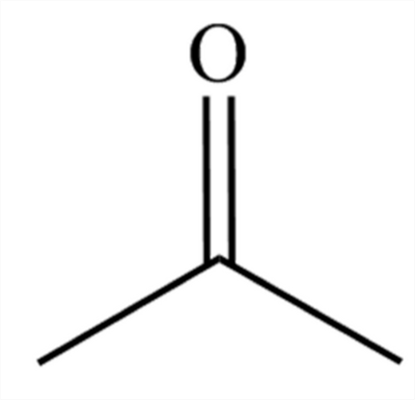
Structural Formula: CH3COCH3
Molar Mass: 58.08 g/mol
CAS Number: 67-64-1
SMILES: CC(=O)C
Appearance: Colorless, highly volatile liquid
Odor: Characteristic, sweetish solvent-like odor
Acetone is the simplest and one of the most extensively used aliphatic ketones. Its molecular structure consists of a carbonyl group bonded to two methyl groups. The strongly polarized C=O bond gives acetone a substantial molecular dipole and makes the carbonyl oxygen an effective hydrogen-bond acceptor and Lewis-basic center. Acetone is consequently classified as a polar aprotic solvent and is widely employed in laboratory, analytical and industrial chemistry. NIST reference data identify acetone by CAS Registry Number 67-64-1 and report a molecular mass of 58.0791 g/mol.
Chemical and physical properties
Acetone is a highly volatile liquid under ambient conditions. Experimental thermodynamic data compiled by NIST give a normal boiling point of approximately 56 °C and a melting point close to −95 °C. This exceptionally broad liquid range at ordinary laboratory temperatures, combined with rapid evaporation, makes acetone useful wherever a volatile processing or reaction solvent is required.
The density of liquid acetone is approximately 0.79 g/cm3 near room temperature. It has a relatively low viscosity and is completely miscible with water. It is also miscible with or readily dissolves in numerous common organic solvents, including alcohols, ethers, esters and many hydrocarbons.
Acetone is a polar aprotic solvent. Its carbonyl oxygen can accept hydrogen bonds and efficiently solvate many polar compounds and cations, while the molecule lacks an O–H or N–H bond capable of acting as a conventional hydrogen-bond donor. These characteristics make acetone particularly useful as a medium for reactions in which nucleophilic species need to remain comparatively reactive.
The carbonyl carbon of acetone is electrophilic and undergoes reactions characteristic of ketones, including nucleophilic addition, formation of imines and oximes, reduction to 2-propanol and carbon-carbon bond-forming reactions. The hydrogen atoms located at the α-position to the carbonyl group can also participate in enolization and enolate formation, allowing acetone to undergo aldol and Claisen-Schmidt-type condensation reactions.
Applications
Acetone is extensively used as a laboratory and industrial solvent. Its combination of polarity, water miscibility, relatively low boiling point and high volatility allows it to dissolve a broad spectrum of organic compounds while remaining easy to remove after a reaction or processing step. It is commonly employed as a reaction medium, extraction and washing solvent and for cleaning laboratory equipment and chemical-processing surfaces.
In organic synthesis, acetone is both a solvent and a chemical building block. Its carbonyl group undergoes numerous nucleophilic addition and condensation reactions. In Claisen-Schmidt chemistry, for example, acetone reacts with aromatic aldehydes to form α,β-unsaturated ketones. It can also be reduced to 2-propanol or transformed into imines, oximes and other carbonyl derivatives.
Acetone is an important industrial intermediate in the production of several organic chemicals and polymer precursors. Scientific literature describes its use in processes associated with methyl methacrylate, bisphenol A and methyl isobutyl ketone. In bisphenol A synthesis, acetone reacts with phenol under acid-catalyzed conditions to form the corresponding bisphenol structure.
In analytical chemistry, acetone is used for sample preparation, cleaning and selected chromatographic applications. Research into more sustainable analytical solvents has also identified acetone as a potentially preferable alternative to several more hazardous conventional organic solvents in suitable chromatographic and extraction procedures.
Industrial production
Modern large-scale acetone production is closely connected with phenol manufacture through the cumene process. Benzene and propylene are first converted into cumene, which is oxidized to cumene hydroperoxide. Acid-catalyzed cleavage of this intermediate subsequently produces phenol and acetone in approximately equimolar amounts. Scientific reviews identify the cumene route as the dominant industrial source of acetone.
Handling and safety
Acetone is highly flammable and its vapors can readily form ignitable mixtures with air. It should therefore be handled away from flames, sparks, hot surfaces and other ignition sources. Because of its high volatility, operations involving significant quantities should be performed with effective ventilation.
Repeated or prolonged contact can remove lipids from the skin and cause dryness or irritation. Vapors at sufficiently high concentrations can irritate the eyes and respiratory tract and may produce reversible central nervous system effects. Appropriate protective gloves, eye protection and suitable ventilation should therefore be used during laboratory and industrial handling.
Scientific references
NIST Chemistry WebBook, SRD 69. Acetone. CAS Registry Number 67-64-1. National Institute of Standards and Technology.
Ouellette, R. J.; Rawn, J. D. Organic Chemistry. Elsevier. Sections describing acetone and 2-butanone as polar aprotic solvents and their physicochemical behavior.
Głowacz-Różyńska, A. et al. Greener organic solvents in analytical chemistry. Current Opinion in Green and Sustainable Chemistry, 2017, 5, 1–4. DOI: 10.1016/j.cogsc.2017.03.002.
A review on commercial-scale high-value products that can be produced alongside cellulosic ethanol. Biotechnology for Biofuels and Bioproducts, 2019. Discussion of industrial acetone production and the cumene process.
SOLVENTS: From Past to Present. ACS Omega, 2024. Review of the historical development, production and chemical applications of acetone and other common organic solvents.
Safety

Signal Word: Danger
H225 (> 99.9%): Highly Flammable liquid and vapor [Danger Flammable liquids]
H319 (> 99.9%): Causes serious eye irritation [Warning Serious eye damage/eye irritation]
H336 (98.7%): May cause drowsiness or dizziness [Warning Specific target organ toxicity, single exposure; Narcotic effects]
P210, P233, P240, P241, P242, P243, P261, P264+P265, P271, P280, P303+P361+P353, P304+P340, P305+P351+P338, P319, P337+P317, P370+P378, P403+P233, P403+P235, P405, and P501
Storage and Handling
Store in tightly closed containers in a cool, dry, and well-ventilated area away from ignition sources and oxidizers. Use explosion-proof equipment and follow proper grounding procedures.