
 CATEGORIES
- ORGANIC COMPOUNDS(1240)
- Thiols(1)
- Metal-organic compounds(1)
- Sulfonic acids(6)
- Alcohols(78)
- Aldehydes(52)
- Alkyl nitrites(6)
- Amines(67)
- Aminoacids(78)
- Amides(33)
- Anhydrides(11)
- Acyl Halides(5)
- Carboxylic Acids(192)
- Dyes and Indicators(107)
- Esters(52)
- Ethers(17)
- Organic Halogens (Organohalides)(35)
- Flavonoids(5)
- Heterocycles(37)
- Hydrocarbons(42)
- Imides(2)
- Ketones(29)
- Mixed solvents(16)
- Nitro Compounds(6)
- Nitriles(9)
- Organic salts(74)
- Phenols(35)
- Polymers ( HMW compounds )(66)
- Sugars (Saccharides)(24)
- Silicoorgano and Phosphoorganocompounds(1)
- Peptides(2)
- Terpenes(16)
- Others(137)
- INORGANIC COMPOUNDS(1103)
- LAB EQUIPMENT(5176)
- *(1)
- Organic Synthesis(438)
- Industry(783)
Language
US version allows shipping to all available destinations


 MANUFACTURER
2,5-dimethoxybenzaldehyde, Pure >99%
Regular price:
Regular price:
product unavailable
add to wish list
0


Description
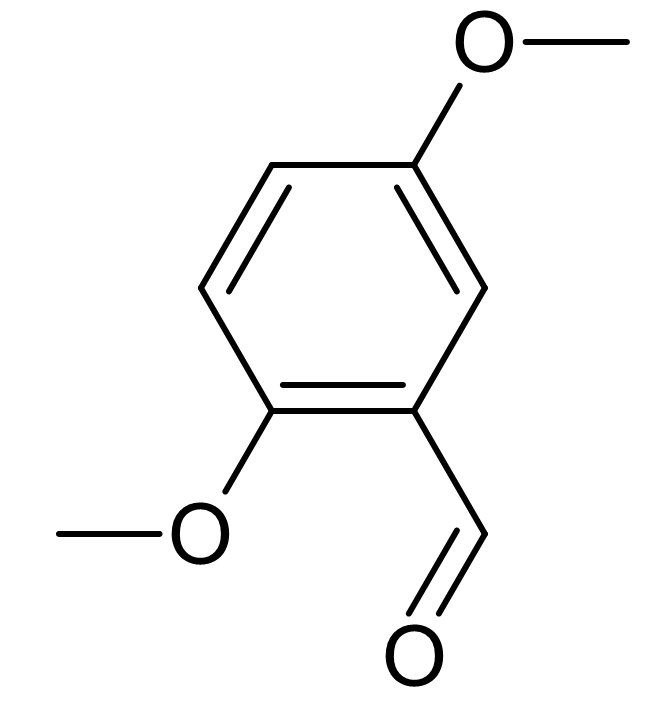
2,5-Dimethoxybenzaldehyde
Other Names: Benzaldehyde, 2,5-dimethoxy-; 2,5-Dimethoxybenzenecarbaldehyde; 2-Hydroxy-5-methoxybenzaldehyde methyl ether
Chemical Formula: C9H10O3
Molar Mass: 166.17 g/mol
CAS Number: 93-02-7
SMILES: COC1=CC(=C(C=C1)OC)C=O
Appearance: Colorless to pale yellow crystalline solid
Melting Point: Approximately 46–50 °C
2,5-Dimethoxybenzaldehyde is an aromatic aldehyde containing two methoxy groups positioned at the 2- and 5-positions of the benzene ring relative to the aldehyde functionality. The molecule combines an electrophilic carbonyl group with two electron-donating methoxy substituents, giving it characteristic reactivity in condensation, carbon–carbon bond-forming and functional-group transformation reactions. Because of this combination, 2,5-dimethoxybenzaldehyde is used as a versatile aromatic building block in organic synthesis and as a model compound in structural, spectroscopic and computational chemistry.
Chemical and physical properties
2,5-Dimethoxybenzaldehyde has a molecular mass of 166.17 g/mol and is generally obtained as a crystalline solid. Single-crystal X-ray diffraction studies reported a melting point of approximately 321 K, corresponding to about 48 °C, which agrees closely with commonly reported experimental melting ranges of approximately 46–50 °C.
Reduced-pressure phase-change data compiled by the NIST Chemistry WebBook report a boiling temperature of approximately 419.2 K, corresponding to about 146 °C, at a pressure of approximately 0.013 bar. The relatively high boiling temperature at atmospheric pressure expected for this aromatic oxygenated compound means that reduced-pressure distillation is preferable when thermal exposure must be minimized.
Single-crystal X-ray diffraction shows that 2,5-dimethoxybenzaldehyde crystallizes in the monoclinic space group P21/n. At 150 K, reported unit-cell parameters are approximately a = 3.878 Å, b = 11.551 Å, c = 17.815 Å and β = 91.81°. The crystallographic density determined for the crystal structure is approximately 1.384 g/cm3. The molecule is nearly planar, with the aldehyde and methoxy substituents substantially conjugated with the aromatic ring.
Spectroscopic investigations demonstrate the characteristic features of an aromatic aldehyde. FTIR measurements show a strong carbonyl stretching band near 1620 cm−1, together with aromatic and methoxy C–H stretching vibrations. In experimental 1H NMR spectra recorded in CDCl3, the methoxy groups appear in the region of approximately 3.6–3.8 ppm, the aromatic protons occur between approximately 6.9 and 7.3 ppm, and the aldehyde proton gives a characteristic signal near 10.45 ppm.
Applications
2,5-Dimethoxybenzaldehyde is used as an aromatic building block in organic synthesis. The aldehyde group provides a convenient reaction center for condensation reactions, nucleophilic additions and carbon–carbon bond-forming transformations, while the methoxy-substituted aromatic ring can be retained or selectively modified in subsequent synthetic steps.
It is frequently used in the preparation of Schiff bases through condensation with primary amines, hydrazides and related nitrogen-containing compounds. Such products are studied as organic ligands, coordination-chemistry intermediates and model compounds for investigations of molecular structure, hydrogen bonding and electronic properties.
The compound has also been employed as a starting material in the construction of complex cyclic and polycyclic molecular frameworks. Published synthetic studies demonstrate its usefulness in sequences involving cycloaddition, rearrangement and ring-forming reactions, illustrating the versatility of the dimethoxy-substituted aromatic aldehyde skeleton in advanced organic synthesis.
2,5-Dimethoxybenzaldehyde is additionally used in crystallographic and computational chemistry. Experimental X-ray structures have been compared with density-functional-theory calculations to study molecular conformation, intermolecular contacts, Hirshfeld surfaces, electronic structure and vibrational properties. These investigations make it a useful reference compound for comparing positional isomers of dimethoxybenzaldehyde.
In analytical chemistry, the compound can be characterized by infrared spectroscopy, NMR spectroscopy, electron-ionization mass spectrometry and gas chromatography. Reference mass-spectral and chromatographic retention data are available from the NIST Chemistry WebBook, making it suitable as a reference material in method-development and compound-identification studies.
Scientific references
- Brugman, S. J. T.; Engwerda, A. H. J.; Kalkman, E.; de Ronde, E.; Tinnemans, P.; Vlieg, E. The crystal structures of four dimethoxybenzaldehyde isomers. Acta Crystallographica Section E: Crystallographic Communications, 2019, 75, 38–42. DOI: 10.1107/S2056989018017152.
- Al-Zaqri, N.; et al. Exo⇔Endo Isomerism, MEP/DFT, XRD/HSA-Interactions of 2,5-Dimethoxybenzaldehyde: Thermal, 1BNA-Docking, Optical, and TD-DFT Studies. Molecules, 2020, 25, 5970. DOI: 10.3390/molecules25245970.
- Kotha, S.; et al. Synthesis and Rearrangement of Cage [4.3.2]Propellanes that Contain a Spiro Linkage. European Journal of Organic Chemistry, 2017, 4277–4282. DOI: 10.1002/ejoc.201700617.
- Selective demethylation of 2,5-dimethoxybenzaldehyde to 5-hydroxy-2-methoxybenzaldehyde. The Journal of Organic Chemistry, 1974, 39(16), 2437–2438. DOI: 10.1021/jo00930a032.
- (E)-N′-(2,5-Dimethoxybenzylidene)-2,4-dihydroxybenzohydrazide. Acta Crystallographica Section E, 2010. DOI: 10.1107/S160053681001130X.
- NIST Chemistry WebBook, SRD 69. Benzaldehyde, 2,5-dimethoxy-, CAS 93-02-7. National Institute of Standards and Technology. Molecular identification, phase-change data, infrared spectrum, electron-ionization mass spectrum and gas-chromatographic data.
- PubChem. 2,5-Dimethoxybenzaldehyde, CID 66726. National Center for Biotechnology Information. Molecular formula, molecular weight, CAS number, SMILES and structural identifiers.
Safety

Signal Word: Danger
Hazard Statements
H315: Causes skin irritation
H319: Causes serious eye irritation
H334: May cause allergy or asthma symptoms or breathing difficulties if inhaled
H335: May cause respiratory irritation
Precautionary Statements
P101: If medical advice is needed, have product container or label at hand
P102: Keep out of reach of children
P261: Avoid breathing dust
P304+P340: IF INHALED: Remove person to fresh air and keep comfortable for breathing
P342+P311: If experiencing respiratory symptoms: Call a doctor
P501: Dispose of contents/container to a licensed hazardous-waste disposal contractor or return to supplier
First Aid Measures
Eye Contact: Rinse cautiously with water for several minutes. Remove contact lenses if present and easy to do. Continue rinsing. Seek medical attention if irritation persists.
Skin Contact: Wash skin thoroughly with soap and water. Remove contaminated clothing and wash before reuse.
Inhalation: Move person to fresh air and ensure they are breathing comfortably. Seek medical help if symptoms develop.
Ingestion: Rinse mouth. Do not induce vomiting unless instructed by medical personnel. Seek medical attention.
Handling and Storage
Storage Conditions: Store in a tightly closed container in a cool, dry, and well-ventilated place away from incompatible substances such as strong oxidizers.
Handling Precautions: Avoid dust formation. Use in a well-ventilated area. Wear suitable protective equipment including gloves and eye protection.