
 CATEGORIES
- ORGANIC COMPOUNDS(1140)
- Thiols(1)
- Metal-organic compounds(1)
- Sulfonic acids(6)
- Alcohols(74)
- Aldehydes(47)
- Alkyl nitrites(6)
- Amines(61)
- Aminoacids(59)
- Amides(33)
- Anhydrides(11)
- Acyl Halides(5)
- Carboxylic Acids(170)
- Dyes and Indicators(99)
- Esters(52)
- Ethers(18)
- Organic Halogens (Organohalides)(30)
- Flavonoids(5)
- Heterocycles(25)
- Hydrocarbons(38)
- Imides(2)
- Ketones(29)
- Mixed solvents(16)
- Nitro Compounds(5)
- Nitriles(9)
- Organic salts(74)
- Phenols(30)
- Polymers ( HMW compounds )(68)
- Sugars (Saccharides)(24)
- Silicoorgano and Phosphoorganocompounds(1)
- Peptides(2)
- Terpenes(16)
- Others(125)
- INORGANIC COMPOUNDS(1055)
- LAB EQUIPMENT(5176)
- *(1)
- Organic Synthesis(421)
- Industry(775)
Language
US version allows shipping to all available destinations


 MANUFACTURER
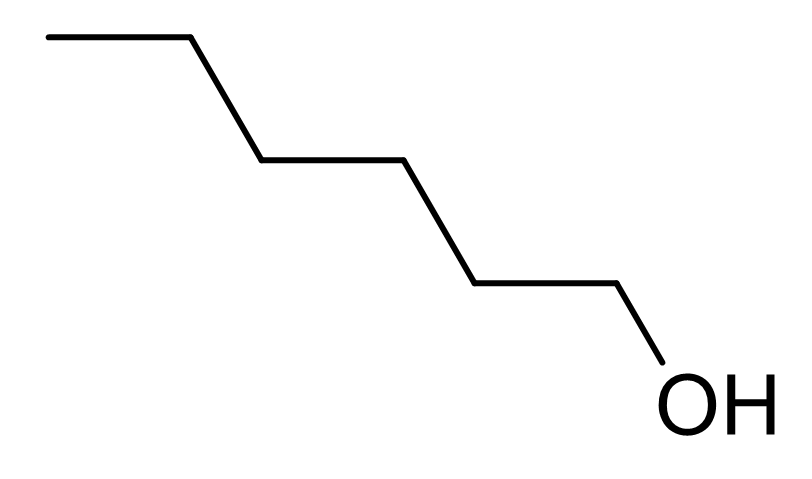
1-Hexanol
Regular price:
Regular price:
product unavailable
add to wish list
0


Description
1-Hexanol
Other Names: Hexan-1-ol, n-Hexanol, Hexyl alcohol, n-Hexyl alcohol, 1-Hydroxyhexane
Chemical Formula: C6H14O
Molar Mass: 102.17 g/mol
CAS Number: 111-27-3
SMILES: CCCCCCO
Appearance: Colorless liquid
Odor: Characteristic alcohol-like odor
1-Hexanol is a straight-chain primary alcohol consisting of a six-carbon hydrocarbon chain terminated by a hydroxyl group. The molecule combines a relatively hydrophobic alkyl chain with a polar hydroxyl group capable of acting as both a hydrogen-bond donor and a hydrogen-bond acceptor. This amphiphilic molecular character strongly influences its solubility, intermolecular association and behavior in liquid mixtures. 1-Hexanol is frequently investigated as a representative higher alkanol in thermodynamic, spectroscopic and physicochemical studies, particularly in research concerning hydrogen bonding, liquid-phase molecular interactions, vapor–liquid equilibria and transport properties.
Chemical and physical properties
1-Hexanol is a colorless liquid under ambient conditions. NIST thermodynamic data give an average normal boiling temperature of approximately 430 K, corresponding to about 157 °C. The average reported fusion temperature is approximately 225 K, or about −48 °C.
The density of 1-hexanol is approximately 0.82 g/cm3 near room temperature. It is therefore less dense than water. Its relatively long hydrocarbon chain limits its miscibility with water, while the hydroxyl group allows substantially stronger intermolecular interactions than occur in hydrocarbons of comparable molecular size.
The hydroxyl group of 1-hexanol forms intermolecular hydrogen bonds. Consequently, liquid 1-hexanol exhibits significant molecular association, which affects properties such as viscosity, enthalpy of vaporization and phase behavior. Experimental investigations of 1-hexanol-containing mixtures have demonstrated measurable deviations from ideal behavior resulting from disruption and formation of hydrogen-bonded structures between different molecular species.
Experimental measurements of density, viscosity and refractive index for 1-hexanol-based systems have been reported over broad temperature ranges. These measurements are widely used to characterize intermolecular interactions and to develop thermodynamic and transport-property models for alcohol-containing liquid mixtures.
Applications
1-Hexanol is used as an organic solvent and extraction medium in laboratory and separation chemistry. Its combination of moderate polarity and limited water miscibility makes it suitable for liquid–liquid extraction systems. Experimental studies have investigated 1-hexanol as an extraction solvent for separating organic compounds from aqueous phases and for studying liquid–liquid equilibrium behavior.
In organic synthesis, 1-hexanol is used as a starting material for the preparation of esters and other hexyl derivatives. The hydroxyl group readily undergoes esterification with carboxylic acids. For example, catalytic esterification reactions involving 1-hexanol have been investigated with acrylic acid, acetic acid and other carboxylic acids using heterogeneous acid catalysts and mesoporous catalytic materials.
1-Hexanol is also an important model substrate in oxidation chemistry. Oxidation of the primary alcohol functionality can produce hexanal and, under stronger or prolonged oxidative conditions, hexanoic acid. Catalytic and enzymatic oxidation of 1-hexanol has therefore been studied extensively for understanding alcohol oxidation mechanisms, catalyst selectivity and reaction kinetics.
In physical chemistry and chemical engineering research, 1-hexanol is employed as a model higher alcohol for measurements of density, viscosity, refractive index, vapor pressure, phase equilibrium and excess thermodynamic properties. Such measurements contribute to the development and validation of models describing molecular association and transport phenomena in multicomponent liquid systems.
Scientific references
- NIST Chemistry WebBook, SRD 69. 1-Hexanol, CAS 111-27-3. National Institute of Standards and Technology. Molecular identification, phase-change, thermochemical, vapor-pressure and spectroscopic data.
- PubChem. 1-Hexanol, CID 8103. National Center for Biotechnology Information. Molecular formula, molecular weight, CAS number, SMILES and physicochemical identifiers.
- Kulikov, D.; Verevkin, S. P.; Heintz, A. Enthalpies of Vaporization of a Series of Aliphatic Alcohols. Fluid Phase Equilibria, 2001, 192, 187–207. DOI: 10.1016/S0378-3812(01)00633-1.
- Kemme, H. R.; Kreps, S. I. Vapor Pressure of Primary n-Alkyl Chlorides and Alcohols. Journal of Chemical & Engineering Data, 1969, 14, 98–102. DOI: 10.1021/je60040a011.
- Živković, E. M. et al. Volumetric and Viscometric Study of 1-Hexanol-Based Binary Systems: Experimental Determination and Modeling. Journal of Chemical & Engineering Data, 2020, 65, 3044–3062. DOI: 10.1021/acs.jced.0c00083.
- Cano-Gómez, J. J. et al. Density and Viscosity of Binary Liquid Mixtures of Ethanol + 1-Hexanol and Ethanol + 1-Heptanol from 293.15 to 328.15 K at 0.1 MPa. Journal of Chemical & Engineering Data, 2015, 60, 1945–1955. DOI: 10.1021/je501133u.
- Sert, E.; Atalay, F. S. Development of Kinetic Mechanism for the Esterification of Acrylic Acid with Hexanol Catalyzed by Ion-Exchange Resin. International Journal of Chemical Kinetics, 2014. DOI: 10.1002/kin.20841.
- Šalić, A.; Zelić, B. ADH-Catalysed Hexanol Oxidation with Fully Integrated NADH Regeneration Performed in Microreactors Connected in Series. RSC Advances, 2014. DOI: 10.1039/C4RA05421K.
- Performance of Membrane Assisted Solvent Extraction with Homologous Solvents for the Removal and Recovery of Phenol. Desalination and Water Treatment, 2022, 251, 64–78. DOI: 10.5004/dwt.2022.28117.
Safety

Signal Word: Warning
H302+H312 (82.5%): Harmful if swallowed or in contact with skin [Warning Acute toxicity, oral; acute toxicity, dermal]
H302 (100%): Harmful if swallowed [Warning Acute toxicity, oral]
H312 (82.5%): Harmful in contact with skin [Warning Acute toxicity, dermal]
H319 (82.5%): Causes serious eye irritation [Warning Serious eye damage/eye irritation]
P264, P264+P265, P270, P280, P301+P317, P302+P352, P305+P351+P338, P317, P321, P330, P337+P317, P362+P364, and P501
Handling and Storage
Storage Conditions: Store in a tightly sealed container in a cool, dry, and well-ventilated area away from heat and oxidizing agents.
Handling Precautions: Avoid contact with eyes and skin. Use appropriate personal protective equipment and ensure good ventilation during handling.