
 CATEGORIES
- ORGANIC COMPOUNDS(1129)
- Thiols(1)
- Metal-organic compounds(1)
- Sulfonic acids(6)
- Alcohols(74)
- Aldehydes(47)
- Alkyl nitrites(6)
- Amines(55)
- Aminoacids(59)
- Amides(33)
- Anhydrides(11)
- Acyl Halides(5)
- Carboxylic Acids(170)
- Dyes and Indicators(99)
- Esters(52)
- Ethers(17)
- Organic Halogens (Organohalides)(30)
- Flavonoids(5)
- Heterocycles(24)
- Hydrocarbons(34)
- Imides(2)
- Ketones(29)
- Mixed solvents(16)
- Nitro Compounds(5)
- Nitriles(9)
- Organic salts(74)
- Phenols(30)
- Polymers ( HMW compounds )(68)
- Sugars (Saccharides)(24)
- Silicoorgano and Phosphoorganocompounds(1)
- Peptides(2)
- Terpenes(16)
- Others(126)
- INORGANIC COMPOUNDS(1055)
- LAB EQUIPMENT(5176)
- *(1)
- Organic Synthesis(417)
- Industry(775)
Language
US version allows shipping to all available destinations


 MANUFACTURER
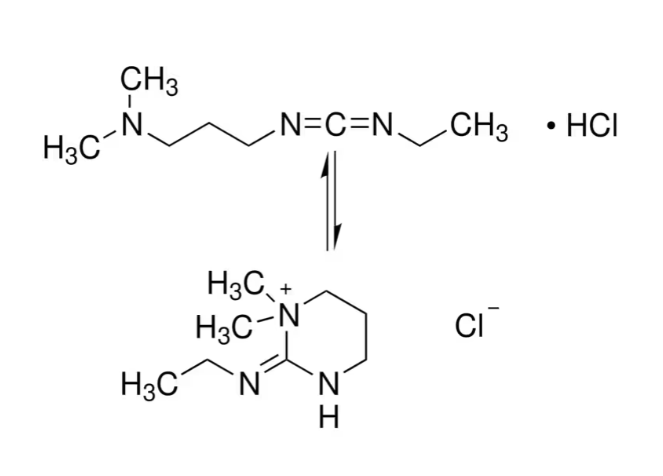
1-Ethyl-3-(3-dimethylaminopropyl)carbodiimide Hydrochloride (EDC · HCl, EDCI · HCl)
Regular price:
Regular price:
product unavailable
add to wish list
0
carbodiimide Hydrochloride (EDC · HCl, EDCI · HCl) "Pin It")
Description
1-Ethyl-3-(3-dimethylaminopropyl)carbodiimide Hydrochloride (EDC · HCl, EDCI · HCl)
Synonyms: EDC, EDCI, EDAC, Water-Soluble Carbodiimide
CAS Number: 25952-53-8
EC Number: 247-929-7
Chemical Formula: C₈H₁₇N₃·HCl
Molar Mass: 191.70 g/mol
Appearance: White to off-white crystalline powder
Chemical and Physical Properties
Density: Not specified / solid powder
Melting Point: 110–115 °C
Boiling Point: Not applicable (decomposes)
Vapor Pressure: Negligible
Solubility: Freely soluble in water and polar organic solvents
Flash Point: Not applicable (non-combustible solid)
Log Pow: −1.3 (approx.)
Applications
Peptide Synthesis: Widely used as a carbodiimide coupling reagent in peptide bond formation
Bioconjugation: Activates carboxyl groups for protein and nucleic-acid crosslinking
Crosslinking Chemistry: Used in EDC/NHS coupling systems
Laboratory Reagent: General-purpose dehydrating and activating agent in organic synthesis
⚠️ Not intended for use in food, cosmetic, or pharmaceutical applications.
Safety Information

Signal Word: Warning
Hazard Statements
H302 Harmful if swallowed.
H311 Toxic in contact with skin.
H315 Causes skin irritation.
H317 May cause an allergic skin reaction.
H319 Causes serious eye irritation.
H373 May cause damage to organs (Stomach, large intestine, lymph node) through prolonged or repeated exposure if swallowed.
H410 Very toxic to aquatic life with long lasting effects.
Precautionary Statements
P273 Avoid release to the environment.
P280 Wear protective gloves/ protective clothing/ eye protection/ face protection.
P301 + P312 IF SWALLOWED: Call a POISON CENTER/ doctor if you feel unwell.
P302 + P352 + P312 IF ON SKIN: Wash with plenty of water. Call a POISON CENTER/ doctor if you feel unwell.
P305 + P351 + P338 IF IN EYES: Rinse cautiously with water for several minutes. Remove contact lenses, if present and easy to do. Continue rinsing.
P314 Get medical advice/ attention if you feel unwell.
Handling and Storage
Handling: Avoid contact with skin, eyes, and clothing. Prevent inhalation of dust. Use only with adequate ventilation.
Storage: Store tightly sealed, in a cool, dry environment. Protect from moisture and incompatible reagents (especially bases and strong oxidizers).