
 CATEGORIES
- ORGANIC COMPOUNDS(1135)
- INORGANIC COMPOUNDS(1055)
- Mineral Acids(51)
- Chelates(3)
- Elements(130)
- Salts(556)
- Oxides(121)
- Hydroxides(30)
- Hydrides(15)
- Other(19)
- Nanoparticles(3)
- Standard solutions(126)
- LAB EQUIPMENT(5176)
- *(1)
- Organic Synthesis(421)
- Industry(775)
Language
US version allows shipping to all available destinations


 MANUFACTURER
Hydrides are compounds in which hydrogen is bonded to another element, often in the formal oxidation state −1 (H⁻) or as a covalent H atom. They include ionic, covalent, and metallic types and are key reagents for reduction and hydrogen storage.
LAH Lithium Aluminum Hydride (LiAlH₄)

⚠️ ✈︎ Shipping Limitations: We do not ship this product to: US | Unless government approved ⓘ
Availability: Large quantity
Dispatched within: 5 days
Sodium Borohydride

⚠️ ✈︎ Shipping Limitations: We do not ship this product to: US, DE | Unless government approved ⓘ
Availability: na wyczerpaniu
Dispatched within: 5 days
Sodium Borohydride For Organic Synthesis 1kg

⚠️ ✈︎ Shipping Limitations: We do not ship this product to: US, DE | Unless government approved ⓘ
Availability: Large quantity
Dispatched within: 7 days
Sodium Borohydride for Reduction >99,9% - 100g

⚠️ ✈︎ Shipping Limitations: We do not ship this product to: US, DE | Unless government approved ⓘ
Availability: Large quantity
Dispatched within: 7 days
Sodium Borohydride for Reduction >99,9% - 25g

⚠️ ✈︎ Shipping Limitations: We do not ship this product to: US, DE | Unless government approved ⓘ
Availability: Large quantity
Dispatched within: 7 days
Sodium Borohydride for Reduction >99,9% - 500g

⚠️ ✈︎ Shipping Limitations: We do not ship this product to: US, DE | Unless government approved ⓘ
Availability: Large quantity
Dispatched within: 7 days
Sodium Borohydride for Reduction >99,9% - 5g

⚠️ ✈︎ Shipping Limitations: We do not ship this product to: US, DE | Unless government approved ⓘ
Availability: Large quantity
Dispatched within: 7 days
Sodium Borohydride Pure >99,9% 600g - 600g

⚠️ ✈︎ Shipping Limitations: We do not ship this product to: US, DE | Unless government approved ⓘ
Availability: Large quantity
Dispatched within: 7 days
Sodium Cyanoborohydride NaBH3CN | For Organic Synthesis

Availability: Large quantity
Dispatched within: 7 days
Sodium Hydride Dispersion in Oil 60% - NaH - Pure - [ CAS : 7646-69-7 ] - 100g
![Sodium Hydride Dispersion in Oil 60% - NaH - Pure - [ CAS : 7646-69-7 ] - 100g](/environment/cache/images/productGfx_801_200_200/afeb47b959a3112c6a556bca92c2ff1f.jpg?overlay=1)
Availability: Large quantity
Dispatched within: 7 days
Sodium Hydride Dispersion in Oil 60% - NaH - Pure - [ CAS : 7646-69-7 ] - 10g
![Sodium Hydride Dispersion in Oil 60% - NaH - Pure - [ CAS : 7646-69-7 ] - 10g](/environment/cache/images/productGfx_804_200_200/96c3b8cefe3564ae89b5fc0320279056.jpg?overlay=1)
Availability: Large quantity
Dispatched within: 7 days
Sodium Hydride Dispersion in Oil 60% - NaH - Pure - [ CAS : 7646-69-7 ] - 25g
![Sodium Hydride Dispersion in Oil 60% - NaH - Pure - [ CAS : 7646-69-7 ] - 25g](/environment/cache/images/productGfx_803_200_200/a6979aabae02c6c292317c7a0939e46a.jpg?overlay=1)
Availability: Large quantity
Dispatched within: 7 days
Sodium Hydride Dispersion in Oil 60% - NaH - Pure - [ CAS : 7646-69-7 ] - 50g
![Sodium Hydride Dispersion in Oil 60% - NaH - Pure - [ CAS : 7646-69-7 ] - 50g](/environment/cache/images/productGfx_802_200_200/82d8bd1d41dfed1824c7f9367a3d464c.jpg?overlay=1)
Availability: Large quantity
Dispatched within: 7 days
Sodium Triacetoxyborohydride (STAB)
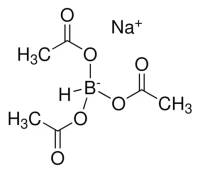
⚠️ ✈︎ Shipping Limitations: We do not ship this product to: US | Unless government approved ⓘ
Availability: na wyczerpaniu
Dispatched within: 7 days
Synhydrid ; Vitride ; Sodium bis(2-methoxyethoxy)aluminium hydride - 60% - SAFER LAH ALTERNATIVE

⚠️ ✈︎ Shipping Limitations: We do not ship this product to: US, DE | Unless government approved ⓘ
Availability: Large quantity
Dispatched within: 5 days
Hydrides are broadly defined as binary (and related) compounds containing hydrogen and a more electropositive or less electronegative partner. Their bonding and properties depend strongly on the element to which hydrogen is attached:
1) Ionic (saline) hydrides.
Formed with very electropositive metals (mainly Group 1 and heavier Group 2). They contain discrete hydride ions, H⁻, in a crystal lattice (e.g., NaH, CaH₂). These are strong Brønsted bases and powerful reducing agents; they react vigorously with water or protic solvents to release H₂. Their high lattice energies make many of them high-melting solids.
2) Covalent (molecular) hydrides.
Formed with p-block elements and many transition metals where H is covalently bonded (e.g., CH₄, NH₃, SiH₄, BH₃ adducts). Their reactivity follows periodic trends tied to bond polarity and strength. For instance, E–H bond acidity increases down a group for many p-block hydrides (e.g., HF < HCl < HBr < HI in acidity), while hydrides of boron and aluminum are typically electron-deficient and act as hydride donors in reductions.
3) Metallic (interstitial) hydrides.
Common for transition metals and lanthanides, where hydrogen occupies interstitial sites in a metal lattice (e.g., PdHₓ, LaNi₅H₆). These often display non-stoichiometry and are important for reversible hydrogen storage, catalysis, and modifying electrical/structural properties of metals.
4) Complex hydrides.
These contain polyatomic anions with hydridic character, such as borohydrides (BH₄⁻) and alanates (AlH₄⁻). Familiar examples include LiAlH₄ and NaBH₄. Their hydridic H atoms transfer as H⁻ to electrophiles, making them central in organic and inorganic reduction chemistry. Selectivity depends on the metal, counterion, solvent, and substrate.
Hydrides in coordination and catalysis.
Transition-metal hydride complexes (M–H) are pivotal intermediates in hydrogenation, hydroformylation, and many C–H activation processes. The M–H bond can behave as hydridic or protic depending on metal oxidation state and ligand environment, enabling steps like migratory insertion, β-hydride elimination, and heterolytic H₂ activation.
Key characteristics and uses.
Hydrides span a wide range of stability and reactivity: from inert molecular hydrides (alkanes) to extremely reactive ionic/complex hydrides. This diversity underpins applications in synthetic reductions, semiconductor processing (e.g., silanes), batteries and energy materials (metal hydrides), and industrial catalysis where controlled hydride transfer or H₂ release/uptake is essential.