
 CATEGORIES
- ORGANIC COMPOUNDS(1135)
- INORGANIC COMPOUNDS(1055)
- Mineral Acids(51)
- Chelates(3)
- Elements(130)
- Salts(556)
- Aluminium(18)
- Ammonium(51)
- Antimony(4)
- Barium(20)
- Bismuth(5)
- Caesium(9)
- Cadmium(2)
- Calcium(33)
- Cesium(3)
- Copper(22)
- Cobalt(13)
- Chromium(11)
- Lead(14)
- Lanthanum(12)
- Lithium(15)
- Manganese(12)
- Sodium(151)
- Silver(7)
- Potassium(54)
- Zinc(16)
- Cerium(2)
- Tin(5)
- Nickel(11)
- Gold(0)
- Iron(22)
- Zirconium(1)
- Mercury(2)
- Magnesium(21)
- Strontium(17)
- Mixed Salts(1)
- Oxides(121)
- Hydroxides(30)
- Hydrides(15)
- Other(19)
- Nanoparticles(3)
- Standard solutions(126)
- LAB EQUIPMENT(5176)
- *(1)
- Organic Synthesis(421)
- Industry(775)
Language
US version allows shipping to all available destinations


 MANUFACTURER
Potassium Dichromate
Regular price:
Regular price:
product unavailable
add to wish list
0

Description
Potassium Dichromate
Other Names: Potassium bichromate, Dipotassium dichromate, Dichromic acid dipotassium salt, Potassium dichromate(VI)
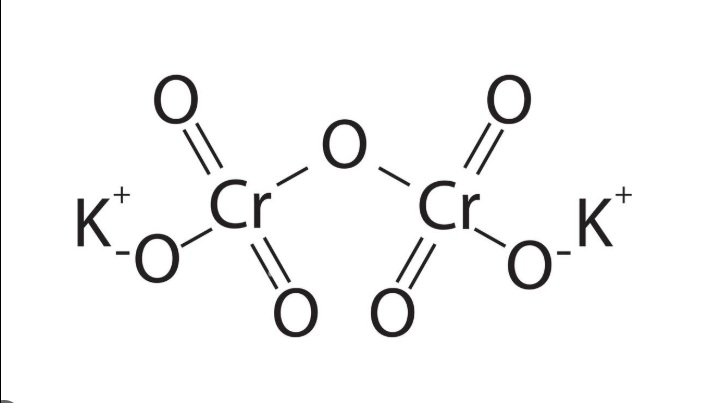
Chemical Formula: K2Cr2O7
Molar Mass: 294.18 g/mol
CAS Number: 7778-50-9
SMILES: [O-][Cr](=O)(=O)O[Cr](=O)(=O)[O-].[K+].[K+]
Appearance: Orange to orange-red crystalline solid
Odor: Odorless
Potassium dichromate is an inorganic chromium(VI) compound composed of potassium cations and dichromate anions, Cr2O72−. It is a well-characterized strong oxidizing agent and an important reference compound in analytical, inorganic and physical chemistry. The dichromate ion contains two tetrahedral chromium(VI) centers linked through a bridging oxygen atom, and its electronic and vibrational properties have been investigated extensively using spectroscopic techniques. Raman and infrared studies of crystalline, molten and aqueous potassium dichromate have provided detailed information about the internal vibrational modes and structural behavior of the dichromate ion.
In aqueous systems, chromium(VI) speciation depends strongly on concentration, acidity and other solution conditions. Chromate, hydrogen chromate and dichromate species can participate in concentration- and pH-dependent equilibria. Spectroscopic investigations have therefore frequently used potassium dichromate as a source of chromium(VI) for studying the structure, equilibrium chemistry and optical properties of aqueous chromate systems.
Chemical and physical properties
Potassium dichromate is a crystalline solid with an intense orange to red-orange color characteristic of chromium(VI) oxoanions. Its molecular mass is approximately 294.18 g/mol. Published reference data report a melting point of approximately 398–400 °C and a density of about 2.676 g/cm3. Experimental studies have also investigated structural transitions in solid potassium dichromate and its behavior in the molten state. :contentReference[oaicite:2]{index=2}
The compound is soluble in water, with solubility increasing substantially with temperature. Reference data report approximately 4.9 g per 100 mL of water at 0 °C. Measurements of potassium dichromate and its aqueous solutions have been reported in the scientific literature as part of systematic studies of chromate and dichromate solution properties. :contentReference
Potassium dichromate exhibits pronounced oxidizing properties because chromium is present in the +6 oxidation state. In redox reactions, chromium(VI) can be reduced to lower oxidation states, particularly chromium(III). This well-defined redox chemistry, combined with the availability of highly pure crystalline material, has made potassium dichromate an established primary-standard substance in classical oxidimetric analysis. :contentReference[oaicite:4]{index=4}
Applications
Potassium dichromate is widely used in analytical chemistry as an oxidimetric reagent and primary standard for oxidation-reduction measurements. Scientific studies have demonstrated that appropriate high-purity grades provide excellent primary standards, including for quantitative reactions involving iron(II) and other reducing species.
In synthetic chemistry, potassium dichromate has been studied as an inorganic oxidizing reagent for the conversion of various organic functional groups. Published reagent literature describes its use in oxidation chemistry, including transformations of alcohols into aldehydes, ketones and carboxylic-acid derivatives depending on substrate and reaction conditions.
Potassium dichromate is also used in physical and inorganic chemistry research involving chromium(VI) speciation, UV-visible spectroscopy, Raman spectroscopy, infrared spectroscopy, phase transitions and crystal-surface investigations. Its well-defined crystalline structure and strong spectroscopic response make it a useful model compound for studying dichromate-ion structure and interactions in both solid and aqueous systems.
Safety information
Potassium dichromate is a highly hazardous chromium(VI) compound and a strong oxidizer. Chromium(VI) compounds are associated with serious toxicological effects, including genotoxicity and carcinogenicity. The International Agency for Research on Cancer (IARC) classifies chromium(VI) compounds as carcinogenic to humans (Group 1). Appropriate engineering controls, personal protective equipment and procedures for hazardous chromium(VI) compounds are therefore required when handling this material.
Scientific references
1. NIST Chemistry WebBook, SRD 69. Potassium dichromate, CAS 7778-50-9. National Institute of Standards and Technology.
2. Freeman, F. Potassium Dichromate. Encyclopedia of Reagents for Organic Synthesis. Wiley, 2007. DOI: 10.1002/047084289X.rp210.pub2. :contentReference
3. Belcher, R.; Chakrabarti, C. L.; Stephen, W. I. Some observations on potassium dichromate as an oxidimetric standard. Analyst, 1969, 94, 20–25. DOI: 10.1039/AN9699400020. :contentReference
4. Knoeck, J.; Diehl, H. Coulometric assay of the primary standards potassium dichromate and ammonium hexanitratocerate. Talanta, 1969, 16(2), 181–193. DOI: 10.1016/0039-9140(69)80269-9.
5. Potassium dichromate as an oxidimetric reagent. Talanta, 1966, 13(11), 1473–1495. DOI: 10.1016/0039-9140(66)80096-6. :contentReference[oaicite:13]
6. Vibrational spectra of crystalline, molten and aqueous potassium dichromate. Spectrochimica Acta Part A: Molecular Spectroscopy, 1973, 29(8), 1585–1600. DOI: 10.1016/0584-8539(73)80109-6. :contentReference
7. Kearley, R. A. Some Physical Properties of Sodium Chromate, Sodium Dichromate, and Potassium Dichromate, and Their Aqueous Solutions. Journal of Chemical & Engineering Data, 1964, 9(4), 548–551. DOI: 10.1021/je60023a025. :contentReference[oaicite:15]{index=15}
8. IARC Working Group on the Evaluation of Carcinogenic Risks to Humans. Chromium (VI) Compounds. IARC Monographs, Volume 100C, 2012. :contentReference
Handling and storage
Store in a tightly closed container in a dry, cool and well-ventilated place. Protect from moisture, heating and chemically incompatible substances. Keep away from combustible materials, reducing agents, organic substances and acids. Avoid dust formation and contact of the product with contaminants. Close the container tightly after use.