
 CATEGORIES
- ORGANIC COMPOUNDS(1135)
- INORGANIC COMPOUNDS(1055)
- Mineral Acids(51)
- Chelates(3)
- Elements(130)
- Salts(556)
- Aluminium(18)
- Ammonium(51)
- Antimony(4)
- Barium(20)
- Bismuth(5)
- Caesium(9)
- Cadmium(2)
- Calcium(33)
- Cesium(3)
- Copper(22)
- Cobalt(13)
- Chromium(11)
- Lead(14)
- Lanthanum(12)
- Lithium(15)
- Manganese(12)
- Sodium(151)
- Silver(7)
- Potassium(54)
- Zinc(16)
- Cerium(2)
- Tin(5)
- Nickel(11)
- Gold(0)
- Iron(22)
- Zirconium(1)
- Mercury(2)
- Magnesium(21)
- Strontium(17)
- Mixed Salts(1)
- Oxides(121)
- Hydroxides(30)
- Hydrides(15)
- Other(19)
- Nanoparticles(3)
- Standard solutions(126)
- LAB EQUIPMENT(5176)
- *(1)
- Organic Synthesis(421)
- Industry(775)
Language
US version allows shipping to all available destinations


 MANUFACTURER
Tetrasodium Pyrophosphate
Regular price:
Regular price:
product unavailable
add to wish list
0

Description
Tetrasodium Pyrophosphate
Other Names: Sodium Pyrophosphate, Tetrasodium Diphosphate, Sodium Diphosphate, TSPP, Pyrophosphoric Acid Tetrasodium Salt
Chemical Formula: Na4P2O7
Molar Mass: 265.90 g/mol
CAS Number: 7722-88-5
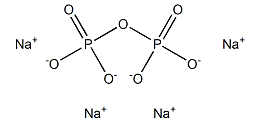
SMILES: [O-]P(=O)([O-])OP(=O)([O-])[O-].[Na+].[Na+].[Na+].[Na+]
Appearance: White crystalline powder or granules
Odor: Odorless
Tetrasodium pyrophosphate (TSPP) is an inorganic condensed phosphate consisting of four sodium cations and the pyrophosphate anion P2O74−. The pyrophosphate ion contains two phosphorus-centered tetrahedral units connected through a bridging oxygen atom. Its high negative charge gives TSPP a pronounced ability to interact with multivalent metal ions and mineral surfaces. These properties are responsible for its behavior as a sequestrant, water-softening agent and dispersing or deflocculating additive. Tetrasodium pyrophosphate occurs in both anhydrous and hydrated forms, including the crystalline decahydrate Na4P2O7·10H2O.
Chemical and physical properties
Anhydrous tetrasodium pyrophosphate is a white crystalline inorganic solid with a density of approximately 2.53 g/cm3. Published physicochemical data report a melting temperature of approximately 988–995 °C for the anhydrous material. The decahydrate has substantially different thermal properties and loses its hydration water upon heating.
Tetrasodium pyrophosphate is soluble in water, and its solubility increases strongly with temperature. Reported values are approximately 3.16 g/100 mL in cold water and about 40.26 g/100 mL in boiling water. Aqueous solutions are alkaline; a 1% solution typically has a pH close to 10.2.
In aqueous systems, pyrophosphate can interact with calcium, magnesium and other polyvalent ions through coordination and precipitation equilibria. This affinity for metal ions contributes to its water-softening and sequestration properties. Pyrophosphate can also hydrolyze to orthophosphate in aqueous solution, although under moderately alkaline conditions the uncatalyzed hydrolysis can be relatively slow.
The pyrophosphate anion can adsorb onto mineral and oxide surfaces and alter interparticle forces. Studies of kaolin, bentonite and concentrated alumina suspensions have demonstrated that sodium pyrophosphate compounds can strongly influence dispersion, viscosity, sedimentation and rheological behavior.
Applications
Tetrasodium pyrophosphate is used as a builder and water-conditioning component in detergent and industrial cleaning systems. Its interaction with calcium and magnesium ions reduces the effects of water hardness and can improve the performance of surfactant-containing formulations. Experimental studies of detergent builders have demonstrated substantial water-softening activity for tetrasodium pyrophosphate in hard-water systems.
It is widely investigated and applied as a dispersing and deflocculating agent for mineral suspensions. In ceramic processing, sodium pyrophosphate can improve the rheological properties of concentrated alumina slurries, facilitating deagglomeration, slip casting and subsequent ceramic processing. Similar effects have been reported for kaolin and bentonite dispersions.
In clay processing and mineral beneficiation, TSPP can promote dispersion of fine particles and assist in separating clay minerals from associated mineral impurities. Studies on kaolin and montmorillonite systems have shown that pyrophosphate adsorption and its interactions with dissolved metal ions can significantly modify suspension stability and mineral-surface chemistry.
Tetrasodium pyrophosphate is also used in oral-care formulations for control of mineralized dental deposits. Clinical studies of pyrophosphate-containing dentifrices have demonstrated inhibition of supragingival calculus formation. This behavior is associated with the interaction of soluble pyrophosphate species with calcium-containing mineral phases.
In coordination and inorganic chemistry research, sodium pyrophosphate is used as a source of the P2O74− ligand. The anion can coordinate metal centers in multiple modes, including bridging interactions, and has therefore been investigated in the preparation and structural characterization of transition-metal pyrophosphate complexes.
Scientific references
- National Center for Biotechnology Information. PubChem Compound Summary for CID 24403, Tetrasodium Pyrophosphate. Molecular formula, molecular mass, CAS number, SMILES and physicochemical data. https://pubchem.ncbi.nlm.nih.gov/compound/24403
- Chou K.S., Lee L.J. Effect of Dispersants on the Rheological Properties and Slip Casting of Concentrated Alumina Slurry. Journal of the American Ceramic Society, 1989, 72(9), 1622–1627. DOI: 10.1111/j.1151-2916.1989.tb06293.x
- Ma M., Pierre A.C. Influence of dispersants on the solubility of calcined kaolin. Applied Clay Science, 1998, 13(2), 137–147. DOI: 10.1016/S0169-1317(98)00016-7
- Bidwell J.I., Jepson W.B., Toms G.L. The Interaction of Kaolinite with Polyphosphate and Polyacrylate in Aqueous Solutions—Some Preliminary Results. Clay Minerals, 1970, 8(4), 445–459. DOI: 10.1180/claymin.1970.008.4.07
- Foster M.W., Roberts J.S., Brodie J.B. The Effect of Builders in Hard Water Detergent Solutions. Canadian Journal of Research, 1948, 26f(2), 76–85. DOI: 10.1139/cjr48f-010
- MacArthur D.M., Beevers C.A. The crystal structure of sodium pyrophosphate decahydrate, Na4P2O7·10H2O. Acta Crystallographica, 1957, 10, 428–432. DOI: 10.1107/S0365110X57001383
- Ikotun O.F., Armatus N.G., Julve M., Kruger P.E., Lloret F., Nieuwenhuyzen M., Doyle R.P. Synthesis and Structural and Magnetic Characterization of {[(phen)2Ni]2(μ-P2O7)}·27H2O and {[(phen)2Mn]2(μ-P2O7)}·13H2O: Rare Examples of Coordination Complexes with the Pyrophosphate Ligand. Inorganic Chemistry, 2007. DOI: 10.1021/ic700439a
- Moon J.H. et al. Clinical and Microbiological Efficacy of Pyrophosphate Containing Toothpaste: A Double-Blinded Placebo-Controlled Randomized Clinical Trial. Microorganisms, 2020, 8(11), 1806. DOI: 10.3390/microorganisms8111806
Handling and storage
Store in a tightly closed container in a dry, cool and well-ventilated place. Protect from moisture, direct sunlight and contamination of the product. Avoid dust formation during transferring and dosing. Close the container tightly after use to reduce caking and loss of product quality. Keep away from strong acids and chemically incompatible substances.