
 CATEGORIES
- ORGANIC COMPOUNDS(1135)
- INORGANIC COMPOUNDS(1055)
- Mineral Acids(51)
- Chelates(3)
- Elements(130)
- Salts(556)
- Oxides(121)
- Hydroxides(30)
- Hydrides(15)
- Other(19)
- Nanoparticles(3)
- Standard solutions(126)
- LAB EQUIPMENT(5176)
- *(1)
- Organic Synthesis(421)
- Industry(775)
Language
US version allows shipping to all available destinations


 MANUFACTURER
Sodium Triacetoxyborohydride (STAB)
Regular price:
Regular price:
product unavailable
add to wish list
0

 "Pin It")
Description
Sodium Triacetoxyborohydride (STAB)
Other Names: Sodium triacetoxyhydroborate, Sodium triacetohydroborate, STAB, NaBH(OAc)3
Chemical Formula: C6H10BNaO6
Linear Formula: NaBH(OCOCH3)3
Molar Mass: 211.94 g/mol
CAS Number: 56553-60-7
Appearance: Colorless to white powder
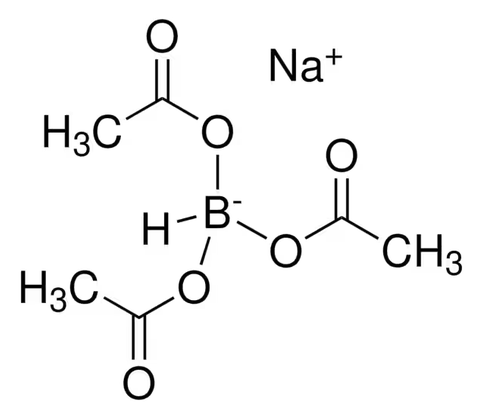
Sodium triacetoxyborohydride, commonly abbreviated as STAB, is a mild hydride reducing reagent widely used in synthetic organic chemistry. Structurally, it is an acetoxy-substituted derivative of sodium borohydride in which three hydrogen atoms of the borohydride anion are replaced by acetoxy groups. These electron-withdrawing substituents decrease the reducing strength of the remaining boron–hydrogen bond, giving the reagent substantially greater chemoselectivity than sodium borohydride in many organic transformations. STAB is particularly well established as a reducing agent for reactions involving imines and iminium ions.
Chemical and physical properties
Sodium triacetoxyborohydride is supplied as a colorless to white solid. The reagent is moisture sensitive and is rapidly decomposed by water and other strongly protic media. Hydrolysis consumes the active hydride and generates hydrogen gas, so exposure to atmospheric moisture can progressively decrease reagent activity. Analytical studies have shown that the effective hydride content of stored STAB may decline with time, making reagent potency an important parameter in reproducible synthetic procedures.
STAB can be prepared from sodium borohydride and acetic acid. Formation of the triacetoxyborohydride species involves stepwise protonolysis of borohydride and liberation of hydrogen. Thermal and reaction-calorimetry studies of this preparation have demonstrated that both heat release and hydrogen evolution must be controlled during larger-scale synthesis.
The reagent is compatible with several aprotic organic solvents. Literature procedures for reductive amination commonly employ 1,2-dichloroethane, tetrahydrofuran or, in selected cases, acetonitrile. Water and strongly protic solvents are generally unsuitable for storage of the reagent because they promote decomposition of the active borohydride species.
Applications
The principal application of sodium triacetoxyborohydride is the reductive amination of aldehydes and ketones. In these reactions, an aldehyde or ketone reacts with a primary or secondary amine to form an imine or iminium intermediate, which is subsequently reduced by STAB to the corresponding amine. The reagent has been successfully applied to aliphatic and aromatic aldehydes, cyclic and acyclic aliphatic ketones and a broad range of primary and secondary amines.
STAB is particularly useful because it preferentially reduces iminium species under conditions where direct reduction of the starting carbonyl compound can be comparatively slow. This selectivity enables many reductive amination reactions to be performed as convenient one-pot transformations. Studies comparing STAB with sodium cyanoborohydride, borane-based reagents and catalytic hydrogenation have demonstrated high product yields and reduced formation of certain side products for numerous substrates.
The reagent also displays useful functional-group compatibility. Reductive amination reactions with STAB have been performed in the presence of acetals, ketals, carbon-carbon multiple bonds, nitrile groups and nitro groups. This chemoselectivity makes the reagent valuable for the synthesis of structurally complex secondary and tertiary amines and for multistep organic synthesis where preservation of additional functional groups is required.
Sodium triacetoxyborohydride can additionally reduce aldehydes to the corresponding alcohols under suitable conditions, while ketones are substantially less reactive toward direct reduction. This difference in reactivity has been investigated as a method for selective carbonyl reduction.
Handling and stability
Sodium triacetoxyborohydride should be protected from moisture because hydrolytic degradation destroys active hydride and releases hydrogen gas. Scientific studies of STAB stability and quantitative analysis have demonstrated that partially degraded reagent can contain significantly less active reducing species than expected from nominal material mass. Storage and handling under dry conditions are therefore important for maintaining reproducible reducing activity.
Scientific references
Abdel-Magid, A. F.; Carson, K. G.; Harris, B. D.; Maryanoff, C. A.; Shah, R. D. Reductive Amination of Aldehydes and Ketones with Sodium Triacetoxyborohydride. Studies on Direct and Indirect Reductive Amination Procedures. Journal of Organic Chemistry, 1996, 61, 3849–3862. DOI: 10.1021/jo960057x.
Gribble, G. W.; Ferguson, D. C. Reactions of Sodium Borohydride in Acidic Media. Selective Reduction of Aldehydes with Sodium Triacetoxyborohydride. Journal of the Chemical Society, Chemical Communications, 1975, 535–536. DOI: 10.1039/C39750000535.
Zacuto, M. J.; Perona, J.; Dunn, R. A Quantitative Assay of Sodium Triacetoxyborohydride. Organic Process Research & Development, 2019. DOI: 10.1021/acs.oprd.9b00215.
Application of Thermal Analytical Techniques in Development of a Safe and Robust Process for Production of Triacetoxyborohydride (STAB). Thermochimica Acta, 2005, 426, 109–113. DOI: 10.1016/j.tca.2004.06.021.
Safety

Signal Word: Danger
H260 In contact with water releases flammable gases which may
ignite spontaneously.
H302 Harmful if swallowed.
H318 Causes serious eye damage.
H360FD May damage fertility. May damage the unborn child.
P210, P231 + P232, P280, P301 + P312, P305 + P351 + P338, P308 + P313
Handling and Storage
Store in a dry, tightly sealed container under an inert atmosphere (e.g., nitrogen or argon). Keep away from moisture, acids, and oxidizing agents. Avoid inhalation of dust and ensure proper ventilation.