
 CATEGORIES
- ORGANIC COMPOUNDS(1135)
- INORGANIC COMPOUNDS(1055)
- Mineral Acids(51)
- Chelates(3)
- Elements(130)
- Salts(556)
- Oxides(121)
- Hydroxides(30)
- Hydrides(15)
- Other(19)
- Nanoparticles(3)
- Standard solutions(126)
- LAB EQUIPMENT(5176)
- *(1)
- Organic Synthesis(421)
- Industry(775)
Language
US version allows shipping to all available destinations


 MANUFACTURER
Sodium Borohydride
Regular price:
Regular price:
product unavailable
add to wish list
0

Description
Sodium Borohydride
Other Names: Sodium Tetrahydroborate, Sodium Tetrahydridoborate, Sodium Boranate, NaBH4, SBH
Chemical Formula: NaBH4
Molar Mass: 37.83 g/mol
CAS Number: 16940-66-2
Appearance: White crystalline solid or crystalline powder
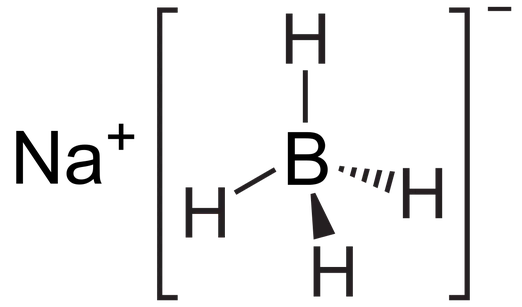
Sodium borohydride is an inorganic borohydride and one of the most widely used hydride reducing agents in synthetic chemistry. It consists of a sodium cation, Na+, and a tetrahedral borohydride anion, BH4−. The B–H bonds of the borohydride anion provide nucleophilic hydride equivalents that can be transferred to electrophilic functional groups. Compared with more powerful hydride reagents such as lithium aluminium hydride, sodium borohydride generally exhibits milder and more selective reducing behavior, which makes it particularly useful for chemoselective transformations.
Chemical and physical properties
Sodium borohydride is a white crystalline ionic solid. At ambient temperature its structure contains tetrahedral BH4− ions associated with Na+ cations. Crystallographic investigations have shown an order–disorder phase transition near 190 K, above which the compound adopts an average cubic NaCl-type structure with orientationally disordered borohydride anions.
The compound is thermally stable compared with many other complex hydrides. Experimental studies report melting at approximately 505 °C, while detailed hydrogen-desorption measurements give a decomposition temperature of approximately 534 ± 10 °C at a hydrogen pressure of 1 bar. Thermal decomposition produces hydrogen and solid sodium- and boron-containing products.
Sodium borohydride dissolves in water and polar protic solvents, but it is not indefinitely stable in these media. Hydrolysis converts the borohydride species into borate-containing products with liberation of hydrogen gas. The rate of hydrolysis depends strongly on pH, temperature and the presence of catalysts; alkaline aqueous solutions are substantially more stable than acidic or catalytically activated systems.
Applications
Sodium borohydride is extensively used for the reduction of aldehydes and ketones to the corresponding primary and secondary alcohols. Carbonyl reduction proceeds through hydride transfer from BH4− to the electrophilic carbonyl carbon. Aldehydes are generally reduced more rapidly than ketones, and the reagent can often reduce these functional groups without affecting less reactive groups present in the same molecule.
Under ordinary conditions, sodium borohydride is considerably less reactive toward carboxylic acids, esters, amides and nitriles than toward aldehydes and ketones. Its reducing power can, however, be modified substantially through changes in solvent, temperature or addition of Lewis acids, iodine, transition-metal salts and other activating agents. Modified NaBH4 systems are therefore used for a considerably broader range of reductive transformations in organic synthesis.
Sodium borohydride can also reduce imines and iminium species and is consequently used in reductive amination and in the preparation of amine derivatives. Its combination of relatively mild reaction conditions, selectivity and convenient handling has established NaBH4 as an important laboratory and process-scale reducing reagent.
In inorganic and materials chemistry, sodium borohydride is employed as a reducing agent for metal ions. Reduction of metal salts by NaBH4 is widely investigated as a route to metallic and metal-containing nanoparticles, including systems based on nickel, cobalt, copper, palladium, silver and other metals. Reaction conditions influence nanoparticle nucleation, growth, particle-size distribution and final material structure.
Sodium borohydride is additionally investigated as a chemical hydrogen carrier because hydrolysis can theoretically release four equivalents of molecular hydrogen per equivalent of NaBH4. Catalysts based on ruthenium, nickel, cobalt and related materials can greatly accelerate hydrogen evolution. This chemistry has been extensively studied for controlled hydrogen-generation systems and fuel-cell-related technologies.
Handling and stability
Sodium borohydride should be protected from moisture, acids and uncontrolled contact with protic media. Hydrolysis and acid decomposition can release flammable hydrogen gas, and catalytic contamination can substantially accelerate this reaction. The material should therefore be stored under dry conditions and handled with appropriate ventilation, eye protection and chemically resistant gloves. Exposure to humid air can progressively convert NaBH4 into hydrated and borate-containing products.
Scientific references
NIST Chemistry WebBook, SRD 69. Sodium tetrahydroborate. CAS Registry Number 16940-66-2.
Colletto, C. Reductive Transformations with Sodium Borohydride and Their Applications. Organic Process Research & Development, 2026, 30, 1082–1118. DOI: 10.1021/acs.oprd.5c00357.
Periasamy, M.; Thirumalaikumar, M. Methods of enhancement of reactivity and selectivity of sodium borohydride for applications in organic synthesis. Journal of Organometallic Chemistry, 2000, 609, 137–151. DOI: 10.1016/S0022-328X(00)00210-2.
Brown, H. C.; Wheeler, O. H.; Ichikawa, K. Chemical effects of steric strains—XIII: Kinetics of the reaction of sodium borohydride with carbonyl groups. Tetrahedron, 1957, 1, 214–220. DOI: 10.1016/0040-4020(57)88041-7.
Urgnani, J.; Torres, F. J.; Palumbo, M.; Baricco, M. Hydrogen release from solid state NaBH4. International Journal of Hydrogen Energy, 2008, 33, 3111–3115. DOI: 10.1016/j.ijhydene.2008.03.031.
Dragieva, I. D.; Stoynov, Z. B.; Klabunde, K. J. Synthesis of nanoparticles by borohydride reduction and their applications. Scripta Materialia, 2001, 44, 2187–2191. DOI: 10.1016/S1359-6462(01)00901-0.
Safety

Signal Word: Danger
H260 (86.7%): In contact with water releases flammable gases which may ignite spontaneously [Danger Substances and mixtures which in contact with water, emit flammable gases]
H301 (99.6%): Toxic if swallowed [Danger Acute toxicity, oral]
H311 (23%): Toxic in contact with skin [Danger Acute toxicity, dermal]
H314 (99.6%): Causes severe skin burns and eye damage [Danger Skin corrosion/irritation]
H318 (71.4%): Causes serious eye damage [Danger Serious eye damage/eye irritation]
H332 (16.7%): Harmful if inhaled [Warning Acute toxicity, inhalation]
H360 (43.7%): May damage fertility or the unborn child [Danger Reproductive toxicity]
P203, P223, P231+P232, P260, P261, P262, P264, P264+P265, P270, P271, P280, P301+P316, P301+P330+P331, P302+P335+P334, P302+P352, P302+P361+P354, P304+P340, P305+P354+P338, P316, P317, P318, P321, P330, P361+P364, P363, P370+P378, P402+P404, P405, and P501
Handling and Storage
Store in a dry, tightly sealed container under an inert atmosphere (e.g., nitrogen or argon). Keep away from moisture, acids, and oxidizing agents. Avoid inhalation of dust and ensure proper ventilation.