
 CATEGORIES
- ORGANIC COMPOUNDS(1309)
- INORGANIC COMPOUNDS(1008)
- Chelates(8)
- Elements(156)
- Hydroxides(32)
- Hydrides(19)
- Mineral Acids(45)
- Other(23)
- Oxides(122)
- Salts(599)
- Aluminium(22)
- Ammonium(57)
- Antimony(4)
- Barium(19)
- Bismuth(5)
- Caesium(9)
- Cadmium(2)
- Calcium(36)
- Cesium(3)
- Copper(22)
- Cobalt(12)
- Chromium(11)
- Lead(14)
- Lanthanum(12)
- Lithium(17)
- Manganese(12)
- Sodium(164)
- Silver(7)
- Potassium(67)
- Zinc(16)
- Tin(5)
- Nickel(18)
- Gold(0)
- Iron(21)
- Zirconium(1)
- Mercury(2)
- Magnesium(21)
- Strontium(17)
- Mixed Salts(1)
- Nanoparticles(3)
- LAB EQUIPMENT(5338)
- *(1)
- Organic Synthesis(532)
- Industry(842)
Language
US version allows shipping to all available destinations


 MANUFACTURER
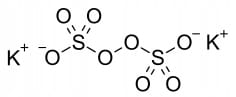
Potassium persulphate ( Potassium persulfate ) Dipotassium peroxysulphate 1000g
Regular price:
Regular price:
product unavailable
add to wish list
0
 Dipotassium peroxysulphate 1000g "Pin It")
Description
Potassium Persulfate
Other Names: Dipotassium peroxodisulfate, Peroxydisulfuric acid dipotassium salt
CAS Number: 7727-21-1
Sum Formula: K₂S₂O₈
Molar Mass: 270.32 g/mol
Appearance: Colorless to white crystalline solid
Potassium persulfate is a strong oxidizing agent composed of potassium ions and peroxodisulfate anions. It is widely used as a source of free radicals for polymerization initiators, oxidizing reactions, and cleaning processes in various industrial and laboratory applications.
Chemical and Physical Properties
Density: ~2.48 g/cm³
Melting Point: Decomposes above 100°C (no true melting point)
Boiling Point: Decomposes before boiling
Solubility in Water: Moderately soluble (~1.2 g/100 mL at 20°C)
Solubility in Other Solvents: Insoluble in alcohol
Odor: Odorless
Applications
Polymer Industry: Used as an initiator for the polymerization of monomers such as styrene, acrylonitrile, and butadiene.
Chemical Synthesis: Employed as a strong oxidizing agent in organic and inorganic reactions.
Analytical Chemistry: Applied in redox titrations and standardization processes.
Electronics: Used in etching solutions for printed circuit board manufacturing.
Water Treatment: Studied for oxidation of pollutants and advanced oxidation processes.
Safety

Signal Word: Danger
H272 (100%): May intensify fire; oxidizer [Danger Oxidizing liquids; Oxidizing solids]
H302 (100%): Harmful if swallowed [Warning Acute toxicity, oral]
H315 (100%): Causes skin irritation [Warning Skin corrosion/irritation]
H317 (94.8%): May cause an allergic skin reaction [Warning Sensitization, Skin]
H319 (100%): Causes serious eye irritation [Warning Serious eye damage/eye irritation]
H334 (100%): May cause allergy or asthma symptoms or breathing difficulties if inhaled [Danger Sensitization, respiratory]
H335 (100%): May cause respiratory irritation [Warning Specific target organ toxicity, single exposure; Respiratory tract irritation]
P210, P220, P233, P260, P261, P264, P264+P265, P270, P271, P272, P280, P284, P301+P317, P302+P352, P304+P340, P305+P351+P338, P319, P321, P330, P332+P317, P333+P317, P337+P317, P342+P316, P362+P364, P370+P378, P403, P403+P233, P405, and P50
Handling and Storage
Storage Conditions: Store in a tightly sealed container in a cool, dry, and well-ventilated place. Keep away from heat sources, organic materials, and reducing agents.
Handling Precautions: Avoid creating dust and direct contact with eyes and skin. Handle with proper PPE and observe standard safety practices.