
 CATEGORIES
- ORGANIC COMPOUNDS(1135)
- INORGANIC COMPOUNDS(1055)
- Mineral Acids(51)
- Chelates(3)
- Elements(130)
- Salts(556)
- Oxides(121)
- Hydroxides(30)
- Hydrides(15)
- Other(19)
- Nanoparticles(3)
- Standard solutions(126)
- LAB EQUIPMENT(5176)
- *(1)
- Organic Synthesis(421)
- Industry(775)
Language
US version allows shipping to all available destinations


 MANUFACTURER
Phosphorous Acid
Regular price:
Regular price:
product unavailable
add to wish list
0

Description
Phosphorous Acid
Other Names: Phosphonic Acid, Orthophosphorous Acid, Dihydroxyphosphine Oxide
Chemical Formula: H3PO3
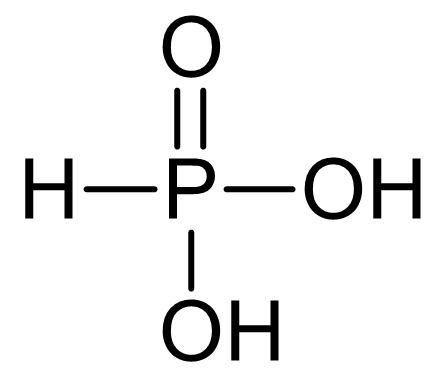
Structural Formula: HP(O)(OH)2
Molar Mass: 82.00 g/mol
CAS Number: 13598-36-2
SMILES: [H]P(=O)(O)O
Appearance: Colorless to white, deliquescent crystalline solid
Phosphorous acid is an inorganic phosphorus oxyacid in which phosphorus is present in the +3 oxidation state. Although its molecular formula H3PO3 may suggest three equivalent acidic hydrogen atoms, its predominant molecular structure is HP(O)(OH)2. One hydrogen atom is bonded directly to phosphorus and is not appreciably ionizable under normal aqueous conditions. Consequently, phosphorous acid is a diprotic rather than triprotic acid. NIST reports the molecular formula H3O3P, molecular mass 81.9958 g/mol and CAS Registry Number 13598-36-2.
Chemical and physical properties
Phosphorous acid is a highly polar crystalline compound that is readily soluble in water. It is also hygroscopic and can absorb atmospheric moisture. Reference data report a density of approximately 1.65 g/cm3 near room temperature and a melting point of approximately 73.6 °C. Strong heating does not lead to simple distillation because the compound undergoes chemical decomposition.
In aqueous solution, phosphorous acid dissociates in two principal stages, with reported pKa1 and pKa2 values of approximately 1.3 and 6.7, respectively. The first dissociation produces the hydrogen phosphite species, while the second produces the phosphite dianion. The P–H hydrogen remains attached to phosphorus during these acid-base equilibria.
The predominant structure contains a tetrahedral phosphorus center with one P–H bond, two P–OH groups and a phosphoryl P=O unit. Phosphorous acid can formally participate in tautomeric equilibria involving a P(OH)3 form, but structural and coordination studies show that the phosphoryl form HP(O)(OH)2 is strongly favored.
A defining feature of phosphorous acid is its reducing character. Because phosphorus is present in a lower oxidation state than in phosphoric acid, H3PO3 can be oxidized to phosphorus(V) compounds. This redox behavior differentiates it significantly from phosphoric acid and underlies many of its synthetic applications.
Applications
Phosphorous acid is used as a reducing reagent and as a source of phosphorus(III) species in inorganic and synthetic chemistry. Its P–H bond provides characteristic reactivity that permits oxidation, hydrophosphonylation and other phosphorus-carbon bond-forming transformations under appropriate reaction conditions.
It is an important precursor for the preparation of inorganic phosphites and related phosphorus compounds. Reaction with bases or metal-containing reagents produces hydrogen phosphite and phosphite salts, which are studied in coordination chemistry, solid-state chemistry and materials science.
Phosphorous acid and related H-phosphonate derivatives are useful starting materials in organophosphorus synthesis. Dialkyl H-phosphonates, which contain the structural motif HP(O)(OR)2, can undergo addition to unsaturated or carbonyl-containing substrates and can be transformed into a wide range of phosphonate derivatives. Organophosphorus chemistry based on reduced phosphorus precursors is an important route to P–C bond formation.
Phosphorous acid is also investigated as an intermediate for more sustainable production of organophosphorus compounds. Research has examined routes that use H3PO3 directly as an alternative phosphorus(III) feedstock, potentially reducing reliance on phosphorus trichloride and decreasing formation of stoichiometric chloride-containing waste.
In analytical and coordination chemistry, phosphite species derived from phosphorous acid are used to investigate phosphorus oxidation states, protonation equilibria, ligand behavior and metal-phosphorus-oxygen interactions. The oxygen atoms can participate in coordination to metal centers, while the phosphorus-bound hydrogen provides a useful spectroscopic and chemical marker.
Thermal behavior and safety
Phosphorous acid should not be heated strongly in closed systems. At temperatures around 200 °C it can undergo disproportionation, producing phosphoric acid and phosphine (PH3). Phosphine is a highly toxic and flammable gas, making uncontrolled thermal decomposition a significant hazard.
The compound is acidic and corrosive and can cause serious damage following contact with skin or eyes. Appropriate chemically resistant gloves, protective clothing and eye or face protection should therefore be used. Handling should take place with suitable ventilation, particularly whenever heating or reactions capable of generating volatile phosphorus compounds are involved.
Scientific references
NIST Chemistry WebBook, SRD 69. Phosphonic acid. CAS Registry Number 13598-36-2.
Larson, J. W.; Pippin, M. Thermodynamics of ionization of hypophosphorous and phosphorous acids. Substituent effects on second row oxy acids. Polyhedron, 1989.
Peruzzini, M.; et al. Stabilization of the tautomers of hypophosphorous and phosphorous acids as ligands. Studies of phosphorus oxyacid structure and coordination chemistry.
Geeson, M. B.; Cummins, C. C. Let’s Make White Phosphorus Obsolete. ACS Central Science, 2020, 6, 848–860. DOI: 10.1021/acscentsci.0c00332.
Safety

Signal Word: Warning
H302: Harmful if swallowed [Warning Acute toxicity, oral]
H314: Causes severe skin burns and eye damage [Danger Skin corrosion/irritation]
P260, P264, P270, P280, P301+P317, P301+P330+P331, P302+P361+P354, P304+P340, P305+P354+P338, P316, P321, P330, P363, P405, and P501
First Aid Measures
Eye Contact: Rinse immediately with water for several minutes. Seek medical attention if irritation persists
Skin Contact: Wash with plenty of soap and water. Remove contaminated clothing
Inhalation: Move to fresh air. Seek medical help if respiratory symptoms appear
Ingestion: Rinse mouth. Do not induce vomiting. Seek medical advice
Handling and Storage
Store in tightly closed containers in a cool, dry, and well-ventilated area
Keep away from strong bases, oxidizers, and moisture
Avoid generating dust. Use proper PPE to prevent contact with skin, eyes, and clothing